

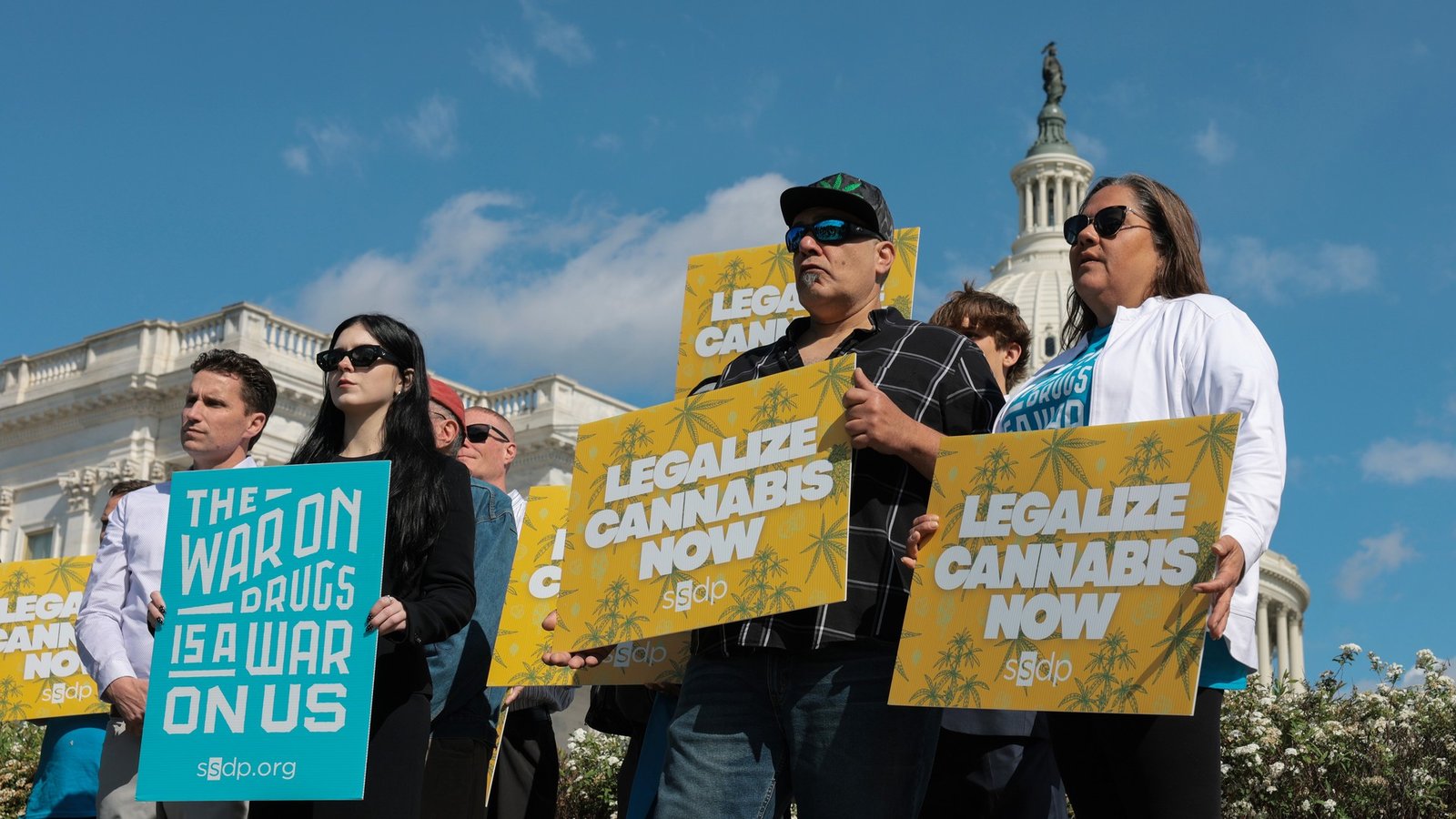
The smell of cannabis smoke wafts through the streets of New York City — especially on a day like Monday. It’s 4/20, the unofficial holiday celebrating marijuana, when cities and towns across the United States host parties where people smoke and buy weed at places like cannabis dispensaries and parks.
Which is legal — although not in the eyes of the federal government.
Marijuana’s legal status in the U.S. remains an interesting study in contradiction. In 1996, California became the first state to legalize its use for medicinal purposes — the first of what’s now 40 states and the District of Columbia where people can buy and partake of the drug with a prescription. Of those, 24 states and the District of Columbia allow adults to use it recreationally in small amounts.
While most Americans live in a state where cannabis is legal in some way, federal law still prohibits its sale and purchase — and calls for prison time for those who break the law. Some offenses come with a sentence of life in prison.
Laws governing cannabis use remain a patchwork from state to state, even as federal law tells a different story.
States versus Feds
Under the federal Controlled Substances Act, marijuana is considered a Schedule I controlled substance.
“It is a Schedule I controlled substance under the federal Controlled Substances Act, and thus is strictly regulated by federal authorities,” Joanna Lampe, Lisa Sacco and Hassan Sheikh wrote for Congress.gov. “In contrast, over the last several decades, most states and territories have deviated from a comprehensive prohibition of marijuana and have laws and policies allowing for some cultivation, sale, distribution, and possession of marijuana.”
The paradox is real. While states are able to choose how they enforce their own criminal laws, those laws do not override federal statutes.
Under federal law, a person caught with any amount of marijuana can be incarcerated for as much as one year. Selling less than 50 kilograms can land a seller five years in prison. Selling over one thousand kilograms can lead to life in federal prison.
Marijuana, according to the feds, is the most commonly used illicit drug in the United States. About 64.2 million people aged 12 years old and older, used cannabis in 2024, according to the National Survey on Drug Use and Health.
But the federal government has done little to resolve the conflicts with the states.
“Thus far, the federal response to states’ legalizing marijuana largely has been to allow states to implement their own laws,” according to Congress.gov. “DEA has nonetheless reaffirmed that marijuana growth, possession, and trafficking remain crimes under federal law irrespective of states’ marijuana laws. Federal law enforcement has generally focused its efforts on criminal networks involved in the illicit marijuana trade.”
Hemp adding to complicated patchwork
Hemp — a derivative of the cannabis plant with extremely low levels of the intoxicating THC component — was legalized nationwide when Congress passed the Farm Bill of 2018, further complicating the regulation of marijuana.
Republicans, who typically favor stronger drug laws, led the charge to legalize hemp. Specifically, Sen. Mitch McConnell, R-Ky., then the Senate majority leader, played a key role in removing the crop from the federal list of controlled substances.
As PBS noted at the time, the change benefited farmers in McConnell’s home state, who were eager to join what was projected to become a $20 billion-a-year industry.
Hemp’s legalization led to the proliferation of products such as THC-infused seltzers, gummies, chocolates and baked goods. Despite containing psychoactive ingredients, their sale was perfectly legal.
That changes on Nov. 12. Last year’s Farm Bill contained new federal regulations on hemp, tightening up the sales of hemp products nationwide. This time, McConnell spearheaded the push for the ban on hemp, while Kentucky’s other Republican senator, Rand Paul, advocated to keep it legal.
Hemp and low-THC products, such as seltzers, are monitored differently than marijuana.
“There’s a real distinction between low-dose hemp beverages and going to a dispensary and buying a joint or flower,” said Marie La France, cofounder of Louis Louis, a low-THC seltzer.
Currently, low-THC drinks are federally legal. Ironically, they are not available in certain states due to state laws.
“To ban hemp outright is going to take these drinks off shelves nationwide,” LaFrance told Straight Arrow News. It’s a billion- dollar industry…. By taking them off shelves, it hurts not only the consumer, but the distributor, the retailer, and the supplier, which is hundreds of thousands of jobs.” “There are several national organizations working together to try and save low-dose hemp beverages,” La France said. As of 4/20, however, the ban is still scheduled to take effect in less than seven months.