

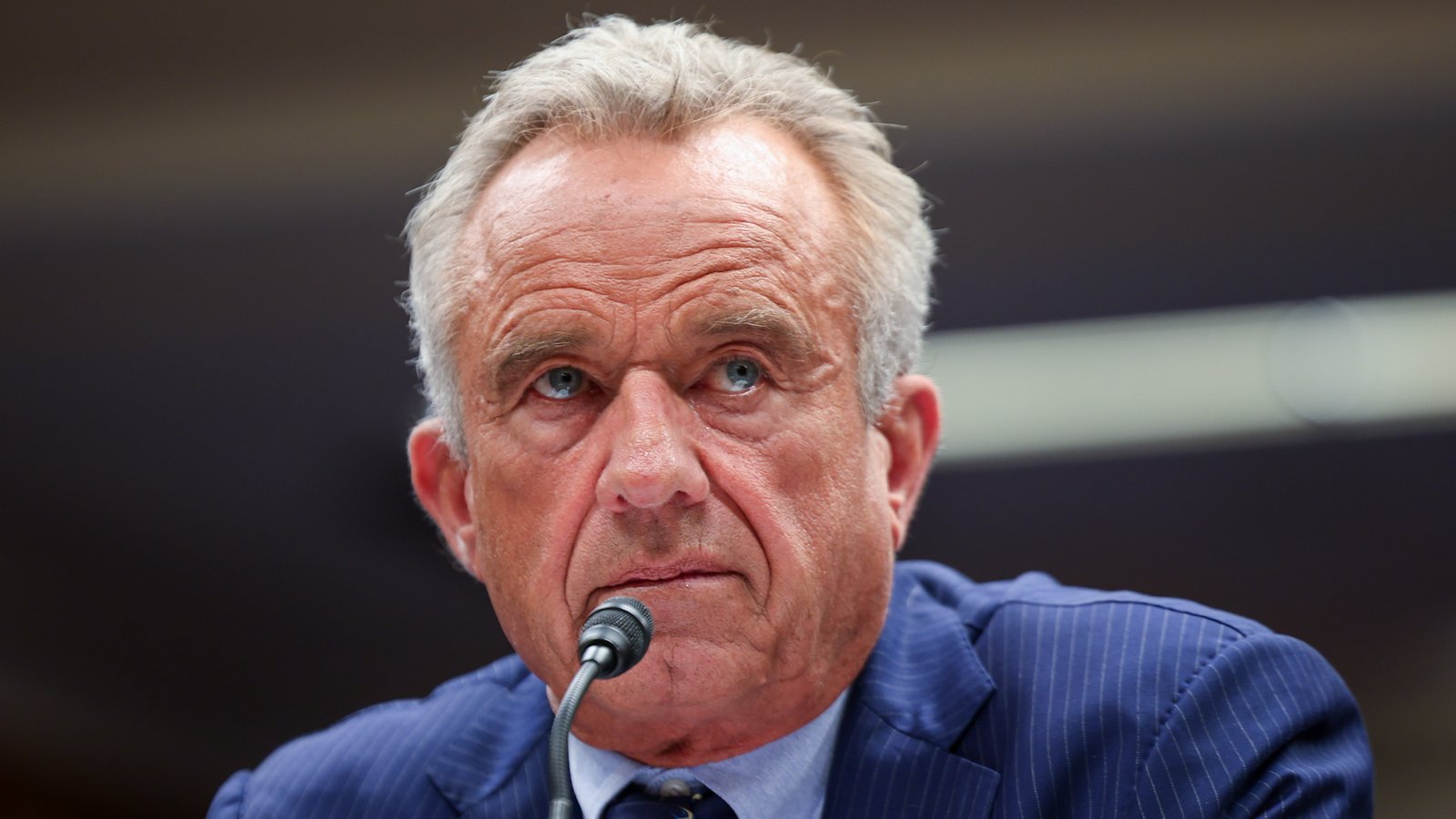
Representatives from 15 states sued the Department of Health and Human Services (HHS), the Centers for Disease Control and Prevention (CDC) and their leaders, Robert F. Kennedy Jr. and Jay Bhattacharya. The complaint, filed Tuesday, alleges that the defendants unlawfully dismantled and reconstituted a federal vaccine advisory panel and then changed the childhood vaccine schedule without following required legal and scientific procedures.
The lawsuit outlines how HHS and the CDC broke three federal laws, Dorit Reiss, a law professor at the University of California San Francisco, told Straight Arrow News.
The plaintiffs include the attorneys general of Arizona, California, Colorado, Connecticut, Delaware, Maine, Maryland, Michigan, Minnesota, New Jersey, New Mexico, Oregon, Rhode Island and Wisconsin as well as Pennsylvania’s governor — all Democrats.
The case follows earlier legal challenges. Last year, six medical organizations — the American Public Health Association, the American Academy of Pediatrics, the Infectious Diseases Society of America, the American College of Physicians, the Society for Maternal-Fetal Medicine and the Massachusetts Public Health Alliance — along with a pregnant woman, sued HHS and Kennedy in federal court in Massachusetts over the department’s decision to remove the COVID-19 vaccine from the list of recommended immunizations for healthy children and pregnant women.
Changes to federal vaccine guidelines
Since the start of the second Trump administration, federal health officials have keyed in on vaccines, overhauling federal guidance and calling for regulatory reform.
When Kennedy took over as HHS secretary, he dismissed all 17 existing members of the Advisory Committee on Immunization Practice, or ACIP. He then appointed a new panel, which went on to amend longstanding recommendations regarding chickenpox, flu and hepatitis B vaccinations.
In December, President Donald Trump signed an executive order directing HHS and the CDC to review vaccine recommendations in other developed countries and update U.S. federal guidance. The following month, the CDC released its revised 11-vaccine schedule.
HHS provided limited detail about the review process, including ACIP’s role. The department said the U.S. recommends more childhood vaccine doses than peer nations and called for additional randomized trials examining individual vaccines, combination shots and timing.
State officials and health organizations immediately pushed back. Within days of unveiling the new vaccine schedule, at least 18 states rejected the change. Fifteen states and territories — California, Colorado, Connecticut, Delaware, Guam, Hawaii, Illinois, Maryland, Massachusetts, New Jersey, New York, North Carolina, Oregon, Rhode Island and Washington – also formed the Governor’s Public Health Alliance to counter federal actions on vaccination.

The American Academy of Pediatrics also released its own vaccine schedule, which largely resembled recommendations that predated the Trump administration.
“The decision to change CDC’s childhood immunization schedule is reckless and deeply dangerous,” Massachusetts Public Health Commissioner Robbie Goldstein said in a January press release.
Federal vaccine recommendations are not legally binding; states determine their own vaccine laws and school requirements. Outside of the military, no American is required by federal law to be vaccinated.
“When we talk about these required mandates or vaccine mandates in the United States, it’s ultimately a policy in place that makes vaccination a condition of attending school in those states,” said Jason Schwartz, an associate professor in the Department of Health Policy and Management at the Yale School of Public Health.
“In no case is an individual or a child being vaccinated against their will or against their parents’ will,” he said.
Although federal vaccine guidelines are not legally binding, some contend they function in that way.
“The realities are that when the CDC issues guidelines, they become de facto edicts,” Jeffrey Singer, a general surgeon and senior fellow at the Cato Institute, has argued.
The legal case
Tuesday’s multi-state lawsuit alleges that HHS, the CDC and their leaders violated three federal laws.
First, the plaintiffs argue that Kennedy and HHS violated the Federal Advisory Committee Act by replacing ACIP members without ensuring the panel was fairly balanced or independent, as required by law.
“The requirement in the act is for balanced representation and for the federal government maintaining its independence and addressing and objectively assessing the decision without undue influence,” Reiss told SAN.
During ACIP’s Dec. 5 meeting, Kirk Milhoan, a pediatric cardiologist and the advisory panel’s chair, stated that the “committee felt ‘a little bit like puppets on a string as opposed to really being [an] independent advisory panel,’” according to the lawsuit.
The act also requires each federal advisory committee to create and abide by a charter. The ACIP charter specifically calls for members to be vaccine experts — a criteria many current ACIP members do not meet, according to the lawsuit. Previously, CDC officials undertook a rigorous vetting process to ensure potential ACIP panelists met the expert criteria and had no conflicts of interest.
The lawsuit also claims that HHS and CDC violated the Administrative Procedure Act by changing vaccine policy without fully explaining its reasoning or addressing potential public health consequences. Under the law, agencies must carefully review evidence, consider the risks and benefits of their decisions and clearly show how proposed changes are supported by evidence. In this case, the plaintiffs say, HHS officials did not adequately examine the potential harms of weakening vaccine recommendations, relied on comparisons to countries that aren’t directly comparable to the U.S. and claimed the changes would restore public trust without providing evidence.
Finally, the plaintiffs argued that HHS and the CDC did not change the vaccine schedule based on evidence.
“Under the Public Health Service Act, the CDC director needs to make recommendations that reflect the best available science in public health,” Reiss said.
The plaintiffs argue that the CDC violated this law.
Hepatitis B vaccines rates fell before federal guidance change
An analysis published this week in JAMA found that hepatitis B vaccine coverage among U.S. newborns was already declining before HHS formally revised its guidance. The study found that between July 2023 and September 2025, the share of newborns receiving the vaccine decreased by roughly 10 percentage points. Coverage peaked in February 2023 at approximately 83.5%, according to the analysis.
The study examined medical records for more than 12 million infants nationwide. Researchers affiliated with the University of California San Diego School of Medicine, Harvard Medical School and the National Bureau of Economic Research began their trend analysis in July 2023, citing what they described as “heightened public discourse and media coverage regarding childhood vaccination,” including a widely circulated podcast in which Kennedy discussed hepatitis B vaccination.
Long-term data show that hepatitis B vaccination coverage has increased substantially over the past two decades. In 2002, only 20.9% of newborns received the vaccine within 24 hours of birth, according to World Health Organization data. By 2022, almost 75% of newborns received the vaccine when they were born. The number of children who had received all three recommended doses of the vaccine also increased from 88.3% to 92.7% in that same period.
In 2023, the most recent year for which data are available, there were 2,212 acute hepatitis B cases among adults and children. That same year, seven perinatal infections — cases transmitted from mother to infant shortly before, during, or immediately after delivery — were reported.
Coverage for other routine vaccines — including diphtheria, whooping cough, measles, polio and chickenpox — has also declined in recent years, preceding federal vaccine policy changes. A recent SAN analysis of national polling data, scientific studies, government reports and dozens of interviews with parents found that declining trust in physicians and public health institutions — along with concerns about vaccine safety — has influenced many parents’ decisions to delay or forgo vaccination.