

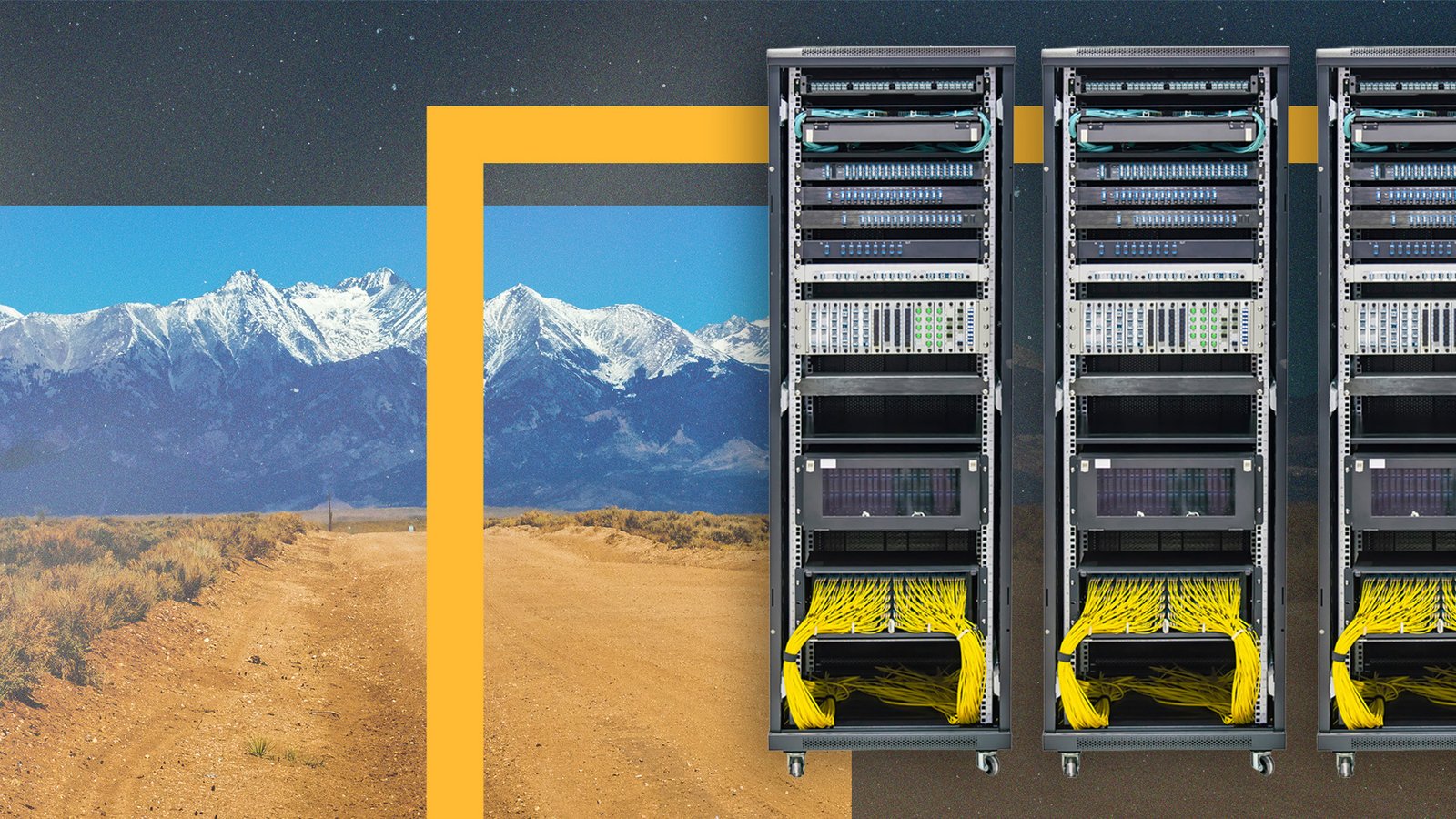
The head of a rural electric cooperative in Colorado wants data centers to come to his community. He says it will help counteract increases to electricity bills at a time when rising costs are affecting utilities across the country.
The San Luis Valley Rural Electric Cooperative is small. Its largest customer is the Wolf Creek ski resort. In a farming community, the electricity need at any given time reaches its peak during irrigation season when farms pump groundwater to the surface. But the valley is changing.
“Irrigation load has been declining. Over about 20 years, there’s been a lot of regulatory restrictions around the water. So a lot of the fields are going into fallowing,” leaving their fields bare of crops, Eric Eriksen, CEO of the San Luis Valley Rural Electric Cooperative, told Straight Arrow News.
That decline in irrigation means the agricultural region struggles to maintain jobs. It also means there’s extra capacity on the local power grid, which was built for a larger load than it currently serves. And that’s a big part of why Eriksen wants data centers.
“If we had a two-megawatt data center, you can see that would be our biggest customer. And that’s small in the energy world, but to us, it’s huge,” Eriksen said, adding that it would “help share in the cost burden of paying for that infrastructure and would be a great benefit to our members.”
Two megawatts is enough electricity to power about 800 to 1,400 homes, depending on weather conditions and home sizes.
Across the country, proposed facilities are hundreds of times larger than the two megawatts Eriksen envisions. And as the growth of data centers starts to feel inevitable, rural electric cooperatives are sending a message to the tech industry that they are open for business. With a nonprofit structure and operational flexibility, cooperatives have the potential to reap the benefits that come with courting a data center. At the same time, the imbalance between Big Tech and a small electric cooperative has industry analysts on alert for what could go wrong.
“We think rural America is going to be a disproportionate location for data centers, just because it’s cheaper land, more open space,” Jim Matheson, CEO of the National Rural Electric Cooperative Association, told SAN.
The tech industry has come into 2026 with an awareness that consumers are worried about increasing electricity rates. In March, representatives from seven leading tech companies joined President Donald Trump to sign a ratepayer protection pledge to pay for their allotted power, cover the cost of grid upgrades and keep paying those costs, even if they do not need the electricity.
A major concern is “making sure that infrastructure needed to serve the data centers is only paid for by the data centers,” said Cathy Kunkel, an analyst with the Institute for Energy Economics and Financial Analysis. “But even that is easier said than done.”
The pledge aims to address common pressure points: Ratepayers could be on the hook for new transmission lines or end up paying for new power plants. However, the lack of specificity in the pledge, which is not legally binding, means those concerns remain.
What makes electric cooperatives different?
Many data center developers are considering connecting to the grids of rural electric cooperatives, which serve only about 12% of the population but cover over 50% of U.S. land.
There are two main types of electric cooperatives: Generation and transmission co-ops and distribution co-ops. Generation and transmission co-ops operate power plants and transmission lines. The generation co-ops are owned by various distribution co-ops that deliver that power to homes and businesses, though they can generate a portion of their own electricity.
“We are owned and governed by the consumers that we serve,” Matheson said, adding that there’s “no one-size-fits-all description for co-ops” due to a plethora of state laws, varying sizes and diverse communities served.
In many states, electric cooperatives do not undergo the same regulatory process as investor-owned utilities. Typically, when a utility company wants to raise rates or create a new rate class specifically for large electric loads, it must ask the state’s public utility commission for approval. It’s a lengthy legal process in which stakeholders such as corporations or environmental groups can intervene. State regulators weigh various legal filings, hear public comments and ultimately decide on the rates.
At a cooperative, the board of directors, which is elected by the members, must approve rate changes. In 23 states, electric cooperatives also undergo the typical regulatory process at the public utility commission, according to the NRECA. In the remaining states without full regulatory oversight of electric co-ops, Matheson said the quicker process and greater independence make co-ops well suited for data centers.
“We have the extra flexibility in a lot of our circumstances to structure the deal for what it means in that specific location between that utility and that data center,” said Matheson. Although, he acknowledged that “it creates some risk too,” and cooperatives “have to make sure we’re making good decisions in terms of how we negotiate these relationships.”
What benefit is there for cooperatives?
“There is no escaping this. The data centers are coming,” said Ted Compton, the co-director of the nonprofit Co-op Innovation Network. “If you can’t come up with a way to wring some benefit out of this, it’s just going to be directionally negative for you.”
Electric cooperatives can also take on an economic development role. They seek out opportunities to attract new businesses that will create jobs and expand the tax base.
When it comes to electricity costs, data centers present a “simple economic advantage,” Compton told SAN. “You’re selling a lot more electrons with similar infrastructure. So you get to spread out that cost more broadly.”
For the San Luis Valley Electric Cooperative, costs to buy power have already risen. Eriksen said the math works out that adding a data center could prevent future rate increases for existing customers — perhaps even enabling lower rates.
One co-op in East Texas shows what that can look like: The Rayburn Electric Cooperative serves about 625,000 people northeast of Dallas, and expects 1,300 megawatts of data centers to come online in its service territory by 2030. That’s roughly 80% of the co-ops current peak electric load, which already includes about 300 megawatts of existing data centers, Christian Nagel, the co-op’s senior director of power supply and production, told SAN.
The growth of data centers “supports lower rates for all members,” said Nagel. The benefit is ”realized and expected to continue,” he told SAN, but he did not specify how much the co-op has been able to lower rates.
Can co-ops balance the risk?
Despite the promise of keeping electric rates down, some analysts foresee a problem if electric co-ops bring on too many data centers.
“That’s a serious financial exposure to one customer and that tends to be more pronounced when we are talking about co-ops because they’re smaller,” Kunkel told SAN. If the AI boom does not ultimately match up with projected electricity demand growth, electric cooperatives that built new infrastructure to serve data centers would see costs go up.
And without the oversight of a public utility commission, Kunkel added, “if the management is making poor decisions, the residential ratepayers don’t really have much recourse.”
Electric co-ops are aware of a power imbalance when dealing with Big Tech, but many have developed practices to shield members from adverse risks.
“Rural electric co-ops often feel like they’re the David in the David and Goliath story,” Compton said. “You do have more power than you think,” he said, and it lies in the cooperatives’ governance model and ability to collaborate.
At the generation and transmission Arkansas Electric Cooperative Corporation, prospective data center developers must make a down payment of $1,000 per megawatt just to have their project studied to determine whether it can connect to the grid.
“It really serves as a gate mechanism,” said Jonathan Oliver, the co-op’s chief operating officer.
Wabash Valley Power Alliance, a generation and transmission co-op in Indiana, charges a flat $50,000 fee for any project requesting at least 35 megawatts of electricity.
New transmission lines “are long-term type assets,” the co-op’s president Jeff Conrad told SAN. The fee aims to ensure developers have reliable financial backing, before the co-op invests in upgrading the grid. “We expect them to be around 30, 40 years.”
The cooperatives in both Indiana and Arkansas have each received requests from tech firms to build 1,000 megawatts or more of data centers.
In the Southern Rockies, Eriksen hopes he can land at least two megawatts on the San Luis Valley’s grid.
Editor’s Note: This article has been updated to reflect Jim Matheson’s correct title.