

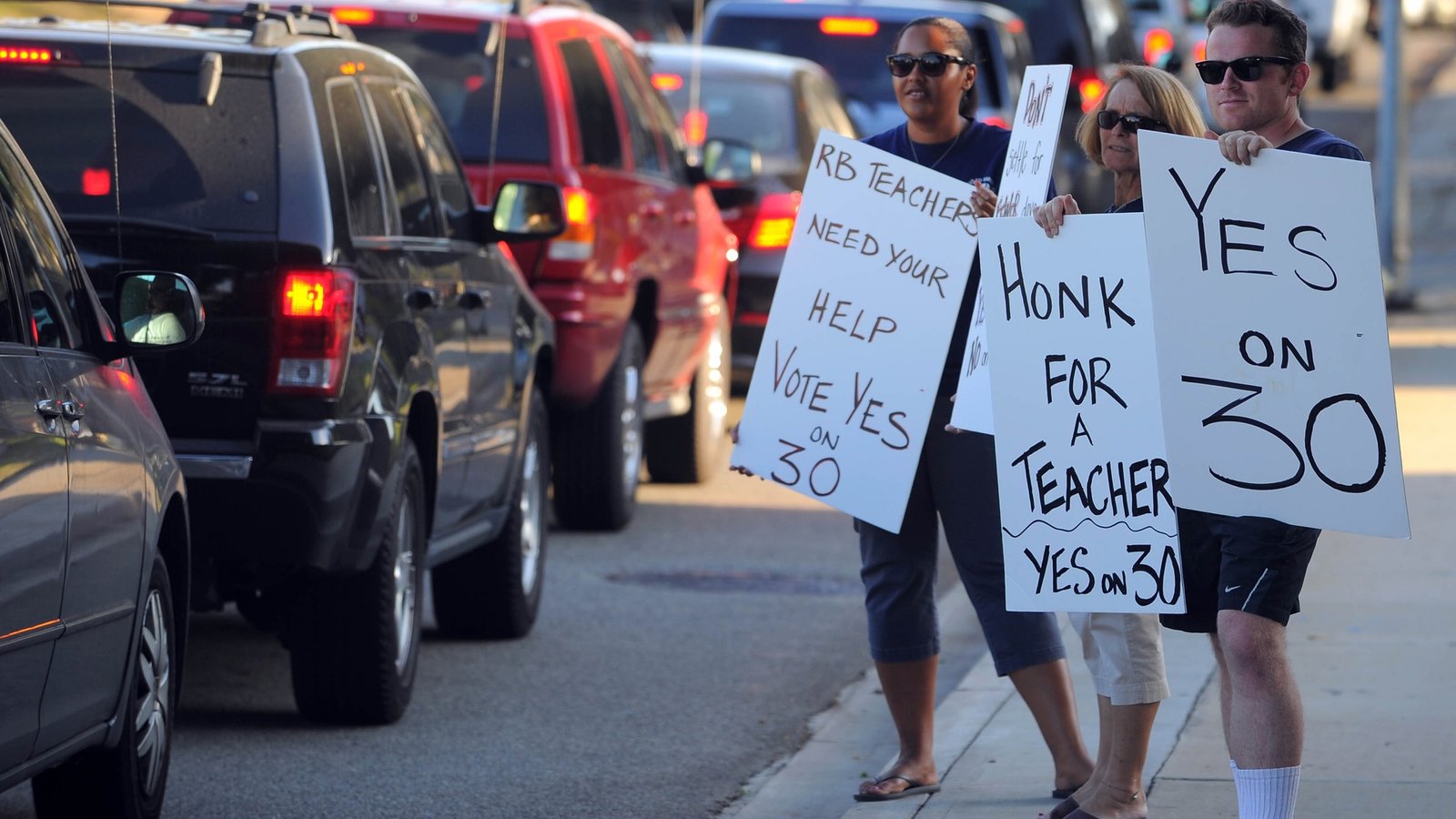
What was billed as a temporary tax hike in California in 2012 could become permanent for wealthy Californians. That new push is heavily backed by one of the largest teachers’ unions in the country.
“The most permanent thing in the world is a temporary government program,” Wayne Winegarden, senior fellow at the Pacific Research Institute, told Straight Arrow News, paraphrasing renowned economist Milton Friedman.
Prop. 30
In 2012, voters approved Prop. 30, which temporarily increased both the sales tax for everyone and the income tax for individuals earning more than $250,000 per year.
“Very simply, increase the top income tax rates on the wealthy by one percentage point,” Winegarden said. “It was supposed to be a temporary measure to basically help fund education at a time when there was a difficult budget year.”
The sales tax hike was allowed to expire in 2017.
However, voters approved an extension of the income tax hike with Prop. 55 in 2016. That extension is set to expire in 2030.
“Now, at the ballot, voters will be asked whether to make those permanent,” Jared Walczak, senior fellow at the Tax Foundation, told SAN.
Temporary to permanent
The California Teachers Association, or CTA, is now helping to collect signatures in an attempt to get the California Children’s Education and Health Care Protection Act of 2026 onto the November ballot.
“People have shown us time and time again that they know that investing in our students, our communities, and educators is one of the best investments we can make as a state,” David Goldberg, CTA president, told EdSource.
The CTA has contributed at least $5 million to a committee that’s backing that initiative.
That initiative says if that additional revenue goes away, there will be “devastating” cuts to schools, health care for children and more. Roughly $2 billion of that money goes to children’s health care.
That increased revenue coming from that increased tax rate is not a small number. The additional tax brought in $9.8 billion in FY 2024-2025 and $9 billion in the prior fiscal year.
The union was also the driving force behind the extension in 2016. That’s mainly because much of the additional revenue goes to education in the state.
The initiative will need roughly 900,000 signatures to get onto the ballot. The union’s 310,000 members alone would set the initiative off to a good start.
“At this point, the expectation seems to be that this will become permanent,” Walczak said. “California has grown accustomed to it. California’s approach to school funding has become very reliant on it. It’s very hard to unwind higher rates when you have had them for so long.”
Funding education
Due to the original language of Prop. 30 and certain rules for tax usage in California, much of the additional revenue does go to education.
It comes as spending on education continues to skyrocket in the state.
Prop. 98, which passed in 1988, requires a certain level of spending per student. Over the last six years, the amount spent per student in the state has risen more than 50%.
“While we’ve been spending more and more, performance is going lower and lower,” Winegarden said. “It means we’re actually getting a negative return on the money we’re spending. And so, the teachers are going to consistently say, ‘Oh, we need more money.’”
Data shows test scores have not improved much, including after the COVID-19 pandemic.
“Education is undoubtedly important, but spending all this money is not getting us a quality education,” Winegarden said.
Tax concerns
When it came time to extend the Prop. 30 tax increase in 2016, former California Gov. Jerry Brown was not supportive of that plan.
“He sold it as a temporary increase,” Winegarden said.
Moving this increase from temporary to permanent status is something voters need to think about.
“Californians need to take that into account when they think about future potential temporary taxes — that once they adopt them, it’s very hard to walk away from them, even if their initial design is temporary,” Walczak said.
Winegarden echoed that sentiment.
“If they’re going to do this, how do you know they’re not going to raise the sales tax when the income tax revenues disappoint? And they will,” he said.
This all comes at a time when taxing the rich has become a hot-button issue in California.
A proposed billionaire tax has some of the state’s wealthiest people moving to other states.
“California’s lack of tax competitiveness is a growing problem,” Walczak said. “There’s increased migration to other states. The workforce is more mobile than ever, and that’s particularly true of the tech sector.”
It’s not just the billionaires in California who are taking their money elsewhere, and continuing to push higher tax rates on wealthier Californians isn’t helping.
“Extending these income tax rates, it’s hitting that same pressure points and it’s causing the same incentives to leave,” Winegarden said. “And if you look at the latest IRS migration data, you can see it. People with greater means are leaving the state.”
Losing wealthier Californians comes at a cost, specifically when it comes to state revenues.
That could cause even more budget issues in the future which will need to be addressed somehow.
“It’s always, ‘OK, well, let’s just go raise taxes and take it from the private sector,’” Winegarden said. “The private sector is the productive part of the economy that creates the resources so that we can provide important public goods.”
California still has, by far, the largest share of the national GDP.
But the experts SAN spoke with believe that the gap could begin to close if the state continues in this direction.
“We’re not creating private sector jobs outside of health care,” Winegarden said. “These are really disturbing trends.”
The tech industry, which remains a major part of California’s economy, is also a concern.
“The very tech that has been created, in many cases in California, enables future tech companies to locate anywhere,” Walczak said. “And therefore tax competitiveness will matter more than ever.”