

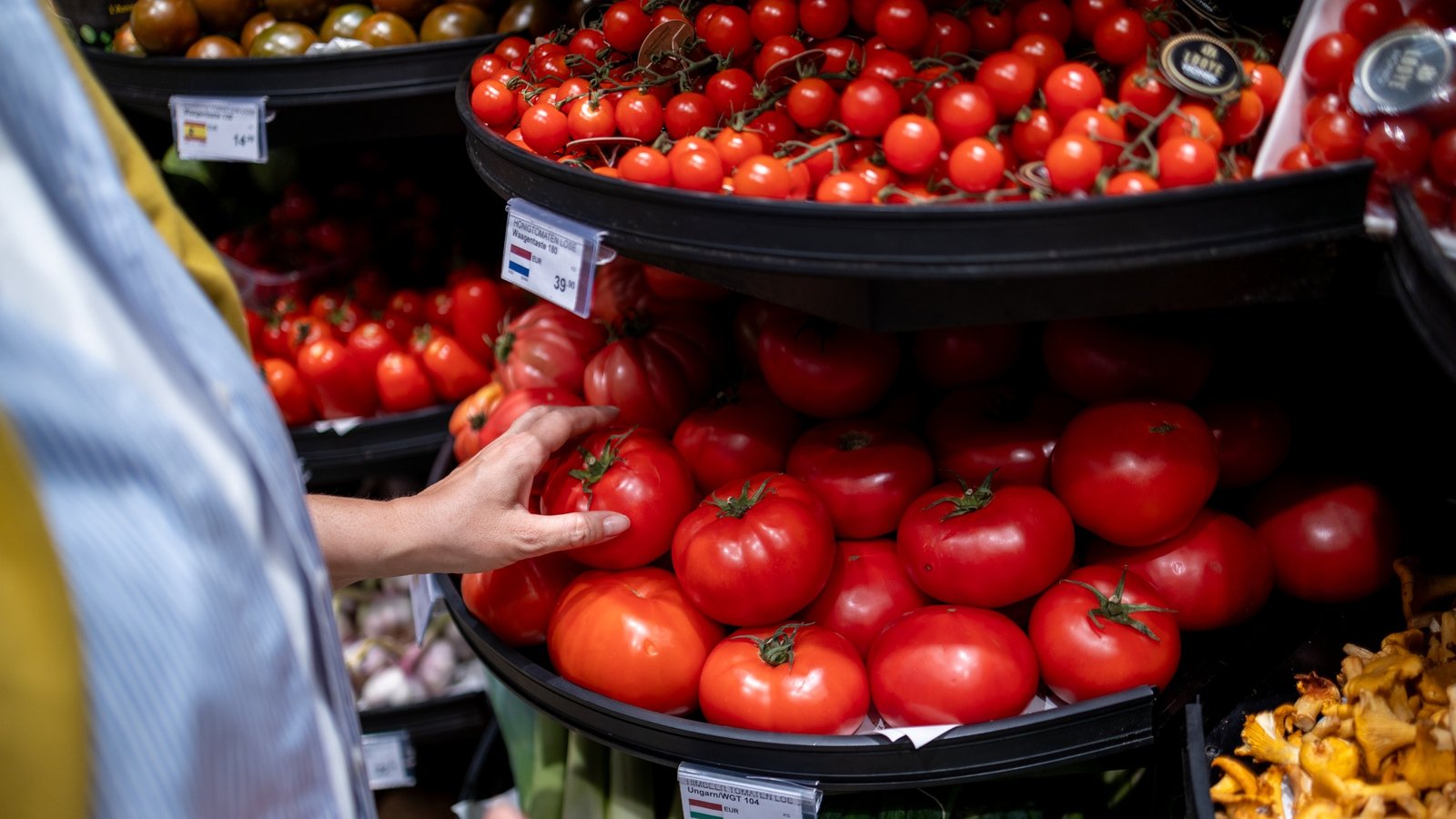
As food costs only seem to be going up, fresh tomatoes are the latest grocery store staple to be hit with skyrocketing prices.
From Roma to beefsteak, the fruits — yes, they’re fruits! — are used in a myriad of everyday recipes. And according to the Bureau of Labor Statistics, tomatoes now sell for an average of $2.26 per pound, the highest in nearly a decade.
Tomato prices jumped 15.3% from February to March, according to the latest Consumer Price Index (CPI), and are up 22.6% from last year.
What’s driving prices up?

Unbiased. Straight Facts.TM
Tomatoes cost an average of $1.90 per pound in February and $2.26 a pound in March.

The war with Iran may seem far away, but it’s having a big impact in the U.S. With the Strait of Hormuz, one of the world’s most critical oil shipping lanes, closed, oil prices are soaring, making it more expensive to transport all kinds of goods.
On top of that, more than one-third of the global seaborne fertilizer travels through the Strait of Hormuz, according to the United Nations Conference on Trade & Development.
The Middle East also plays a major role in fertilizer production because its natural gas reserves are used to produce urea and ammonia, key ingredients in nitrogen-based fertilizers. The area accounts for roughly 49% of global urea exports and about 30% of ammonia exports, according to the American Farm Bureau Federation.
But it’s not just the conflict with Iran that’s driving tomato prices higher.
About two-thirds of the fresh tomatoes consumed in the U.S. are imported from Mexico. Last July, the Trump administration pulled out of the 2019 Tomato Suspension Agreement (TSA) with Mexico, imposing a 17% tariff on the household staple.
Then in August, Mexico set new minimum prices for tomatoes, imposing even higher duties ranging from 26% to 40%, depending on the variety of tomato.
Economists estimate the new duties alone could raise tomato prices by 7% to 10%, according to Forbes. However, an industry‑funded analysis from 2023 estimated that if the TSA were terminated, Mexican tomato prices could go up by as much as 52%.
Right now, it’s peak export season for Mexican tomatoes, but Ricky Volpe, an agribusiness professor at Cal Poly, told Axios that while prices normally go up at this time of year, this year’s spike is higher than usual. Volpe also said that he doesn’t expect those prices to drop meaningfully without a strong California harvest.
It’s not just tomatoes
Tomatoes aren’t the only crop seeing huge price hikes. Corn is now topping $4 per bushel.
The U.S. Department of Agriculture (USDA) said corn prices spiked in February due to higher-than-expected demand.
Moreover, consumer demand for protein like beef and chicken remains unusually high. Iowa State University economist Chad Hart told Feedlot that Americans’ appetite for meat is driving increased demand for feed and, consequently, for U.S. corn.
In order to produce more corn, U.S. farmers will need more fertilizer.
“U.S. corn production — which is the backbone of the animal feed system, the ethanol system, and the processed food system — requires enormous nitrogen inputs,” Mark Lewis, co-founder of Trailhead Capital, a mission-driven investment firm that supports regenerative agriculture, told Straight Arrow News.
And experts say the longer the war with Iran lasts, the bigger the effects could be.
“If you’re feeling these costs now, it’s only going to continue to increase as the supply chain fills with higher-cost goods,” Iowa corn farmer Lance Lillibridge told NBC News. “Corn is used in over 4,000 products. It’s not just food — it’s industrial products, like your paper that you would put in your printer has cornstarch in it, plastics, just tons of things have industrial uses from corn.”
It’s not all bad news
Overall, vegetable prices in the U.S. went up 50% between February and March – but they mostly stayed at wholesale prices, according to the CPI.
And the CPI released last week shows overall grocery prices fell by 0.2% in March.