

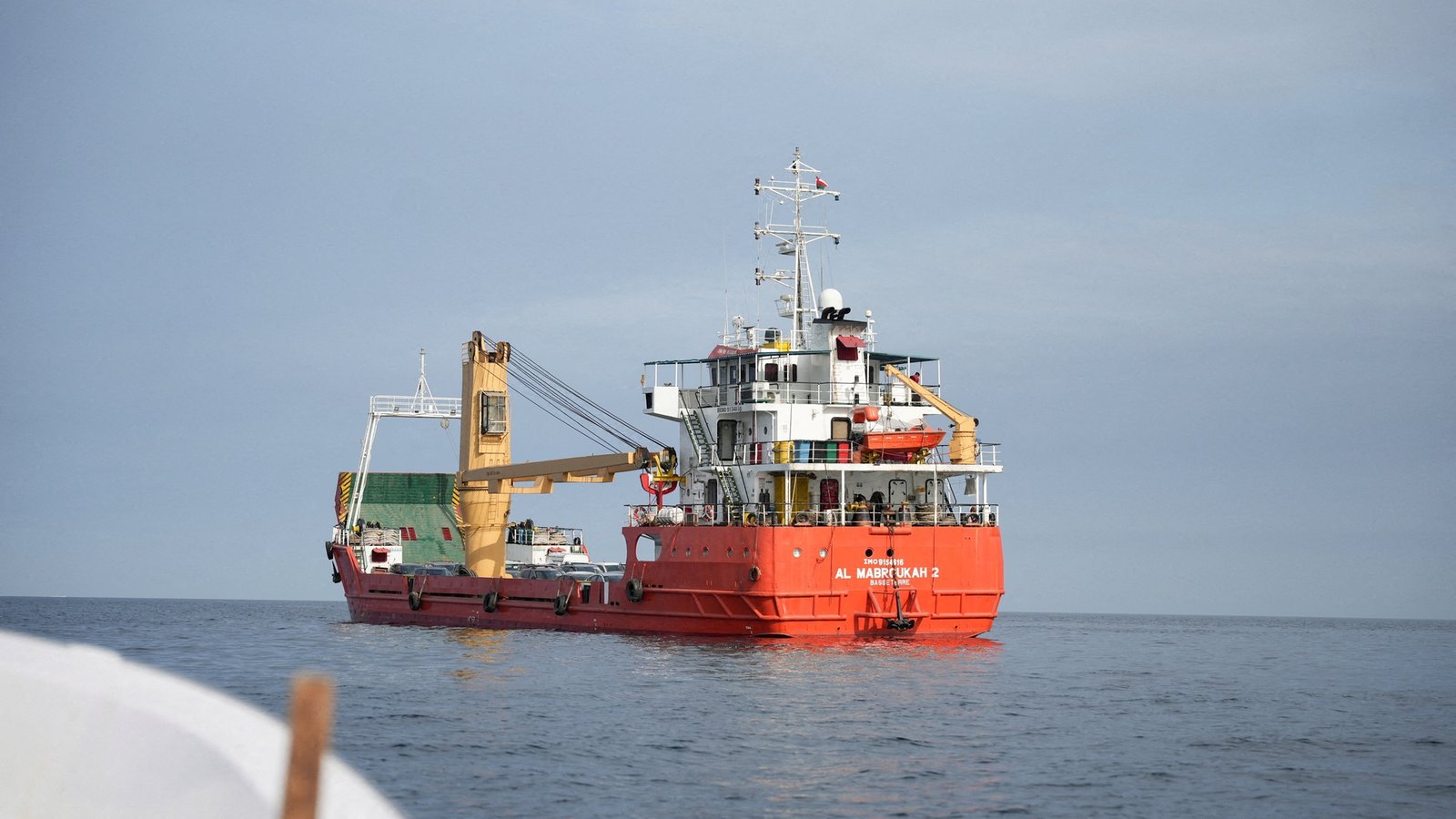
Shipping traffic is heading back to the Strait of Hormuz as vessels that have been stuck in the Persian Gulf for more than a month seize the chance to leave, following Iran’s announcement that the strait is open. But the global flow of oil — and how much Americans pay at the pump — will take time to recover. How long depends on how the maritime insurance industry reacts.
“In line with the ceasefire in Lebanon, the passage for all commercial vessels through Strait of Hormuz is declared completely open for the remaining period of ceasefire,” Iran’s foreign minister Abbas Araghchi announced Friday morning.
The ceasefire negotiated between Israel and Lebanon will last for 10 days. The two-week ceasefire between the U.S., Israel and Iran is scheduled to end on April 21. Talks for a long-term end to the conflict are still ongoing, and President Donald Trump has said that the U.S. blockade of Iranian ports will continue until an agreement is reached.
The war has wreaked havoc on energy markets, pushing up consumer gasoline prices. With Iran’s announcement that the strait is open, oil tankers are already making their way toward the narrow waterway on Iran’s southern border. But the uncertainty afflicting the oil industry has not fully dissipated, and the risk premium associated with moving oil around the Persian Gulf remains.
How many tankers are in transit?
Iran’s announcement has already had an effect on oil tanker traffic, according to a Straight Arrow News analysis of marine traffic data from global analytics company Kpler.
For weeks, tankers idled in clusters off the coast of the United Arab Emirates, near the mouth of the strait. In the hours following Friday morning’s announcement, SAN identified more than a dozen vessels carrying oil that started moving toward the narrow opening that leads to the Gulf of Oman and then the open ocean.
Tankers elsewhere in the Gulf, such as off the coast of Saudi Arabia, Iraq and Kuwait also showed movement.
How does maritime insurance work?
When the U.S. and Israel first attacked Iran on Feb. 28, traffic through the Strait of Hormuz slowed, but it was not solely because of the threat of Iranian drones and missiles. It was also because of higher insurance costs.
A total of 22 ships have been attacked since the beginning of March, including four on March 1, according to data from Kpler. The insurance market that underpins the global shipping industry responded quickly, with many policies canceled before being re-priced.
Cargo ships and oil tankers alike need various types of insurance coverage.
“Everything that moves needs to be insured: the ship, the cargo, the crew, you name it,” said Jean-Paul Rodrigue, a professor of maritime business administration at Texas A&M University. “When the crisis began, the ships could not move, because suddenly the insurance stopped.”
During a war, there’s an extra premium.
The Joint War Committee at the London-based Lloyd’s insurance market sets the premium rate for additional war risk. The premium is set as a percentage of the total value of the ship or its cargo, and must be paid if the ship enters an area the committee deemed risky. At the outbreak of the war, the committee reassessed that risk, expanded the geographic range requiring war coverage and raised rates.
During early March, premiums on the ships and machinery on board, not including cargo, were 2.5%. A typical rate is less than 1%, sometimes as low as 0.1%, according to S&P Global.
Will oil supply chains return to normal?
While some tankers are moving, traffic in the Strait is not expected to quickly return to pre-war levels. One reason is Iran is still controlling traffic, which must flow along a “coordinated route,” foreign minister Araghchi said. Another reason is the insurance.
“Risk premiums will go down very slowly,” said Jatin Dua, director of the Oceans Lab at the University of Michigan.
Rodrigue told SAN “maybe some ships are going to be waiting,” to transit the strait, in hopes of a less expensive insurance policy. That would lengthen the time it takes the oil market to reset.
Dua, who has spent time aboard many ships as part of his research, also noted that captains and crews — in addition to insurers — have a role in assessing the risk of any voyage. And they have a right to refuse to make a journey through a warzone.
“Even with Iran saying the strait is open, individual ships, individual companies will decide,” when to move, he said.
As Matthew Lekstutis, a seasoned supply chain expert and director at the consulting firm Efficio, put it during an interview with SAN in March: “Do you want to be the guy driving the first one through?”
In the long run, the risk premium associated with the Strait of Hormuz is likely to stay above where it was in February.
“It’s going to force a lot of people to reconsider options,” Rodrigue said. For example, he said Gulf states will look at expanded pipeline capacity to reroute oil to other export terminals. And traders will look to buy oil from other sources, such as the U.S.
“With this conflict, Iran has opened a can of worms,” Rodrigue said.