

Artificial intelligence is here, and it’s not going anywhere. Despite that, most of the country remains AI illiterate.
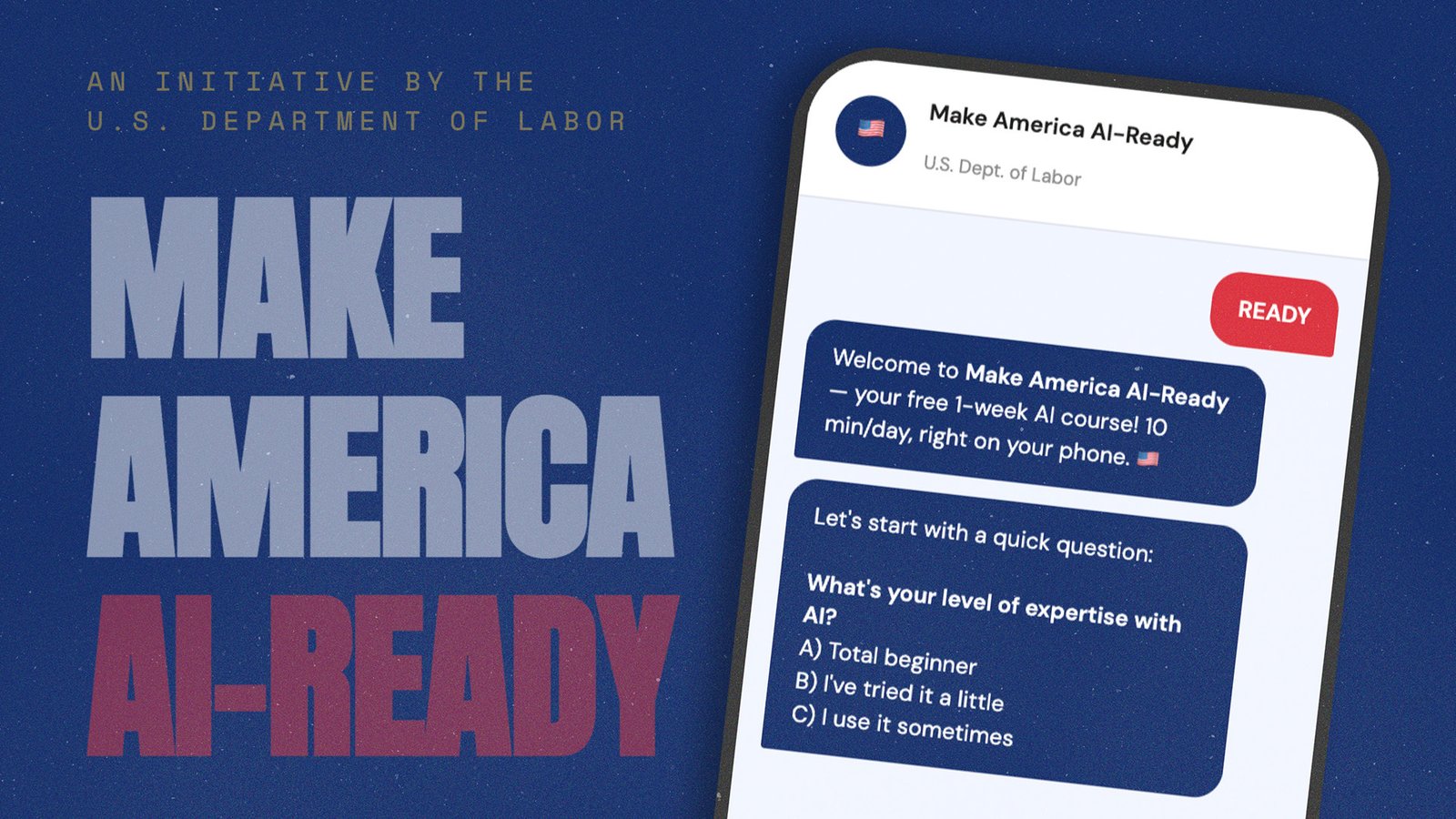
To reverse that, the Department of Labor launched the “Make America AI-Ready” initiative, a free course to help Americans learn the basics of the new technology.
“The ‘Make America AI-Ready’ initiative is designed to ensure every American worker has the chance to learn foundational skills so they can benefit from the opportunities that the AI economy presents,” then-U.S. Secretary of Labor Lori Chavez-DeRemer said.
To gauge the program’s effectiveness, Straight Arrow spoke to AI learning experts and everyday people who took the program to gather their thoughts.
“The intention is a good one,” Victor Lee, associate professor in the Graduate School of Education at Stanford University, told Straight Arrow. “We do need to broadly increase AI literacy across the board, not only for students, but also people already in the workforce.”
How it works
The entire course functions over text messages. You text a number to get started and the learning begins.

“I think it’s a good modality, because it doesn’t require internet,” Sri Ash Tadimalla, AI education fellow at the Computing Research Association, told Straight Arrow.
Others agreed that the medium was the right way to do it.
“I think that’s a fabulous way to serve information out to people without making you have to open up your computer or open up your email, like all the barriers that would usually keep people from wanting to do something,” Simonne Hooper, a senior account manager at a marketing agency in Los Angeles who said she’s pretty familiar with chatbots, told Straight Arrow.
Lee didn’t agree that this was the way to go.
“The folks who I think need these basics probably are not as comfortable with this text-based chatbot learning interface,” he said.
Texting that initial number triggers the seven-day course. Each day is a new pillar of instruction, and the DOL estimates it’ll take you about 10 minutes.
But that depends on your level of AI knowledge and how long it takes you to read the prompts and answer the ensuing questions.
“I’m somebody who’s fine with texting every day,” Mason Wurzburger, a flight nurse outside of Baltimore who said he has room to learn when it comes to AI, told Straight Arrow. “My dad and mom, maybe not the best for that, but I think they would be able to figure it out.”

It begins by asking for your level of confidence in your AI knowledge on a scale of 1-10.
“You would think that a question like that would be intended to be adaptive,” Lee said.
But it’s not. No matter whether you put a 0 or 10, you get the same course.
“If someone says one or zero, you shouldn’t promise them the same seven days as someone who says nine,” Tadimalla said.
Each day comes with a few prompts that include some fun little emojis, a few paragraphs on basic AI education and a multiple-choice trivia question at the end.
The lessons are powered by tech company Arist, which NPR reported offers its services free of charge. How they got that contract has raised some ethical questions.
Does it work?
The answer to that question really depends on what you’re trying to get out of it, but everyone Straight Arrow spoke with agreed this was pretty basic stuff.
“I am not confident that this will be greatly helpful,” Lee said.

“I wish the prompts or the questions and what they taught you was more useful for me,” Hooper added.
But others said it’s not a bad place to start.
“It’s a very good start,” Wurzburger said.
“It’s very, very, very basic,” Tadimalla added. “Ten minutes a day is not enough to become AI literate. So, I think it’s over-promising a lot, but I think it’s a necessary first step.”
The Department of Labor said this is supposed to be just the beginning.
Whether they liked the approach or not, everyone Straight Arrow spoke with agreed that this is all it is, and no one should feel like they’re fully AI-literate once completing the course.
“I wouldn’t encourage them to call themselves or put on their resume that they are AI literate,” Tadimalla said.
“I don’t think that this alone is sufficient, because a lot of what you do at work is highly situated and is going to have a lot of dependencies,” Lee added. “Whereas [this course] speaks to some pretty broad generalities.”
Essentially, if you’ve never seen an AI chatbot before, this may be a good place to start. However, if you’ve managed to navigate to this article, this course may not be super helpful.
“I think more trainings would be necessary,” Wurzburger, who also said the course abruptly stopped after a few days, said.
Hooper believes this should be the opening page of an AI chatbot.
“ChatGPT, before you start using it, should have something like this,” Hooper said. “Like a quick tutorial that just level-sets what you should expect when you’re using it, versus just jumping into it.”

So far, there’s no data on how many people have taken the course or how effective it’s been at teaching people.
Some also felt the text messaging system was a barrier to learning.
“It’s also limited by the inability to ask questions or have a conversation,” Tadimalla said.
Who should use it
“It’s aimed towards somebody who’s either never used it before, somebody who’s older and just not as familiar with computers,” Wurzburger said.
“I don’t think it’s for people who are in today’s corporate environment because in most jobs, you do use AI pretty frequently, and it’s encouraged to learn more about it,” Hooper added.
The Department of Labor specifically mentioned workers in their announcement.
“To make a meaningful impact on workforce performance or preparation, the information I see here is not going to do as much,” Lee said.
However, there is still more than a quarter of the country, or nearly 92 million Americans, who say they have yet to use an AI tool.
Those people, along with the 70% of people who can’t correctly identify common uses of AI, are likely who would really benefit.
“But there’s also a very large segment that is already aware of what might feel like common sense kinds of things for using new technologies,” Lee said. “And this may not necessarily speak to their needs.”
Wurzburger also used that phrase about the course.
“I thought they were common sense, but at least it had the little links where you would take a little test and stuff to just get you a little more hands-on,” he said.

For those who could really use the course, they still need to make the choice to get educated.
“If you are signing up, it means you belong to a certain type of category or group of people who are interested in learning, or who are willing to engage with this type of effort about AI,” Tadimalla said.
What’s not in the course
Nearly 83% of consumers say they’ve seen a video they suspected was an AI creation. AI slop videos also continue to take over the Internet.
However, this course mainly focuses on using chatbots but only scratches the surface of how to detect media that is not real.
“There is a little bit of content I see there that refers to noticing extra fingers or hands or something that looks a bit weird in images,” Lee said. “But again, it’s lacking the situativity. It’s not really speaking to actual AI use in context and all the different forms that it takes or how it looks.”

“That course would not help with that at all,” Hooper added.
Then, there’s the well-documented societal impacts of AI.
“They don’t talk about energy, they don’t talk about social impact, they don’t talk about surveillance, etcetera,” Tadimalla said. “Things that are really important in a robust AI education needs to have those.”
The importance of AI literacy
“I would say it’s the same as if you asked someone 20 or 30 years ago, how important is it to understand how the internet works?” Tadimalla said.

“It’s extremely important,” Hooper added.
Use of AI in the workplace only keeps rising.
Nearly a quarter of U.S. companies have already replaced workers with AI, and Goldman Sachs believes some 11 million Americans could be next.
“I think the average white-collar job, if you don’t have some type of background in AI, there’s a chance you will lose your job to AI in the future,” Wurzburger said. “There’s still a chance of blue-collar jobs being taken over as well, but I think we have a little more time before the autonomous robots take everybody’s jobs.”