

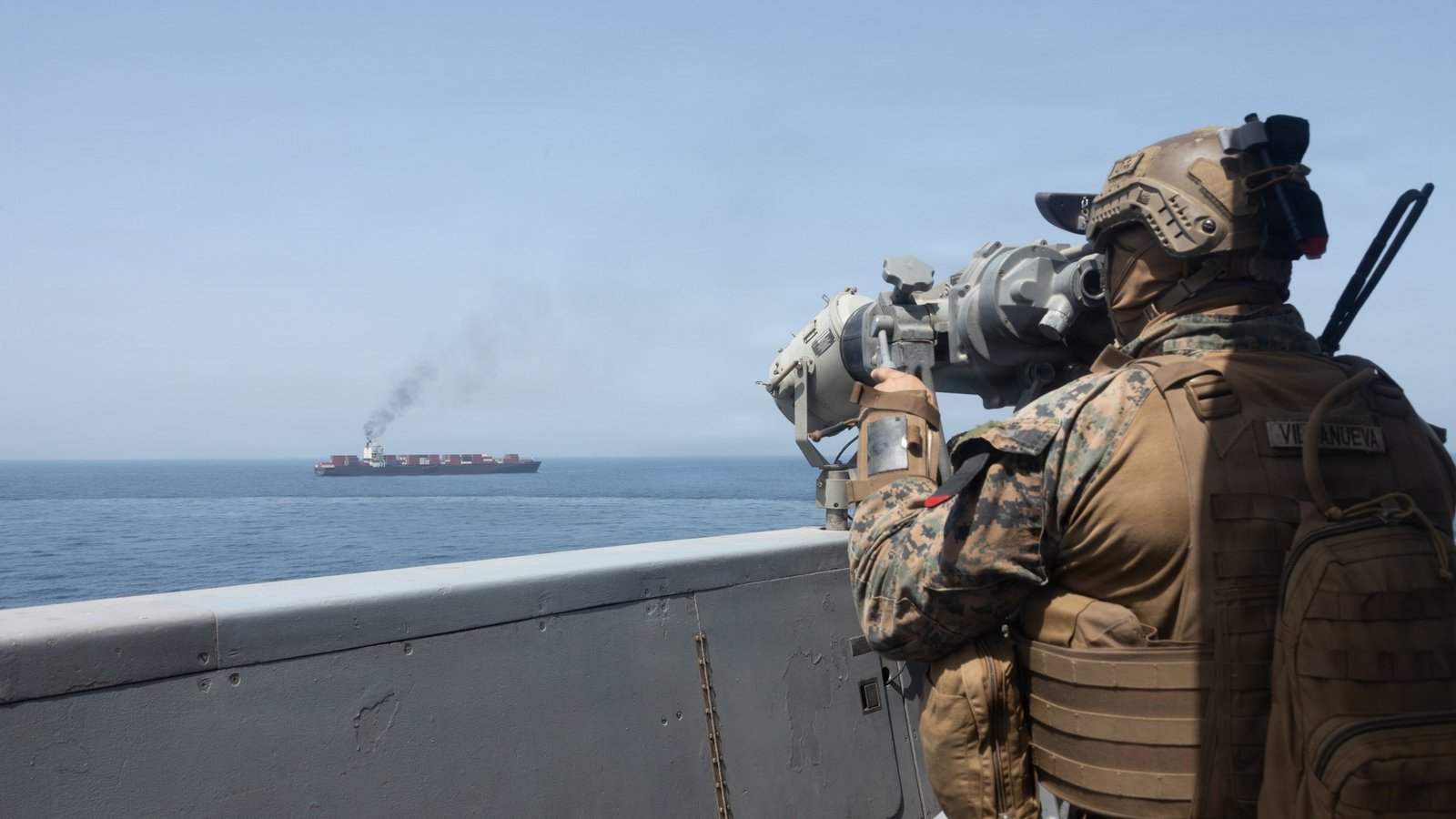
Defense Secretary Pete Hegseth said Friday the Naval blockade near the Strait of Hormuz is expanding, with a second aircraft carrier scheduled to join the force in the coming days.
“Our blockade is growing and going global,” Hegseth said during a Pentagon update. He and Chairman of the Joint Chiefs of Staff, Gen. Dan Caine, noted the ongoing efforts off the coast of Iran, saying since the U.S. Naval blockade was implemented, 34 ships have turned around and avoided conflict with the U.S. military.
During the update, Caine also provided more details on the three ships the U.S. military seized in the last few days, two in the Indian Ocean and one near the Strait.
‘Shoot to kill’: Targeting minelaying vessels
Hegseth and Caine echoed new orders from President Donald Trump. The president issued a new directive Thursday, ordering U.S. forces to “shoot and kill” Iranian boats laying mines in the Strait of Hormuz.
“I have ordered the United States Navy to shoot and kill any boat, small boats though they may be … that is putting mines in the waters of the Strait of Hormuz,” Trump posted. “There is to be no hesitation. Additionally, our mine ‘sweepers’ are clearing the Strait right now. I am hereby ordering that activity to continue, but at a tripled up level!”
Hegseth said the military will do “whatever President Trump decides,” with Caine noting the U.S. military remains poised.
Plans to attack assets around the Strait
Plus, military officials are now drawing up options to target Iran’s capabilities in the Strait if the ceasefire breaks down.
Those plans could include “dynamic targeting” strikes on Iran’s capabilities around the Strait of Hormuz, the southern Arabian Gulf and the Gulf of Oman. Hegseth said the Navy has permission to attack small fast boats, minelaying vessels and other assets Iran has used to shut down the waterway.
The goal is to force Iran back to the negotiating table.
The new development stands in contrast to what the president said Thursday, telling reporters he’s “not under any pressure” to reach a deal, even as the war stretches beyond the timeline he originally set.
“I don’t want to rush it, I want to take my time,” Trump said. “We have plenty of time, and I want to get a great deal. I want to get a deal where our nation and the world is safe from lunatics with nuclear weapons.”
Iran’s top diplomat said he’s been in contact with Pakistani officials about the ceasefire, but offered no details.
Following the renewed threats on the Strait, crude oil prices rose to more than $105 a barrel Friday morning.
Where Lebanon, Israel ceasefire stands
Meanwhile, Israel and Lebanon have extended their ceasefire another three weeks, but fighting continues.
Israel said it struck a missile launcher after a rocket was fired into its territory, and Hezbollah claimed responsibility.
Lebanon’s health ministry said an Israeli strike killed three people, as Israel said those killed were militants involved in the attack.
Round out your reading
- Work for food: New SNAP rules reshaping who gets to eat.
- How Iranians actually feel about regime change and war.
- Feds warn that Russians may hack your internet router. Why?
- The truth behind a medical condition that never existed.
- We’re building a new Straight Arrow. Help us shape our future by taking our survey.