

Two studies published Monday estimated that ending universal hepatitis B vaccination for newborns could result in tens to hundreds of preventable infections and millions in additional healthcare costs.
The analyses, published in JAMA Pediatrics, were conducted by two separate research groups. Both were modeling studies — meaning they used mathematical simulations to estimate outcomes under different scenarios rather than tracking real-world cases.
Why did the CDC change its hepatitis B vaccine guidance for newborns?
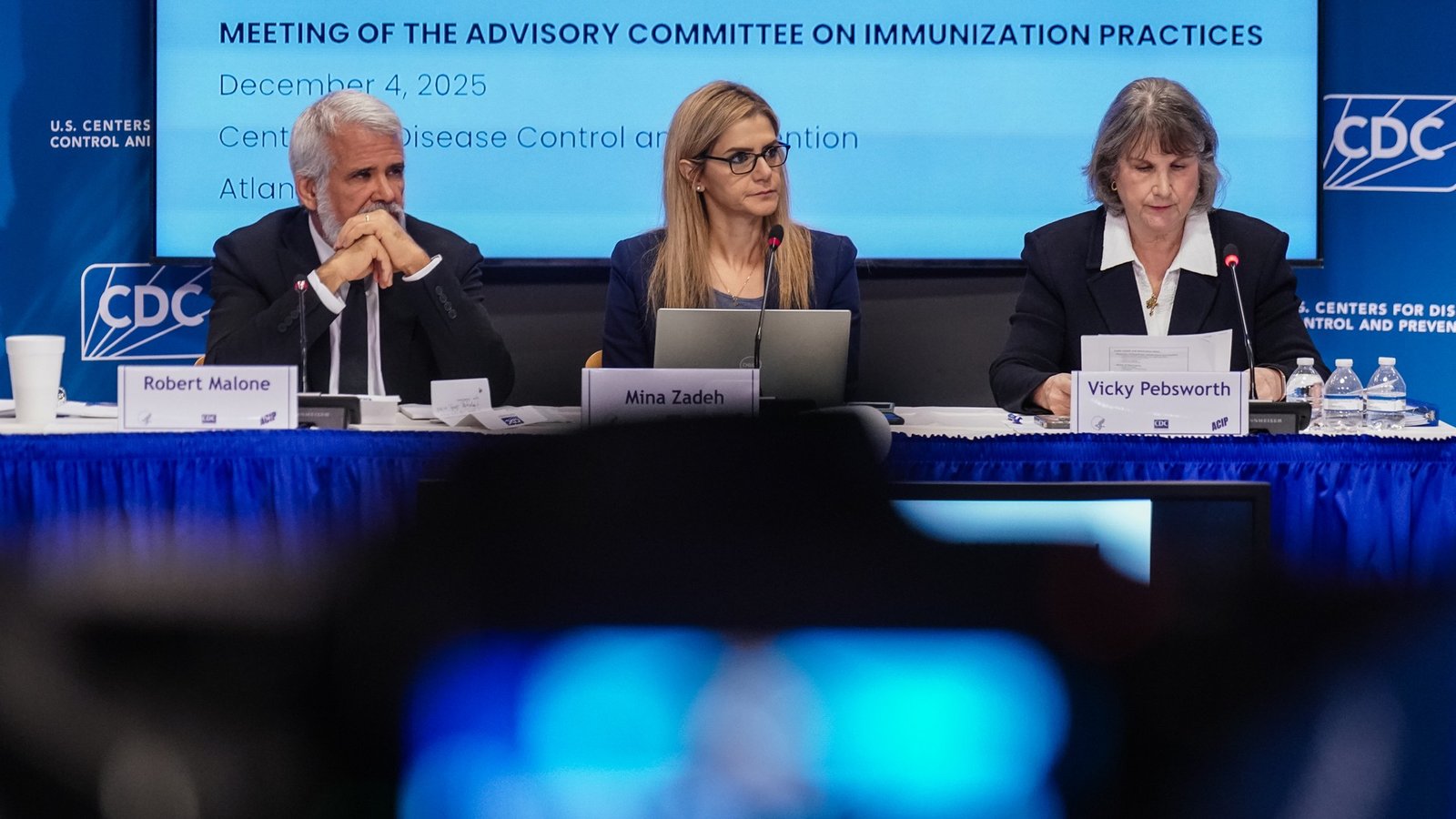
Last December, the Centers for Disease Control and Prevention dropped longstanding guidance — first issued in 1991 — that all newborns receive three doses of the hepatitis B vaccine, including a first dose within 24 hours of birth.
The change was based on recommendations from the Advisory Committee on Immunization Practices (ACIP), a group of physicians and public health officials that advises the federal government on vaccine policies. The panel recommended that instead of universal vaccination, all pregnant women should be screened for hepatitis B and that only infants born to mothers who test positive be vaccinated at birth.
Babies born to women not infected with hepatitis B have an “extremely low risk of hepatitis infection during childhood and especially during the first month of life, and therefore do not need to be routinely vaccinated with the hepatitis B vaccine,” Vicky Pebsworth, a committee member and the research director of the National Vaccine Information Center, said at the time.
Rather than blanket vaccination, the panel and the CDC encouraged what it called individualized decision-making, calling for parents to weigh the risks and benefits of vaccination.
READ MORE: How the search for vaccine safety led parents away from the experts
Some ACIP panelists disagreed.
“The hepatitis B vaccine recommendation is very well established. We know it’s safe, and we know it’s very effective,” said Cody Meissner, a former chief of pediatric infectious diseases at Tufts Medical Center.
Many physicians and health organizations including the American Academy of Pediatrics denounced the revised guidance as “irresponsible and purposely misleading” and continue to recommend hepatitis B vaccination for all newborns.
Hepatitis B and screening
There are six FDA-approved hepatitis B vaccines, and clinical trials have reported that both are generally safe. However, the package inserts for the two vaccines most commonly given to infants, RECOMBIVAX HB and ENGERIX-B, do list some side effects, most commonly nausea, vomiting and upper respiratory infections. Post-market surveillance has documented instances of autoimmune, psychiatric and cardiac disorders, among others, though it is unknown how common these outcomes are following vaccination.
Hepatitis B is a virus that spreads through bodily fluids and can cause liver failure, cancer and premature death. Infections can be acute, meaning they develop and resolve quickly, or lifelong. Infants are especially vulnerable: about 90% of infected babies develop chronic disease — compared with about 5% of adults — and 1 in 4 people infected at birth die prematurely. The Department of Health and Human Services estimated that about 25,000 infants are born to mothers with hepatitis B infections each year, but only about 1,000 become infected with the virus.
While screening pregnant women for hepatitis B can help reduce mom-to-child spread, not all women are routinely tested. A 2023 report from March of Dimes found that 500,000 pregnant women in the U.S. were not screened.
Federal vaccine recommendations are not legally binding. Each state sets its own laws and vaccination schedules, and even then, vaccines are only required for children to attend public school or daycare. (Military personnel are an exception; they are required to receive certain vaccines.)
The consequences
The new studies are the first to estimate the potential impact of the CDC’s shift in hepatitis B vaccine policy.
In one study, researchers modeled outcomes for more than 3.6 million U.S. births — roughly the number born in 2024 — estimating what would happen if the first hepatitis B vaccine dose was delayed to 2 or 12 months. The analysis factored in maternal infection rates, screening and the risk of transmission at birth and within households.
In both scenarios, delaying the vaccine led to more infections, deaths and higher costs than administering it at birth. Even assuming that 100% of newborns received the vaccine at 2 months, delaying the first dose resulted in 90 additional acute infections, 76 chronic infections, 29 deaths and $16.4 million in added costs. Delaying the first dose to 12 months led to 190 additional infections, 50 deaths and nearly $30 million in extra healthcare spending.
The authors of the second study used a mathematical model to compare what would happen if all newborns were vaccinated versus a targeted approach where only babies of unscreened or hepatitis B–positive mothers received the vaccine. The researchers found that if 80% of higher-risk infants were vaccinated there would still be 69 additional infections, rising to 628 additional cases if coverage dropped to 10%.
The Department of Health and Human Services did not respond to requests to comment on the new findings.
Round out your reading
- Scientists unearth new evidence on how the Grand Canyon was shaped.
- Why the Army is adding a second fitness test for combat.
- Illegal midwives, growing demand: The fight over home birth in America.
- 40 years after Chernobyl, the U.S. pushes nuclear power once again.
- We’re building a new Straight Arrow. Help us shape our future by taking our survey.