

Mackinac Island sits in the Straits of Mackinac, right between Michigan’s Lower and Upper Peninsulas, and has long been known as a source of world-class fudge, horse-drawn carriages and an ongoing 128-year ban on automobiles. In the absence of cars, the island still reported four drunk driving arrests between 2020 and 2023.
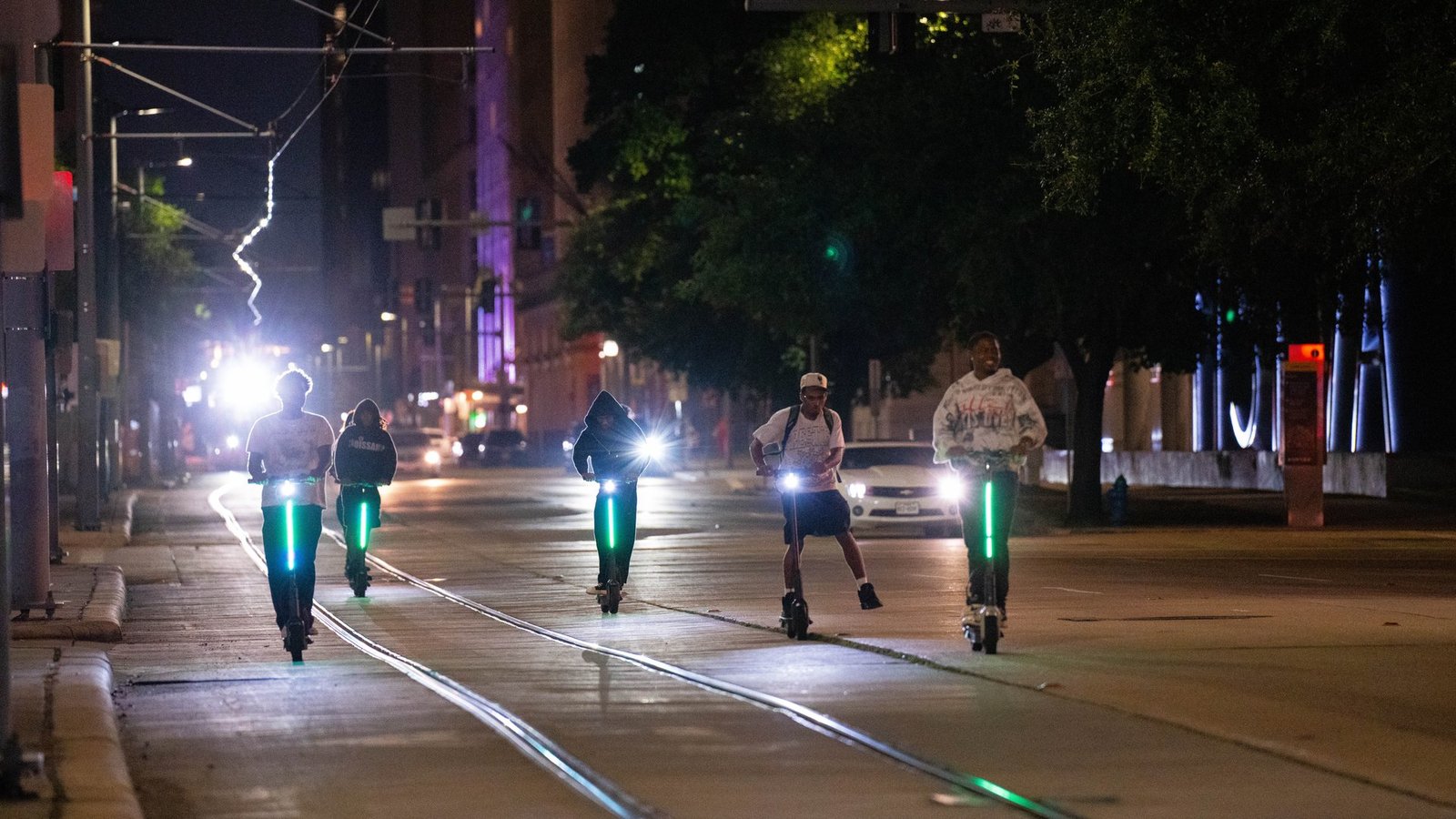
It’s far from the only place in the nation to cite people for drunk driving without a vehicle, as places look to regulate electric bikes or scooters. In some places, they’ve required riders to follow all motor vehicle laws, as research shows the micromobility devices are sending more and more people to the hospital.
“Electric scooters fit somewhere between a bicycle and a conventional car,” David Goodwin, University of Washington School of Law graduate, wrote in the school’s 2025 law review. “Electric scooters cannot cause the ‘carnage and slaughter’ associated with conventional DUI but their speed and self-propulsion invokes a greater risk than that of a bicycle.”
His review included a proposed state law that would impose civil penalties rather than criminal ones to not deter ridership. He told Straight Arrow over email that he still believes it is appropriate and modeled after what New York City, Washington, D.C., and California have done.
The Consumer Product Safety Commission found that, out of the 357 fatalities reported to have occurred while riding e-bikes or e-scooters between 2017 and 2023, four were associated with intoxication. For the e-scooter deaths, it said one rider collided with a commuter train, and the other fell from the device while drunk.
Orlando Health, a network of hospitals and medical offices, urged riders to resist the temptation to hop on an e-scooter or bike after a night out at the bar.
“It sounds like a reasonable idea, but it can be extremely dangerous to operate one of these bikes while under the influence of alcohol or drugs. These substances can dampen your response times and, most importantly, impair your judgment.”
DUIs without the cars
Even though the phrase infers that people are driving to face a DUI charge, it’s not always the case across the nation.
According to the Michigan State Police Crime Dashboard, the offenses happened twice in 2020 and again in 2023 on Mackinac Island. It listed the location as “lake/waterway/beach” and “highway/road/alley/street/sidewalk.” No further information was provided on how the charges transpired.
In Bald Head Island in North Carolina, which promotes a “no cars, no cares” lifestyle, the police reported having three driving while intoxicated cases for 2025 and 25 open container traffic violations. The department didn’t provide information on where the incidents occurred.
Alcohol traffic laws are governed by what states consider a “vehicle” to be. They differ and are typically broader than what one would consider a vehicle.
Several states, like California and Kentucky, have made it a crime to ride a horse while drunk, earning riders driving under the influence or operating while intoxicated charges. In one state, North Dakota, lawmakers repealed a state law that made riding a horse or bicycle while drunk a DUI.
Alcohol was involved in a third of fatal crashes
Medical professionals have studied the injuries associated with micromobility devices as they rose in popularity, with some looking at alcohol factors.
The devices have more often appeared in cities, where people rent them to get from place to place. Some of the largest operators are Lime, Spin, Uber and Bird for e-scooters; Lime, Bird, Rad Power and Pedego for e-bikes, to name a few. The companies boast the devices as sustainable ways to get around town with rentals located in cities like Nashville, New York City and Scottsdale, Arizona.
Lime discourages its riders from riding while impaired or drinking, adding warnings in Nashville that it’s prohibited. Scottsdale outlines its laws on the practice and has charged two people so far this year for such a crime.
“It is illegal to operate motorized bikes or scooters while under the influence of alcohol,” according to the City of Scottsdale. “It is okay to ride a non-motorized bike while under the influence of alcohol, as long as it is being ridden in a safe manner.”
Impaired riding is a concern among medical professionals, with numerous studies published in various journals pointing to the rise of alcohol use while riding the micromobility devices.
Columbia University Mailman School of Public Health said in 2024 that electric scooters had the highest prevalence of alcohol use, and laws are lacking to both criminalize the behavior as well as properly track them. They found that 10.2% of all bicycle and 8.5% of all motorcycle rider injuries involved alcohol.
Rates were higher in fatal crashes, with alcohol being a factor in 27% of bicycle and 42% motorcycle crashes.
“Legislation is lacking on where micromobility devices can be ridden and legislation regulating the riding of these devices while under the influence of alcohol or other recreational drugs is inconsistent and historically difficult to pass,” Kathryn Burford, former postdoctoral scholar at Columbia, said in 2024.
Penalizing drunk rides
Micromobility devices have long lacked federal regulation. U.S. Rep. Dave Min, D-Calif., introduced legislation in March that would set a standard definition of e-bikes and electric scooters.
His legislation, the Safe SPEEDS Act, would mandate that the CPSC create standards for micromobility devices and regularly publish studies on crashes. The legislation would also establish reporting and data collection standards for first responders.
It doesn’t, however, address impaired riding.
The bill is in the House Energy and Commerce Committee.
“This bill will ensure federal e-bike standards are clearly defined while also empowering local governments to enhance their safety programs, keeping our communities safe while in transit,” he said in a March 16 release.
However, Goodwin proposed a model statute for Washington state that would penalize micromobility riders for riding drunk or under the influence. His statute only levied fines against riders, while giving law enforcement the option to impound devices that aren’t rentals.
“An effective policy of deterrence toward intoxicated scootering requires uniform enforcement and proportional penalties,” he said.
Round out your reading
- Scientists unearth new evidence on how the Grand Canyon was shaped.
- Why the Army is adding a second fitness test for combat.
- Illegal midwives, growing demand: The fight over home birth in America.
- 40 years after Chernobyl, the U.S. pushes nuclear power once again.
- We’re building a new Straight Arrow. Help us shape our future by taking our survey.