

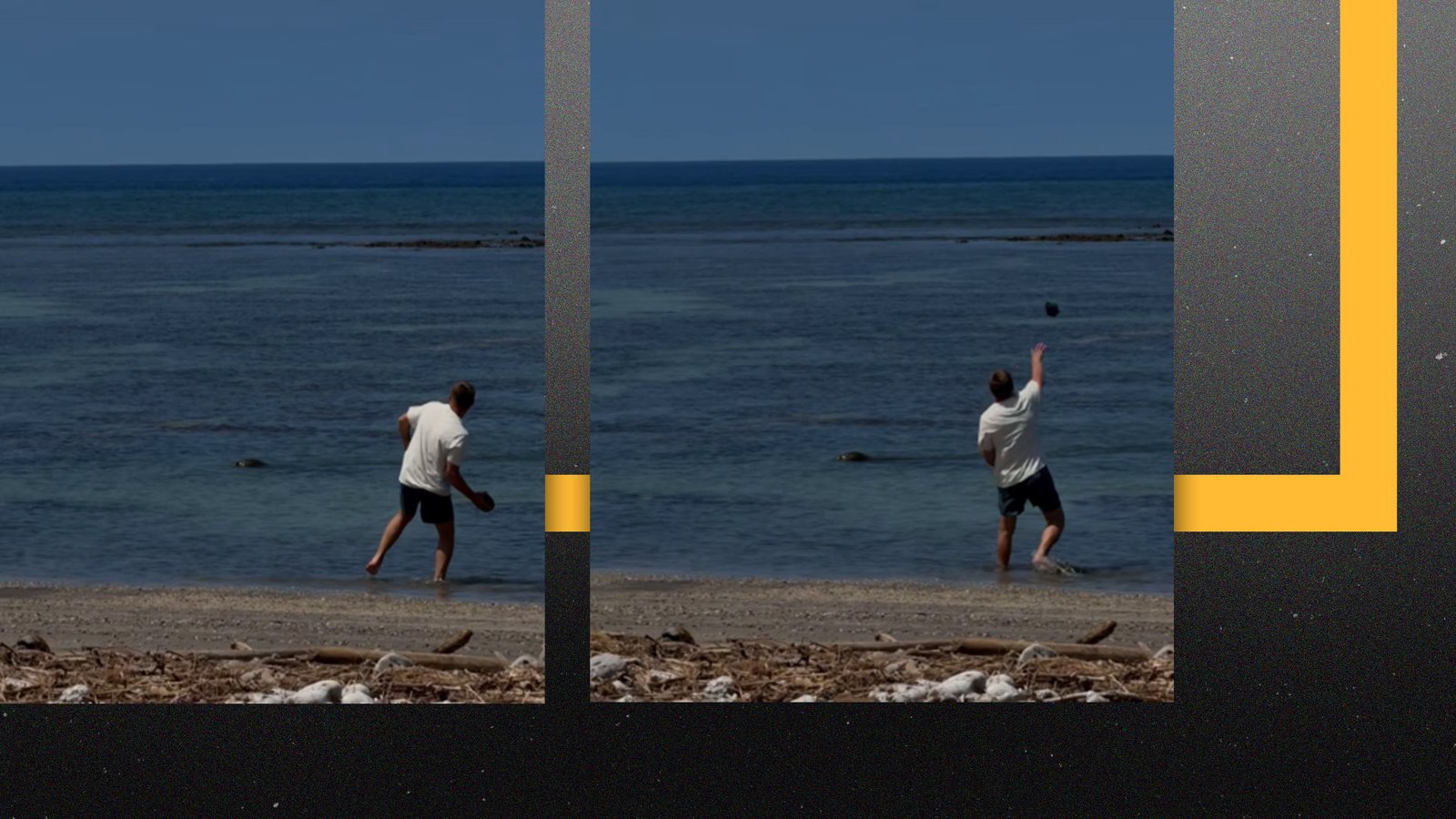
A tourist who was visiting Hawaii earlier this month is expected in court on Wednesday after federal officials charged him with harassing and attempting to harass a protected animal.
Igor Lytvynchuk, 38, was charged after he was caught on video throwing a rock at an endangered Hawaiian monk seal in Maui, barely missing its head. Video of the incident circulated online, sparking outrage and, according to Lytvynchuk’s lawyers, death threats, doxing and physical assault.
Now, his attorneys are arguing that he himself has been assaulted, on top of the allegations that he harassed an endangered animal. But how seriously are the allegations against him?
A severely endangered species
After video of the incident began circulating online, NOAA scientists identified the animal in the water as an adult male monk seal, known as “R404.”
He’s part of one of the most endangered seal species in the world, according to the NOAA, with its population declining for around six decades.
The existing population, which is currently only about a third of its historic size, is primarily in Papahānaumokuākea, a highly protected marine reserve and UNESCO World Heritage Site in the Northwestern Hawaiian Islands. The remaining are in and around the main Hawaiian islands.
Their endangered status stems from food limitations, shark predation, habitat loss, disease and human impacts.
Legal protections
Because of these threats and their status, monk seals have protection under the Endangered Species Act (ESA), Marine Mammal Protection Act (MMPA) and Hawaii state laws.
Both the ESA and MMPA establish protections for endangered species, and when violated, can result in serious charges. Looking at the MMPA, Congress originally passed the legislation in the 1970s, but lawmakers amended it in 1994 to establish a statutory definition of “harassment.”
With the amendment, the MMPA now prohibits “any act of pursuit, torment, or annoyance, which has the potential to: injure a marine mammal or marine mammal stock in the wild, or isturb a marine mammal or marine mammal stock in the wild by causing disruption of behavioral patterns, including, but not limited to, migration, breathing, nursing, breeding, feeding, or sheltering.”
It prohibits individuals from hunting, harassing, capturing, killing or attempting to do any of the previous to endangered mammals.
The ESA prohibits similar actions, allowing individuals to face both civil and criminal penalties. If the act is proven intentional, individuals can face criminal charges, while civil penalties stem from “negligently harassing” or “unintentionally taking” a protected animal.
Harassing or protecting?
That brings us back to the case in Hawaii. Intentionally throwing a rock at an endangered species is harassment, but Lytvynchuk’s attorney claims he was unaware it was a seal.
In fact, he says Lytvynchuk was trying to protect a group of sea turtles, mistaking the seal for an aggressive sea lion.
“So his response was not to hurt this monk seal, but to get it away from the turtles,” Lytvynchuk’s attorney said, according to The Independent.
But a criminal complaint states that a Department of Natural Resources officer, who was investigating the incident, confronted Lytvynchuk, who reportedly told the officer, “he did not care and was ‘rich’ enough to pay the fines.”
Lytvynchuk faces charges of violating both the MMPA and ESA. If convicted, he faces up to a year in prison for each charge and potential fines amounting to $20,000.
Round out your reading
- Tennessee officials will pay $835,000 for jailing man over Charlie Kirk meme.
- Why the immune system turns on women more often than men.
- More than 340 newspapers block the Wayback Machine. What that means for the future of the internet.
- Why Rep. Cohen filed articles of impeachment against Supreme Court Justice John Roberts.
- We’re building a new Straight Arrow. Help us shape our future by taking our survey.