

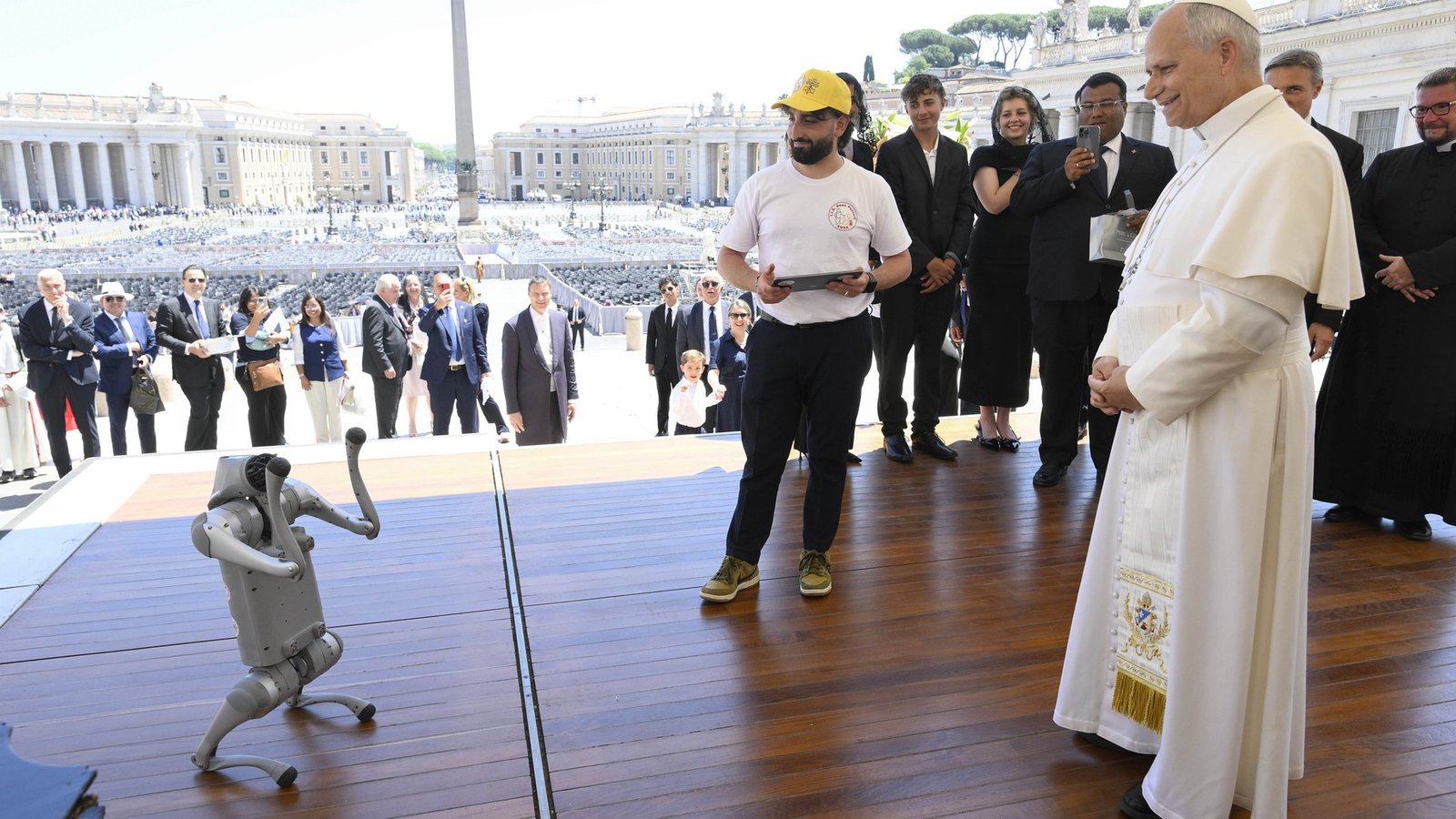
Pope Leo XIV released his much-anticipated “Magnifica Humanitas” (roughly, the Magnificent Humanity) on Memorial Day, with the Catholic leader pleading for humanity’s protection as artificial intelligence rapidly advances. The plea comes as several AI companies have come under fire for their humanlike chatbots, driving some people to harm or suicide.
However helpful or harmful, AI companies have become a cornerstone of the U.S. financial system. OpenAI is planning an initial market offer speculated to be worth $1 trillion. Anthropic is estimated to be worth $900 billion. The AI boom elevated chipmaker Nvidia to the world’s most valuable corporation.
Which begs the question of whether these companies will take papal suggestions if it means reducing those stratospheric share values.
The American pope issued the document as artificial intelligence gains a larger foothold in everyday life, affecting people of all ages and professions. The Vatican said that Pope Leo’s message is to remember that AI is a powerful data processor in the hands of just a few people, and isn’t a viable replacement for human emotion.
“No computational system, however sophisticated, can create a heart that gives itself, or a conscience that discerns good from evil,” Pope Leo wrote in his encyclical. “Even when machines excel in efficiency, a human face that asks to be gazed upon remains the center of our history.”
Already, there are technology companies with an ethics standard, but it’s not common. In the case of Google, the famous search engine cut ties with a federal defense program seven years ago. It reversed course on banning its AI products from being used to create weapons or anything else that could harm people.
A lack of stringent guidelines and safeguards has led to people’s deaths.
A previous Straight Arrow analysis found more than a dozen instances where the chatbots were used in connection with mass murders and suicides. One instance revealed a Northern Ireland man believed his life was in danger after chatting hours on end with a character he created in Grok, a chatbot Elon Musk’s xAI developed. In others, bots like ChatGPT told several people how to die by suicide, leading to several deaths.
“The real question is not whether AI is good or bad, but whether the ways we develop and deploy the technology help individuals and communities become more humane, just and participatory, or whether instead they foster exclusion, control and inequality,” Paolo Carozza, Notre Dame Law School professor and Meta Oversight Board member, said in the university’s press release.

Averting ‘Babel syndrome’
Pope Leo added on X that as technology advances, the pursuit of profits needs to be kept at bay, as it could compromise ethics and cause harm. Pope Leo called it “Babel syndrome.”
“In a context where the wealth of nations depends increasingly on knowledge and technology, when these goods remain concentrated in the hands of a few, without adequate forms of sharing and access, a new imbalance is created that contradicts the universal destination of goods,” the Pope wrote.
The Tower of Babel, he wrote, is a biblical event where people in a new city rebuilt it based on personal pride and the notion to “make a name” for oneself. The project hit a roadblock as it neglected diversity. Pope Leo wrote that the city reveals aggressive self-sufficiency “sacrifices human dignity for efficiency” and holds an aspiration to reach heaven without God’s blessing.
Pope Leo isn’t the first Catholic leader to issue warnings about AI. Then-Pope Francis urged religious leaders in 2024 to safeguard dignity against artificial intelligence as the world navigated toward a new digital age.
“No machine should ever choose to take the life of a human being,” Francis said, according to the U.S. Conference of Catholic Bishops.
Anthropic co-founder Chris Olah directly responded to Pope Leo’s document at The Vatican. No other AI company was present nor was it immediately known if an invitation was extended out to them.
That same company has been used by the Pentagon in the Iran War and the capture of former Venezuelan leader Nicolas Maduro.
“If it helps, one way I sometimes describe it is as being a little like bringing a fictional character to life,” Anthropic co-founder Chris Olah said in response to Pope Leo’s remarks. “And now we’re entering an extraordinary world where those fictional characters speak to us, do work, have jobs.”
Anthropic has been hailed for its ethics. Salil Tripathi, senior advisor at the Institute for Human Rights and Business, wrote in March that Anthropic questioning the Trump Administration over how its Claude program is used could set a precedent for what it means to lead a company with humanity in mind.
“Through embedding human rights principles into its governance structures, and by demonstrating that its commitments apply consistently across all markets and partnerships,” Tripathi wrote, “Anthropic could set a valuable precedent demonstrating that ethical safeguards are compatible with technological leadership.”
Olah shrugged the responsibility of correcting AI off his and other executives’ shoulders. He wrote that society as a whole should fix AI, arguing that critics should be the ones to tell scientists and AI labs when they are failing.
Olah added that incentives like pride, ambition, geopolitical pressure, the pressure to stay viable and on top of innovative research influence how scientists like him operate.
“Every frontier AI lab—including Anthropic—operates inside a set of incentives and constraints that can sometimes conflict with doing the right thing,” Olah wrote.
‘Disarming AI’ for the good
Notably in Pope Leo XIV’s document is a request to disarm AI to better serve humans and fulfill what he deemed to be the responsibility to others to inflict no harm.
His vision for that is to remove the zeal for creating the most powerful program in order to satisfy geopolitical and commercial dominance — the same incentives Olah said developers are drawn to.
“To disarm does not mean rejecting technology, but preventing it from dominating humanity,” the Pope wrote. “It means freeing technology from monopolistic control and opening it to discussion and debate, therefore making it human-friendly and restoring it to the plurality of human cultures and ways of life.”
Round out your reading
- Tennessee officials will pay $835,000 for jailing man over Charlie Kirk meme.
- Why the immune system turns on women more often than men.
- More than 340 newspapers block the Wayback Machine. What that means for the future of the internet.
- Why Rep. Cohen filed articles of impeachment against Supreme Court Justice John Roberts.
- We’re building a new Straight Arrow. Help us shape our future by taking our survey.