

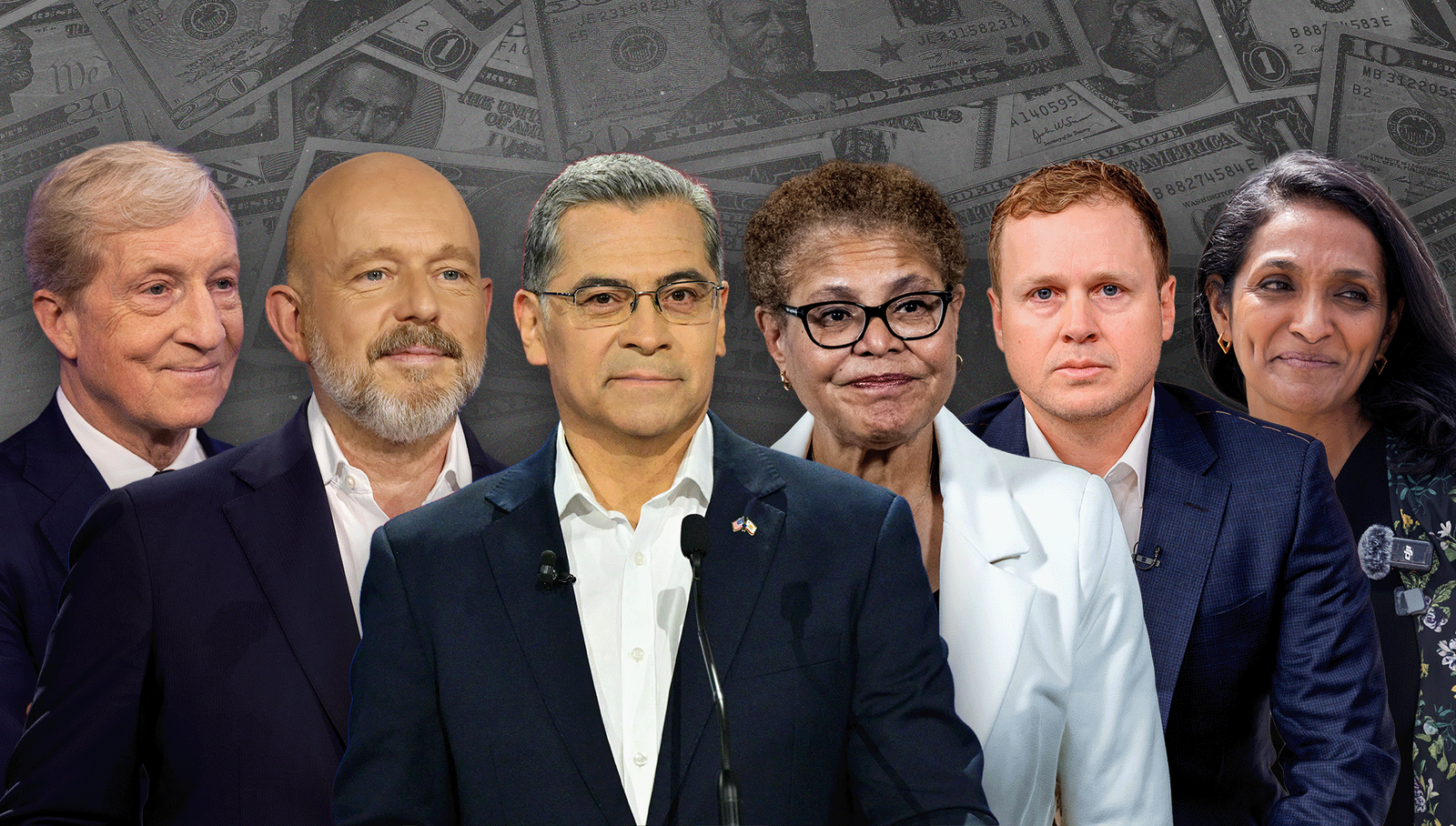
Nobody wins any major election in the United States without some financial backing. The big-time battles for California governor and Los Angeles mayor have brought out a slew of names and mountains of cash.
But do the votes always go where the money goes?
Tuesday’s primary election day will help answer that question.
While we don’t know exactly where the votes are going, we’ve got a pretty clear look at where the money did, and how much.
Self-funding
In the famous words of The Rolling Stones, “you can’t always get what you want.”
While the plan has worked in other states, self-funded billionaires running for public office in California haven’t won, at least not yet.

Tom Steyer, with a net worth of $2.4 billion, is trying to break that streak, and he’s doing so by spending enough money to single-handedly keep cable television alive in the Golden State.
He’s spent a whopping $213 million of his own money on this campaign. That’s the most ever for a primary and roughly more than five times the amount of money every other candidate has raised combined.
“He does not have to rely on corporations, individuals, independent expenditure campaign committees to get his message out,” Christian Grose, professor of political science and public policy and the director of the Democracy and Fair Elections Lab at USC, told Straight Arrow. “So, in some ways he can’t really be bought, but then also voters don’t trust a billionaire.”
Just ask Meg Whitman and Al Checchi.
Checchi, a former co-chairman of Delta Airlines, self-funded his gubernatorial campaign in 1998 but didn’t make it past the primary.
Whitman, spending $140 million of her own money, managed to get herself to the general election in 2010 but lost to former Gov. Jerry Brown.

Steyer appears to be headed down Checchi’s path, but he’s consistently polled in the top five, so anything is possible on Election Day.
“There is a reason he’s in the top three candidates right now, that money has worked,” Grose said. “He may come in third, and that’s quite a bit of money to be expended to end up not making it into the general election.”
His campaign is also now under investigation for payments to influencers.
Other funding
Other candidates in the governor’s race and the Los Angeles mayoral race have had to rely on more traditional ways of raising money for their campaigns.
Typically, politicians in California get money from several places, including Silicon Valley donors, unions and corporations.
Tech-wealthy donors poured a lot of money into San Jose Mayor Matt Mahan, who could not get his campaign off the ground despite raising around $13 million.
“He entered the race really late and raised a boatload of money quickly, and so that to me suggests that his campaign, or some other campaign that tech would have funded, may have done better with a longer time horizon,” Grose said.

The current favorite in that race is former U.S. Health and Human Services Secretary Xavier Becerra.
While he’s near the top of the polls, he’s not near the top of the financial list. He’s only reportedly brought in around $3.5 million.
“He wasn’t fundraising hardly at all,” Grose said.
But then, former Congressman Eric Swalwell’s campaign imploded and Becerra, who is one of the few candidates with decent name recognition, jumped to the front of the pack.
That’s where corporations started getting in line.
Their donations, which were going to Swalwell, have started moving towards Becerra.
“The reason there is, lobbyists are going to be much more likely in Sacramento to be able to reach Becerra, because they know him already,” Grose said.
The unions tend to spend quite a bit of money on get-out-the-vote efforts.
When it comes to spending on a candidate, they’ve been a bit split across the board.
“A number of unions have cross-endorsed Steyer and [Antonio] Villaraigosa and [Katie] Porter and Becerra,” Grose said.

The leading GOP candidate, Steve Hilton, has pulled in $4 million and has led the field in the number of donors.
Hilton has topped the polls at times in recent months, but it’s a tough path for a Republican to the governor’s mansion in deep-blue California.
LA Mayor
“Finances have made a difference, perhaps a little less than in the governor’s race, though LA is still a huge city that is an expensive one to run in,” Grose said.
The race to run Los Angeles has turned into a three-horse race between incumbent Mayor Karen Bass, city councilmember Nithya Raman and reality TV star Spencer Pratt.
Bass and Pratt are by far the leaders in terms of money raised.

The incumbent mayor, who’s been plagued by fallout from her response to last year’s wildfires, has pulled in roughly $3.13 million for her campaign, mostly at the start.
“Bass has raised a ton, which in part scared out some other potential candidates,” Grose said.
Pratt has brought in about $3.26 million, with most of that coming in the final reporting period.
Most of his money has come from individual donors, out-of-state supporters and his connections within the entertainment industry.
However, Los Angeles has not elected a Republican to run the city since Richard Riordan, who served from 1993 to 2001.
“[Pratt’s] message is resonating with conservative donors, but it’s not necessarily going to be enough,” Grose said.

Raman, who entered the race late, has only raised roughly $1 million for her campaign.
LA can be a very tough city to run for office in because it’s so big and so spread out.
Candidates need to find a way to communicate with potential constituents through TV, digital, social, mail and more. All of that costs money.
“You can’t do that without the fundraising, and so I think it’s going to make a difference, and maybe hurts Raman a little bit,” Grose said.
Money in politics
The average price of a gallon of gas in California is $6.01. That average jumps to $6.05 in Los Angeles.
Save Hawaii, California is the most expensive state to live in. Los Angeles is the most expensive city in the country by some metrics.

While people inside the state and city struggle with costs and ongoing inflation, they’re watching these candidates blow tens of millions of dollars on what will ultimately be, for many of them, for nothing.
“I think a lot of voters find the amount of money in politics frustrating,” Grose said.
However, Grose also has a slightly different look at that.
Typically, more than half the money spent in a campaign is on media and advertising.
In the case of Steyer, especially cable television, which really helps an industry that’s seen a massive decline over the last several decades. Those news outlets bank on political spending to keep newsrooms humming long after polls close.
Another 20-35% is often spent on hiring people, providing jobs.
“Yeah, maybe the money could have been spent on something better, but at least there’s some downstream societal benefits to it, right?” Grose said.
He added that the biggest issue with money in politics, and where most of the concern should be, is the purchase of influence.
Recent polling shows 72% of Americans, regardless of party affiliation, believe there is too much money in politics, with only 5% of people disagreeing.
“The pure dollar amount is concerning, but really the influence bought is more concerning,” Grose said.
Round out your reading
- Plea bargains keep America’s courts running. Guilt or innocence barely matters.
- Trump says the media isn’t covering one of his biggest accomplishments. We checked.
- Mike Lindell denied MyPillow was hacked. Its private data is now online.
- Red meat allergy rises with ticks as HHS targets Lyme disease, alpha-gal syndrome.
- We’re building a new Straight Arrow. Help us shape our future by taking our survey.