

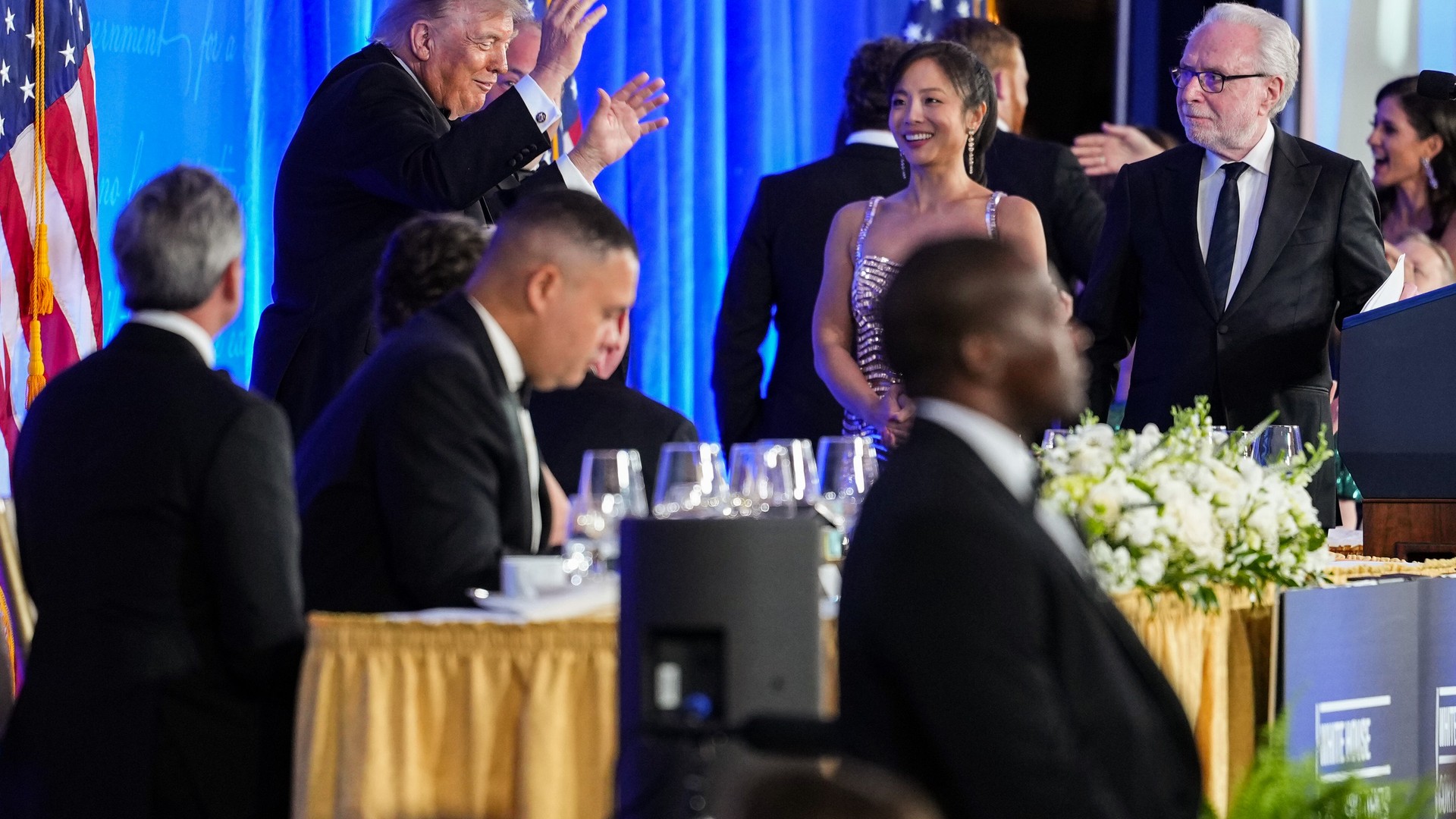
The White House Correspondents’ Association held a rescheduled dinner Friday, returning to its annual celebration of journalism months after a shooting interrupted the group’s April event and prompted renewed attention to political violence, press freedom and security around the presidency.
President Donald Trump attended the dinner and later addressed the audience, mixing praise for law enforcement and the association with jokes about the press and political rivals. He said the rescheduled gathering showed that Americans “do not yield to political violence” and said differences should be settled “not with bullets, but with open and vigorous debate.”
Outgoing WHCA President Weijia Jiang of CBS News said the association chose to continue the tradition after the earlier dinner was halted. She said journalists in the room shifted into reporting mode as law enforcement responded and administration officials gathered information.
“We are back,” Jiang said. “We will not be intimidated. We refuse to let an act of violence have the final word.”
The association presented service awards to the Washington Hilton staff and to Secret Service Officer Victor Gonzalez. Speakers said hotel employees remained at their posts during the April disruption and later helped preserve unserved meals for donation to local shelters. Trump also singled out Gonzalez in his remarks, saying the officer engaged the attacker without hesitation after gunfire struck his protective vest.
Jacqui Heinrich of Fox News, the incoming WHCA president, said political violence “must have no home in America” and described journalism as a public service that can broaden understanding and inform decisions.
Trump said he had wanted the April program to continue after the shooting but later agreed it made more sense to reschedule. He repeated the phrase “the show must go on,” saying the dinner’s return reflected resilience after the disruption.
His remarks also included criticism of news coverage of his presidency, references to his past decision not to attend the dinner while in office, and jokes aimed at journalists, entertainers and political figures. Trump said he believed he had been treated unfairly by the press but told the audience he respected many reporters and planned to return the next year unless coverage became “really, really nasty.”
The evening also included a tribute to the history of presidential press coverage and the First Amendment, including remarks and video segments about the role of reporters in questioning presidents and documenting government actions. One segment was identified from the stage as having used artificial intelligence.
The dinner also featured journalism awards. Andrew Harnik of Getty Images received the visual journalism award for a photo taken in the Oval Office. The Wall Street Journal received the Katharine Graham Award for Courage and Accountability for coverage of the Jeffrey Epstein scandal. This is the same coverage Trump unsuccessfully sued the Journal for defamation over.
The association also presented the Dunigan-Payne Award for Lifetime Achievement to photojournalists Melissa Young and Susan Walsh, citing their decades of work covering presidents, campaigns, disasters, wars and major world events.
In accepting the honor, Walsh said the award “means so much” and said she and Young were often the only two women in the White House travel pool. Young said she was proud to receive the award “for a lifetime of breaking barriers” and urged others to “keep up the good fight and tear down those walls.”
The event is the association’s primary annual fundraiser. It centers on themes of press freedom, public accountability and the continuation of a tradition that dates to the 1920s, when presidents began attending the correspondents’ dinner.
Round out your reading
- From Obama to Trump to Biden: When networks said ‘no’ to presidential speeches.
- ‘The end of American science as we know it.’ White House funding plan sparks alarm.
- AI data centers are popping up everywhere. What exactly do they do?
- The Trump administration is accused of breaking a law built to target the KKK.
- One Republican senator is dead, another is still alive. Both are the center of conspiracy theories.