

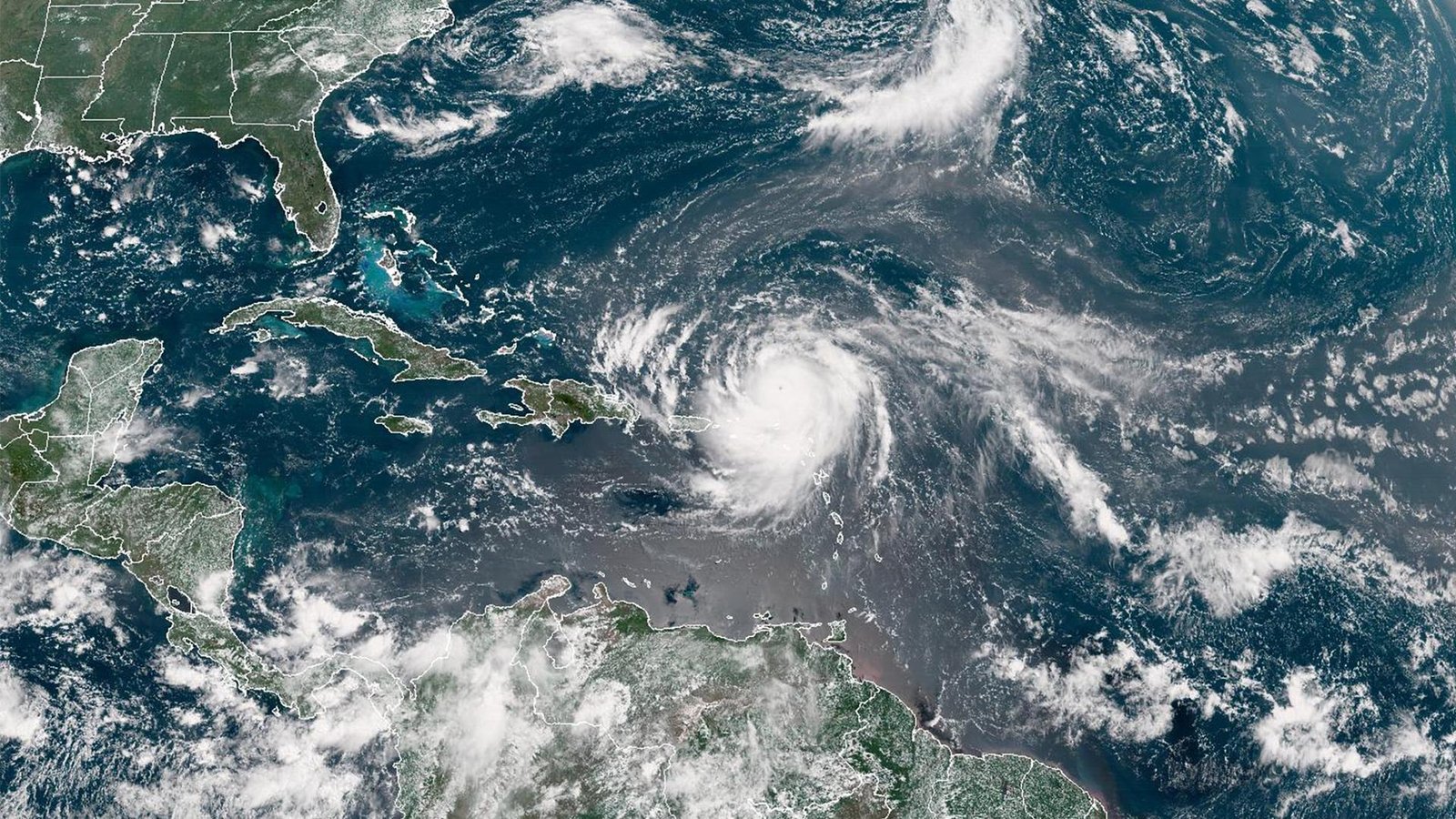
Monday is the official start of the 2026 Atlantic Hurricane season, with forecasters expecting a below-normal season this year.
The National Oceanic and Atmospheric Administration predicts a total of 8 to 14 named storms, three to six of which could become hurricanes, while AccuWeather forecasts 11 to 16 named storms including four to seven hurricanes. Some of these storms could make landfall in the U.S., AccuWeather said.
An average season, meanwhile, has 14 named storms and seven hurricanes.
No matter what kind of season it ends up being, Tyler Roys, a senior meteorologist with AccuWeather, told Straight Arrow it’s still important for people to be prepared.
“For any given location, it only takes one to really make it an impactful season,” he said.
What’s behind the below-normal season?
One of the biggest factors in the below-normal season is the developing El Niño, conditions which tend to support fewer storms and hurricanes, NOAA says. El Niño makes for stronger upper-level winds across the Atlantic, according to AccuWeather, which hampers tropical storms’ ability to take shape.
An El Niño happens when ocean temperatures in the Pacific Ocean near the equator warm up to over 0.5 degrees Celsius above average. If temperatures increase to 2 degrees Celcius above average, this could become a “Super Niño,” Roys said.
“Over the last several months, the atmosphere, and really the waters along the equator in the Pacific Ocean, have been warming up in the central and eastern parts of the Pacific Ocean,” Roys noted. He expects an El Niño to be declared by mid-to-late July.
“Although El Niño’s impact in the Atlantic Basin can often suppress hurricane development, there is still uncertainty in how each season will unfold,” NOAA’s National Weather Service Director Ken Graham said in a statement.
How to get ready for possible storms
As the hurricane season begins, there are ways people can prepare for potential storms.
The National Weather Service advises people know their zones, and if they’re in the Gulf or Atlantic Coasts, to see whether they live in a hurricane evacuation area.
Families should take a moment to sit down and decide how to get in contact with each other, where they will go, and what they will do in an emergency — before it happens, the NWS says. Roys suggests getting all important documents together.
Creating an emergency kit, with supplies such as water; food; flashlights; generators; first aid kits; extra batteries; whistles; local maps and cell phones with chargers and a backup battery, is a good idea as well.
It’s also a good idea to review insurance policies to make sure all property has adequate coverage, according to the NWS.
Roys says people should have ways to get weather information from multiple sources.
Is FEMA prepared?
As people gear up for the upcoming storms, on their own, some are wondering whether the Federal Emergency Management Agency is ready for hurricane season.
Sen. Bennie Thompson, D-Miss., and Sen. Timothy M. Kennedy, D-N.Y., sent a letter dated May 14 to Homeland Security Secretary Markwayne Mullin and FEMA acting administrator Bob Fenton, detailing their concerns.
“As the 2026 hurricane season approaches, we write to express our serious and growing alarm over the Federal Emergency Management Agency’s (FEMA) deteriorating readiness to protect the American people,” they wrote. “The Trump administration spent much of the past year systematically weakening FEMA — forcing out thousands of staff, halting critical preparedness programs, and stalling up to $17 billion in disaster relief funding.”
All this means that “by every available measure, FEMA is less prepared to respond than it has been in a generation,” Thompson and Kennedy wrote.
Fenton, though, said in an interview with CBS News that FEMA’s “ready for hurricane season.”
“This is something we do every year. It’s in our DNA,” he said. The news outlet noted, though, that his confidence also came with “caveats about the need for state and local governments to take the lead on recovery.”
According to the lawmakers, 5,000 FEMA employees have left the agency since January 2025 and nearly half of its top leadership roles are vacant. A Government Accountability Office report shows that last hurricane season, FEMA only started with 12% of its incident management workforce available.
Fenton said this year, numbers are healthier, and a “little bit over 30% of our disaster workforce is ready right now.” Between 30 and 40% are at normal availability, an estimated 30% have been deployed, and another 30% are in training, credentialing, on leave or otherwise assigned, Fenton said.
“I’m comfortable with where we’re at,” Fenton said. “We have a very experienced staff here.”
Fenton told CBS that the agency is still dealing with the fallout from the now-ended DHS partial government shutdown. The funding lapse had a “significant impact,” and FEMA is playing catch-up, Fenton said, adding, “but we play catch-up pretty quick here.”
After losing thousands of employees, Federal News Network reported that FEMA is now trying to fill hundreds of open positions. Two sources said to Federal News Network that senior leaders, during an all-hands meeting, announced a hiring freeze for FEMA has been lifted.
“We are aggressively hiring right now,” Fenton said in his CBS interview.
Round out your reading
- Tennessee officials will pay $835,000 for jailing man over Charlie Kirk meme.
- Why the immune system turns on women more often than men.
- More than 340 newspapers block the Wayback Machine. What that means for the future of the internet.
- Why Rep. Cohen filed articles of impeachment against Supreme Court Justice John Roberts.
- We’re building a new Straight Arrow. Help us shape our future by taking our survey.