

They’ve been around the moon and back, and finally splashed back down to Earth about a week ago. The Artemis II journey was a historic moment for the crew, NASA and the entire U.S.
Millions watched as the Orion capsule splashed down in the Pacific last Friday, with Navy crews pulling Reid Wiseman, Victor Glover, Christina Koch and Jeremy Hansen to safety.
Video of the splashdown shows Navy sailors shouting “welcome home” to the crew as the astronauts were all smiles and cheers.
-

RONALDO SCHEMIDT / AFP via Getty Images -

Danielle Villasana/Getty Images -

Apu GOMES / AFP via Getty Images -

Bill Ingalls/NASA via Getty Images -

Danielle Villasana/Getty Images -

RONALDO SCHEMIDT / AFP via Getty Images -

Bill Ingalls/NASA via Getty Images -

Bill Ingalls/NASA via Getty Images -

Danielle Villasana/Getty Images -

Bill Ingalls/NASA via Getty Images -

Bill Ingalls/NASA via Getty Images -

James Blair/NASA via Getty Images -

Bill Ingalls/NASA via Getty Images -

NASA via Getty Images -

Bill Ingalls/NASA via Getty Images -

Raquel Natalicchio/Houston Chronicle via Getty Images -

Bill Ingalls/NASA via Getty Images -

NASA via Getty Images -

NASA via Getty Images -

RONALDO SCHEMIDT / AFP via Getty Images -

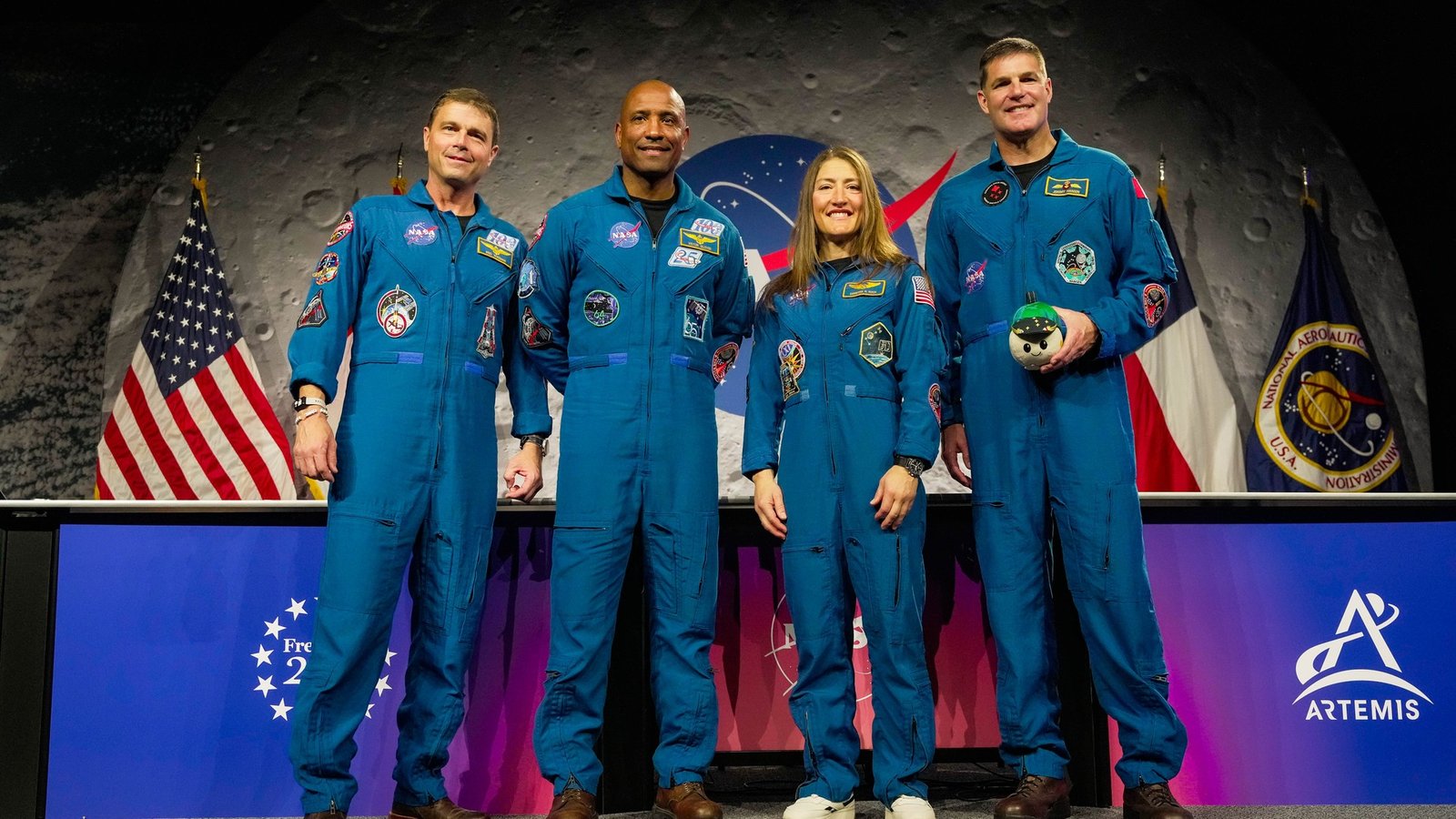
(L-R) NASA’s Artemis II mission astronauts, commander Reid Wiseman, Victor Glover, Christina Koch and Canadian Space Agency’s Jeremy Hansen attend a press conference at Johnson Space Center in Houston, Texas, on April 16, 2026. The astronauts did the first slingshot around the Moon in more than 50 years and traveled deeper into space than any humans before, culminating in a smooth splashdown on April 10 off the coast of California. (Photo by RONALDO SCHEMIDT / AFP via Getty Images)
An unbelievable experience
Now, the Artemis II crew is sharing what that experience was really like, both in space and when returning home.
The crew traveled farther than any astronauts in American history, and they say the experience forged a bond that will last a lifetime.
“This was an unbelievable adventure, and it was made possible by this crew and the support of each other throughout the whole thing,” Wiseman said. “And I’ve said it so many times, we are just, we are bonded forever. I mean, that’s the closest four humans can be and not be a family.”
Hansen described the feeling of being in space as “infinitesimally small.”
“We were all kind of struck by these things that make us feel small, and that the sense I had was the sense of fragility and feeling small and infinitesimally small. But yet this very powerful feeling as a human being, like as a group,” Hansen, a Canadian Space Agency astronaut, said.
For Koch, two moments stood out. First, seeing Earth from deep space, small and distant as they circled the moon.
“When I go to the beach now, I look up at the blue sky and imagine what it looks like from really, really far away, where it wasn’t an absolute, it wasn’t just a background of everything we see, it was small, compared to the universe around it,” she told CBS News.
And second, the return home. She said the reentry was so intense when the Orion capsule became a blazing fireball, almost impossible to look at as it tore back through the atmosphere.
What comes next for space travel?
Now, NASA shifts to the next step.
Artemis III — set for next year — will keep astronauts in Earth’s orbit as they practice docking the Orion capsule with a commercial lunar lander.
That’s a critical step before any return to the moon.
And after that, Artemis IV, targeting 2028, could put astronauts back on the lunar surface for the first time since Apollo 17.