

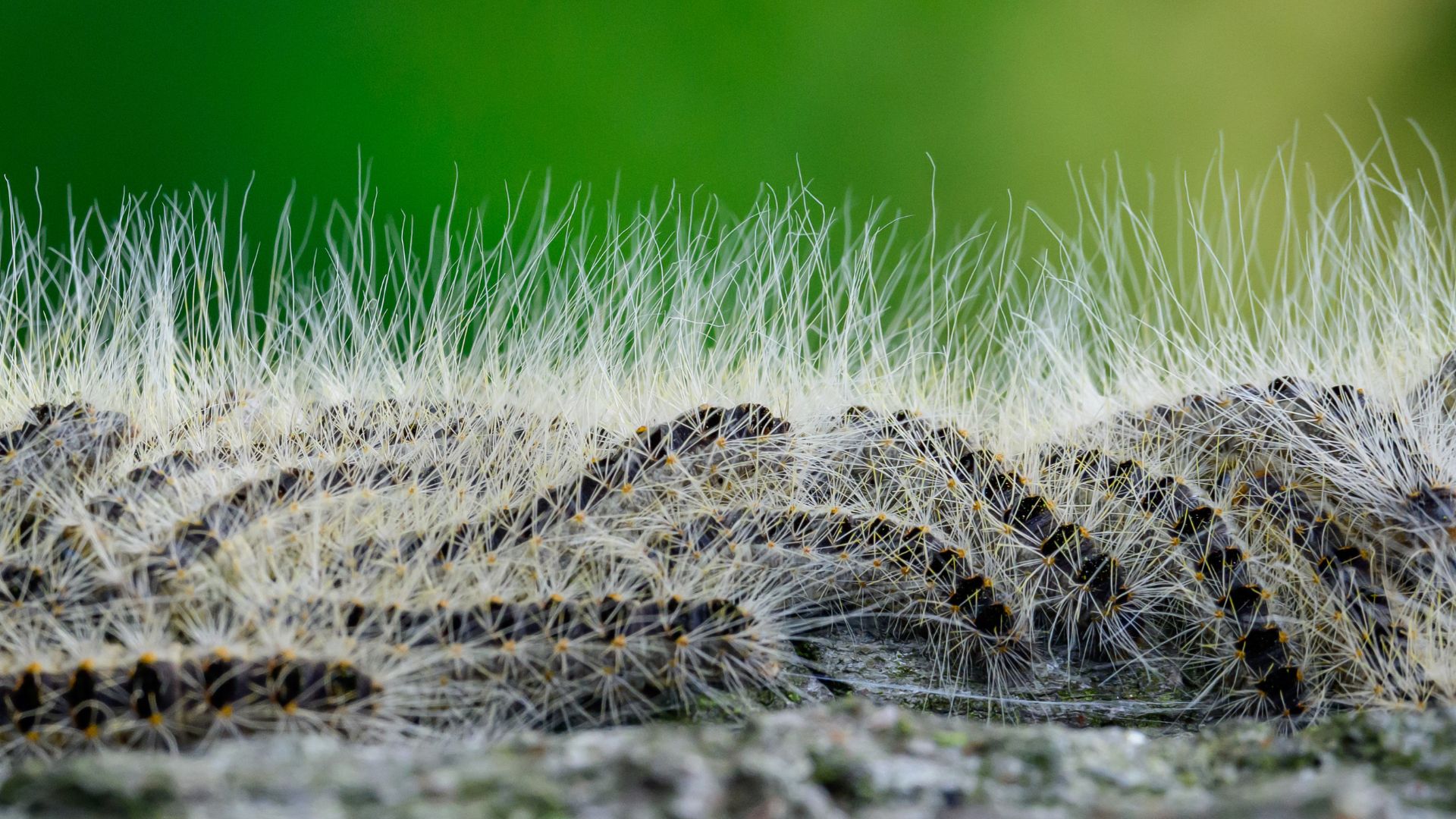
As Germans flock to parks and other shaded venues to escape the record-high temperatures swamping Europe, they’re encountering another problem: caterpillars.
These aren’t just any caterpillars — they’re the larvae that become oak processionary moths, a type of caterpillar with hundreds of thousands of little venomous bristles that can irritate the skin when touched and cause even worse issues if inhaled.
The issue has gotten so bad in some parts of Germany that officials have told residents to keep windows closed so the caterpillars’ hairs don’t fly in from outside, which is a hard ask when the majority of the country doesn’t have air conditioning.
What makes these caterpillars so bad?
The hairy defensive trait of oak processionary moths is almost exclusive to moths and butterflies among insects. Although not insects, some large spiders also have this trait.
But oak processionary moths take this trait to a whole new level. Not only can one caterpillar carry up to 700,000 microscopic bristles on its body, but those bristles can stay around for a long time — sometimes for years.
Even after the caterpillars pupate and turn into moths, their barbed bristles can remain in the area and still affect people, pets and livestock.
The bristles contain a toxic protein called thaumetopoein, which is only found in processionary moths. The protein causes rashes, conjunctivitis and even breathing problems if a person inhales it. In rare cases, an allergic reaction can lead to anaphylactic shock.
Wind can also cause the bristles to travel far from where the caterpillars are and cause even more problems.
The name processionary comes from how the caterpillars travel, which is in long, uniform lines, like a procession. These lines lead to massive, silky-white colonies under tree branches, which make the bristle issue even worse.
Berlin city officials told CNN that the caterpillars had infested at least 2,000 trees in Jungfernheide, the city’s second-largest park, and were closed off with crime scene tape. One official emphasized that the city had no way to eradicate the caterpillars and was only working to limit the damage they caused.
What areas are impacted?
To highlight just how bad the caterpillar issue is, the official said that a team equipped with hazmat suits and vacuum cleaners can clear about 20 trees per day. However, that’s not always the case, since one crew spent an entire day clearing hundreds of nests off just one tree.
Multiple areas of Berlin have reported the insects, including the western district of Spandau, where authorities urged residents to avoid a popular park and nearby areas as the government works to remove the pests.
The caterpillar is native to Germany and other parts of central and southern Europe, making this an annual issue the country has dealt with. But in recent years, the frequency and severity of the infestations have increased.
Data from the Oak Processionary Caterpillar Knowledge Center indicates that moth sightings have risen to 6% this year, compared to 4.5% during the previous year.
But the moths are inching their way into more northern territories of Europe, like the United Kingdom, where the species is invasive and a much bigger problem. Research has also pointed to global climate change as a secondary reason for the recent invasive spread. A study published in Springer Nature suggests that by 2050, climate change may allow the moths to spread even further north.
Is the US at risk?
U.S. researchers are closely monitoring the oak processionary moth’s spread in Europe, but luckily it has not made its way across the Atlantic — yet.
Scientists believe that the moths were introduced to the U.K. through the timber trade, and the U.K. heavily restricts its oak trade to combat the spread. But U.S. researchers believe that if the moth somehow made its way stateside, it would have the right environment to establish itself.
But the U.S. has other dangerous caterpillars already within its borders. The most similar to the oak processionary moth is the browntail moth. Both moths share similar irritating bristles that can easily travel on the wind and remain in the environment for years. They are also both communal and group together in trees. Browntails are invasive and are primarily constrained to Maine and Cape Cod, Massachusetts.
The primary distinction between the species is the sheer volume of bristles. The oak processionary moth generates significantly more than its browntail counterpart.
Round out your reading
- America at 250: Straight Arrow’s week-long look at the pressures testing modern America.
- Ketamine is booming in America. The reasons go beyond drugs.
- Cluster of AI news sites suddenly goes dark after human reporter starts asking questions.
- A 79-year-old, obese, well-connected man gained exclusive access to a new weight loss drug. Is it Trump?
- Newsom pushes national wealth tax after opposing California billionaire tax.