

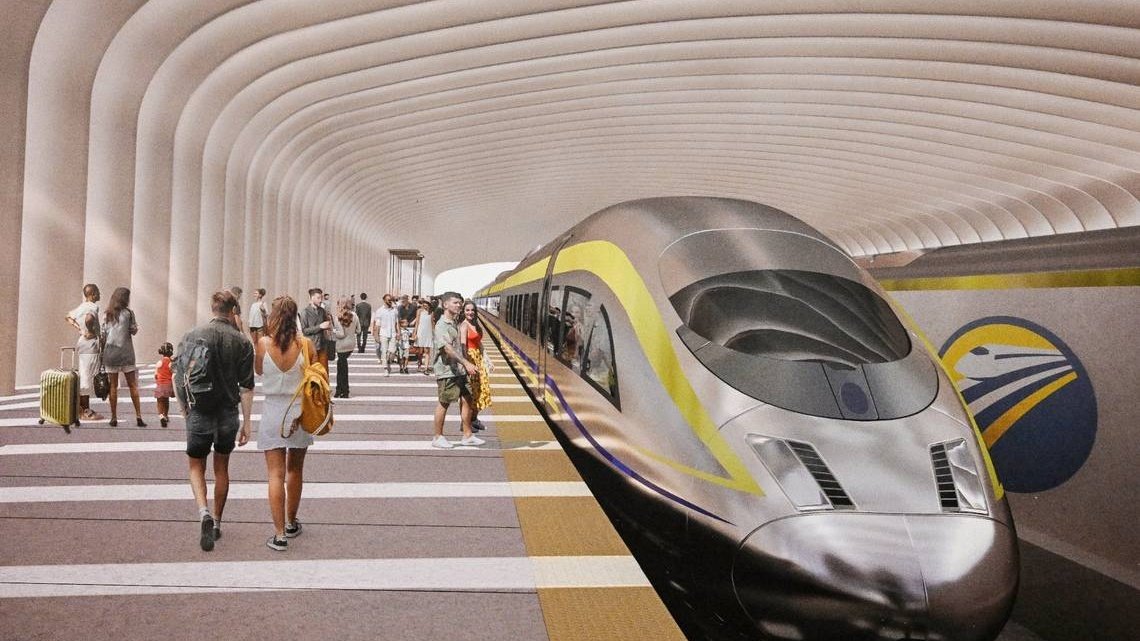
California’s decades-long plan to move people by train at high speeds has been anything but high-speed. The latest plan from the California High-Speed Rail Authority has several issues that have lingered for two decades. Now, a new issue potentially violates state law.
At a hearing earlier this week, California’s Senate Transportation Committee warned the group that its latest business plan may not include details required by state law.
“I am concerned that the authority appears to be making strategic decisions about what information it shares in annual reports,” project Inspector General Benjamin Belnap said, according to KCRA.
That warning caused the Authority to postpone a vote on the business plan that it released in February.
California High-Speed Rail Project
The original goal of this project was to connect cities like Los Angeles and San Francisco with a train that could reach speeds of 200 miles per hour.
The hope was to ease some of the state’s car congestion, greenhouse gas emissions and lower pressure on airports.
Originally introduced in 2008, the project has faced delays, cost overruns, political debates and more. The original cost estimate was $33 billion.
“And ever since then, there’s been this constant problem of trying to seek revenue to get the project started,” Genevieve Giuliano, distinguished professor of public policy at the University of Southern California, told Straight Arrow.
Legal issue
The latest major issue comes in the form of a potential state law violation.
According to the committee the new plan fails to show several required details required in California Proposition 1A, which governs this project, including:
- A complete funding plan.
- A path to a “usable segment” (meaning a plan to build at least part of the train that will work before the whole project is done).
- Assumptions on ridership and revenue.
- A specific timeline.
- Details on environmental and operational readiness.
“This project never did its homework,” Giuliano said.
At the moment, this is just a warning from state lawmakers and there’s no official legal violation.
It’s not the first time this project has had legal issues. In 2013, a judge ruled the plan had the same issue it’s being accused of now, specifically a lack of a financing plan.
That was overturned just a year later, and in 2021, a state appellate court found the project did not violate the law.
The project has also faced several lawsuits with accusations of legal violations.
Other issues
Remember that $33 billion price tag? It’s now ballooned to between $126-$231 billion.
While officials stress that the initial $33 billion wasn’t going to build the entire line, the latest estimates are multiple times those from years past.
The new goal is now to spend $36 billion for a usable segment that runs between Bakersfield and Merced, a train that would run back-and-forth from the ninth most populous city in the state to the 87th.
“Even if we get this thing built between Merced and Bakersfield, you’re not going to see a lot of people on the trains because there aren’t that many people that travel between Merced and Bakersfield,” Giuliano said.
She believes demand has been part of the issue since the beginning, which is why the private sector isn’t stepping in to help fund it.
Even when this project was proposed, the plan was to bring in private sector investment once a viable plan was laid out.
“There’s not enough demand to be expected to generate enough revenue to offset these investments,” Giuliano said.
The High-Speed Rail Authority believed more people would make that journey using their train instead of cars and buses.
Not having private-sector funding has left the project’s financial component in the hands of the state and federal governments.
However, the federal government has provided limited assistance. President Donald Trump is famously critical of super-blue California and has taken several actions, including cutting $4 billion in grants for the project.
While high-speed rails are popular in many places around the world like China, they’re less common here in the U.S. This project would be the first of its kind in the country that can reach those kinds of speeds.
“It’s a new technology and a new kind of construction for California,” Giuliano said. “So, we don’t have highly experienced construction companies that do this kind of thing.”
What’s next?
There have been some attempts to kill this project outright, especially from Republican members of the state legislature. Governor Gavin Newsom has questioned it but never tried to end it.
“Once you start a project like this, it’s very hard to un-start it,” Giuliano said.
So, the project will continue to move more like a lazy river than a high-speed rail.
“We’re going to continue to limp along,” Giuliano said.
That Merced to Bakersfield segment would be the first to go into production.
However, another issue with the latest plan is that the authority wants to relocate the station in Merced. It was originally supposed to be downtown, but the new proposal suggested a move to a more suburban area.
The hope was to save nine miles on rail, but that plan also lacked details.
If/when that segment gets built, the project may have a better chance of bringing in private investment dollars. But as this project continues to move at a snail’s pace, there is at least one thing project officials can hope for.
“There will be some hope that they can keep moving long enough for this administration to leave office, so that they can get some money from the feds in the next Transportation Act,” Giuliano said.
Round out your reading
- Scientists unearth new evidence on how the Grand Canyon was shaped.
- Why the Army is adding a second fitness test for combat.
- Illegal midwives, growing demand: The fight over home birth in America.
- 40 years after Chernobyl, the U.S. pushes nuclear power once again.
- We’re building a new Straight Arrow. Help us shape our future by taking our survey.