

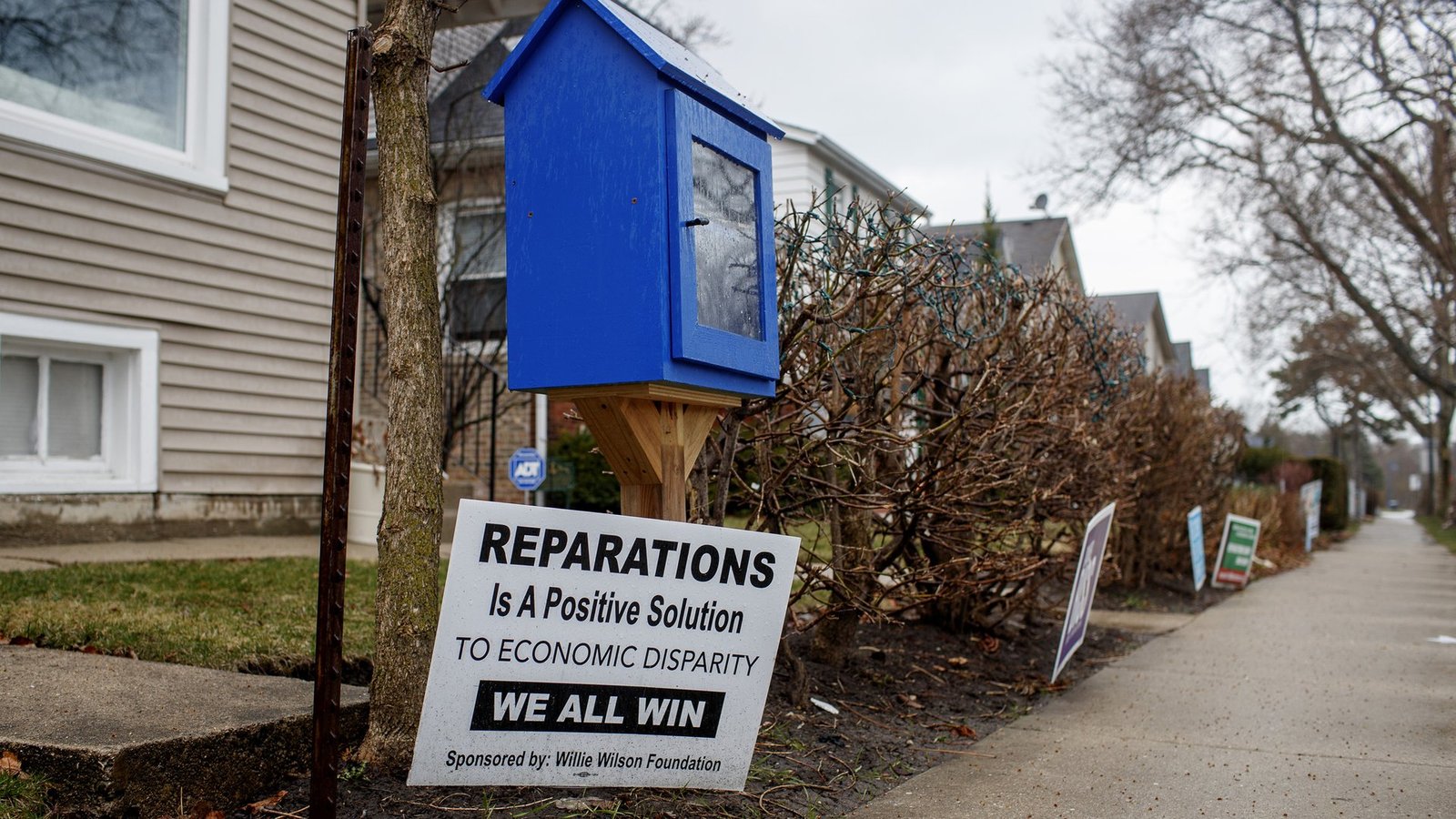
The federal government is stepping into a legal battle against a suburban Chicago town’s plan to send millions of dollars in reparations to its Black residents.
The Justice Department intervened in a lawsuit that alleges Evanston is violating the Fair Housing Act and the Equal Protection Clause with its reparations program for Black people. The city started the program as a way to compensate Black people for the city’s deliberate patterns and practices of discrimination.
Federal prosecutors joined a lawsuit that conservative group Judicial Watch filed in 2024 to stop Evanston’s program from moving forward. Harmeet Dhillon, assistant attorney general of the Justice Department’s civil rights division, said in a Tuesday release that issuing payments based on race “is not the answer.” She added that using the funds to assist people with housing violates the Fair Housing Act.
The city’s program, started in 2019, sought to compensate Black residents who lived in Evanston from 1919 to 1969 and their descendants who were affected by segregation in schooling and housing. The city didn’t explicitly name which laws were discriminatory, but said officials participated in redlining. The practice kept Black people out of recreational centers and kept Black doctors out of the city’s only two hospitals.
The city didn’t immediately respond to Straight Arrow’s request for comment. City attorneys sought to dismiss the lawsuit, but a federal judge allowed it to proceed in March, according to court papers.
City officials approved $10 million in reparations for affected residents and their families, with each receiving a maximum of $25,000. Funds came from the city’s cannabis tax. According to the city, applications for reparations are closed with no indication they’ll reopen.
So far, the city has dispersed $5 million in compensation, the Justice Department said in court papers.
“Evanston hands out $25,000 government payments to blacks only—and the Constitution flatly forbids this kind of racial discrimination,” Judicial Watch President Tom Fitton said in a release. “We are happy that the United States is following our lead and welcome it as an ally in this historic lawsuit against a woke, racist program.”
Judicial Watch contends that Evanston doesn’t have a rigid application process to verify people’s residency or the harm they experienced from the city.
Federal government issues reparations regularly
Evanston isn’t the only place with ongoing reparations efforts. The federal government has ongoing reparations efforts, one of the most popular being the Native American Graves Protection and Repatriation Act, which was signed into law in 1990 to shield graves and return remains, sacred objects or funerary items to tribes.
Two years prior, former President Ronald Reagan signed the Civil Liberties Act of 1987, which acknowledged the harm that internment camps caused Japanese Americans in World War II. The act also pardoned those Americans and Japanese immigrants who violated laws surrounding internment and established a restitution process.
The law tasked the U.S. Attorney General with identifying each affected person to receive $20,000 in reparations. The program ended in 1999 after paying out more than $1.6 billion to more than 82,250 Japanese Americans and immigrants interned during the war, the Justice Department said in a Feb. 19, 1999, release.
“The U.S. Government recognized the injustice of its actions during the war and provided a presidential apology and compensation,” then-Attorney General Janet Reno said in the release. “It was a time when we took away the liberty of an entire community of Americans.”
Federal efforts to offer compensation to Black people have stalled over time. The latest effort has stalled in the Senate and House of Representatives. Both bills are in the respective chambers’ Judiciary Committees.
As for states, California, North Carolina and Virginia established reparations programs for people forcibly sterilized under the state. Sterilization often happened in state-run hospitals as a means to solve poverty or prevent disabled people in state hospitals from reproducing.
North Carolina ended claims in 2014, according to the state Department of Administration. Virginia’s program is ongoing for people involuntarily sterilized and were living as of February 2015. The state’s Department of Behavioral Health and Developmental Services said in an April 30 release that $800,000 has been dispersed to 32 people, and no one applied in 2025.
California stopped accepting applications for its compensation program for people forcibly sterilized on Dec. 31, 2023, according to the state Victim Compensation Board.
At the local level, Palm Springs completed its $5.9 million compensation to survivors and descendants of Section 14, which was a program that forcibly displaced citizens of the Agua Caliente Band of Cahuilla Indians.
Round out your reading
- Could a common dietary supplement accelerate Alzheimer’s?
- NY AG Letitia James gets hundreds of taunts, racial slurs in ICE public reporting portal.
- As Musk becomes the first trillionaire, historian sees warning signs.
- An experimental weight loss drug is so effective, many Americans don’t care it’s not FDA approved.
- How search engine optimization reduced Simone Biles to an ‘NFL wife’.