

Any parent who’s dropped their kids off at school has had that moment of fear about an active-shooter event.
One company thinks drones with non-lethal weapons to apprehend suspects is the answer.
Campus Guardian Angel is testing this through pilot programs in Florida and plans to roll out another test in Georgia.
Earlier this month, Volusia County Schools, one of three districts participating in Florida’s pilot program, hosted a live demonstration of the drones at Deltona High School. The three districts received $557,000 for the program via funding from the Florida Legislature.
Justin Marston, CEO and founder of Campus Guardian Angel, told Straight Arrow that everybody at the demonstration was excited to see the drones in action. Volusia County Sheriff Mike Chitwood called them “the future.”
“There is no experience like being in the room and seeing how fast these things move, how maneuverable they are,” Marston said.

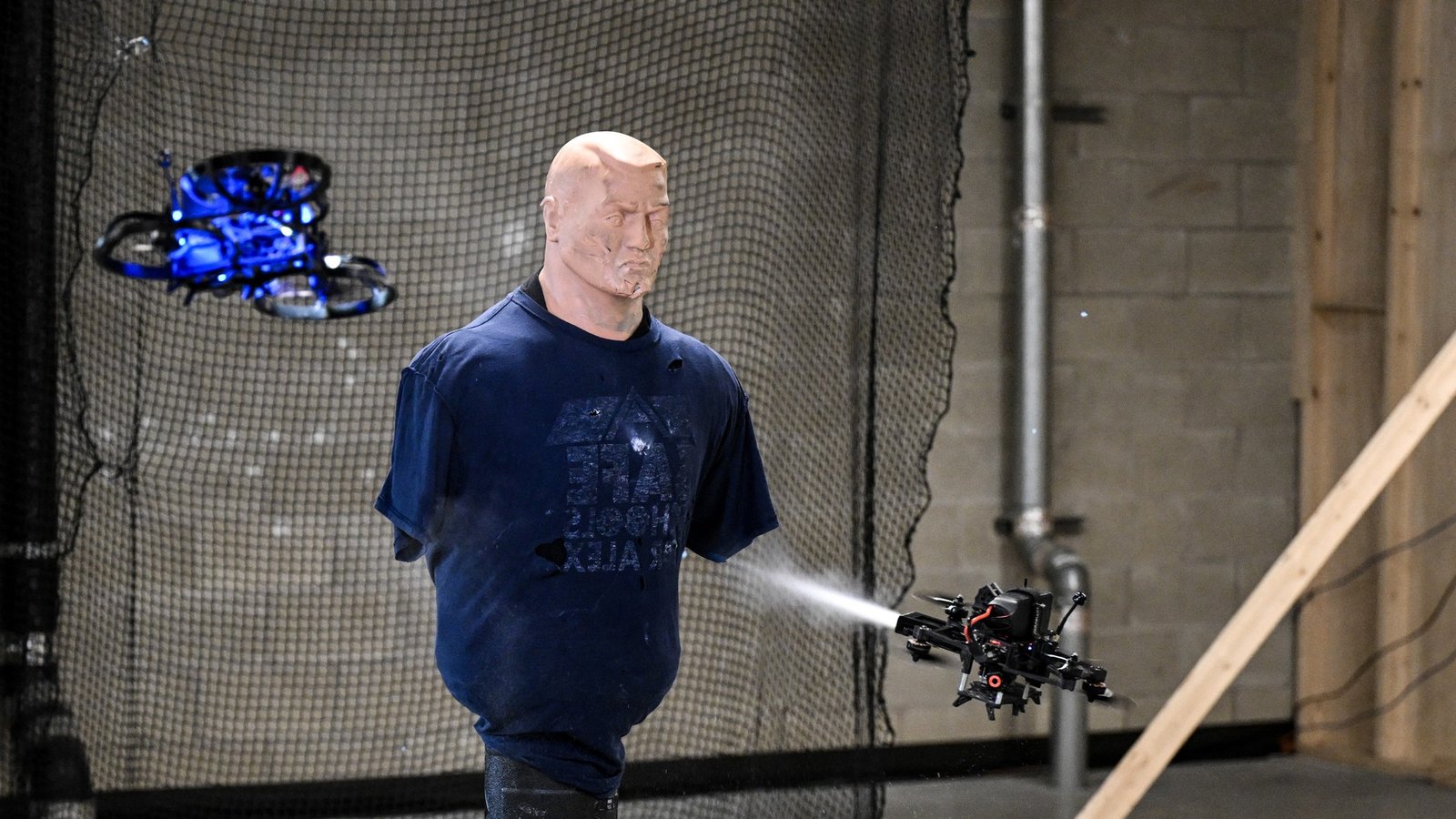
Campus Guardian Angel touts how the drones, which are stored at the schools and operated in its Texas headquarters, can get to a suspect faster than outside law enforcement and then subdue them with sirens, pepper gel and other distraction devices.
But with this technology comes some concerns.
“There are just so many variables, and a high risk of unintended consequences,” Kenneth Trump, President of National School Safety and Security Services, which specializes in school security and emergency preparedness, said in an interview with Straight Arrow.
How this works
Marston said the idea for using drones came after seeing how long it took police to respond during the shooting at Robb Elementary in Uvalde, Texas. He also noticed how effective the use of small drones has been for Ukrainians in the war with Russia.
The way it works is that when someone at a school sees someone with a weapon, they press a panic button that notifies the Campus Guardian Angel’s team at their operation center in Austin, Texas.

The team includes drone pilots, one of whom finds the school resource officer and talks to police arriving on scene. There’s a threat tracker whose job is to find the person with the gun and monitor them as they move around. One person looks at the video cameras in the schools, picks the best angles, and shares those with the rest of the team and law enforcement. Another member of the team is a tactical commander, typically one who has done hostage rescue in real life, either in elite special forces or SWAT, according to Marston. Then, four liaisons speak to police officers on site, teachers, and the people who reported the threat.
Once operators identify the target, drones deploy pepper spray, as well as lights and sirens to subdue an attacker.
The goal, Marston said, is to respond in five seconds, be on the shooter in 15 seconds, and incapacitate them in 60 seconds.
“During a lot of these shootings, you have this period of chaos where nobody knows what’s happening, and it all happens so fast,” Marston said. “So our whole focus is training for those 120 seconds and bringing the best possible team with the best possible picture of all of the sensors and all of the data together in one place, so that we can kind of triage it, figure out what’s happening, figure out the best response, get to that threat as quickly as possible.”
Chris Curran, a professor of educational leadership and policy at the University of Florida, said along with being faster, another benefit of drones is that they can make the situation safer for law enforcement.
Rather than having a human be the first to enter the room with a potential shooter, a drone is, he pointed out.
As Marston said, a “lump of plastic” can take risks people can’t.
Still, experts Straight Arrow spoke with, including Curran and Trump, raised concerns that the drones could target the wrong person.
“The theory approaching this appears to be that you know the suspect’s going to be very visible and distinguishable and easy to find and isolated, and everybody else is going to be out of the hallway,” Trump said. “That’s not necessarily going to be the case, especially in those initial moments as an incident unfolds.”
Marston says the key thing to understand about Campus Guardian Angel is that all of the drones are flown by humans, and are commanded by a tactical operations commander with at least a decade of hostage rescue experience. This gives them the institutional knowledge to pinpoint who the suspect is, and when they are getting ready to shoot, Marston said.
Jay Stanley, senior policy analyst with the American Civil Liberty Union’s Speech, Privacy and Technology Project, says justifying the use of these drones can open up the door to more entities using them, including police.
“Once you open up that door, it becomes very easy and remote and low-risk for officers to use force with a drone,” Stanley said. “They’re likely to be overused by officers in the way that we’ve seen tasers overused. Tasers are supposed to be a replacement for guns. Instead, they become, often an additional tool or sometimes a torture device or a means of punishing people.”
Another question is whether someone, including a student, could hack into the system, Stanley mentioned.

Marston says Campus Guardian Angel has many layers of security around how the drone is managed, as well as a classified network.
“It’s not one thing. It’s called a defense in-depth architecture,” he said. “You don’t want to bet the farm on one security mechanism. You want to have a whole bunch of them so that if one fails, another one still keeps you safe. And so we thought about a lot. We are very paranoid of someone being able to take control of our drones, because that would, obviously, be catastrophic.”
Lack of research
One aspect some point out is the lack of concrete research into the effectiveness of drones.
“The question is — does this actually work to prevent shootings, either to prevent them actively while they’re going on, or to prevent them from happening in the first place?” Charles Branas, the chair of Columbia University’s Department of Epidemiology, said. “And that’s a testable research question that needs to be funded and thought through.”
Then again, federal research into gun violence prevention tactics in general has arrested, Branas, who is leading studies looking into school hardening tactics, added.
A provision called the Dickey Amendment, passed in 1996, prohibited the use of federal funds for research that could be used to advocate for stricter gun laws. Later legislative developments clarified that the amendment does not prohibit federal funding to researching the cause of gun violence. The Centers for Disease Control and Prevention and National Institutes of Health subsequently gave out grants for studies looking into gun violence. The Bipartisan Safer Communities Act was passed in 2022, authorizing billions of dollars in funding for violence prevention, mental health, and school safety.
However, the Trump administration has since terminated, redirected or delayed more than $1 billion in federal grants related to gun violence, according to an analysis by The Trace.
Without research, Stanley said, the question becomes how much schools are spending on a tool like drones of unknown effectiveness — and whether that money might be better spent.
Currently, the Campus Guardian Angel drone system is priced based on square footage. For most schools, that works out to be about $8 a student if they don’t buy the hardware upfront, Marston estimates.
What are other solutions to school shootings?
Additionally, focusing on these school-hardening tactics may also take the focus off more effective, simpler solutions.
Trump, who has worked as an expert witness on civil litigation lawsuits in state and federal court after shootings occur, says that while the facts and merits of each incident vary, one of the common threads is that many of the complaints he sees involve allegations of failures due to human factors.
These include policies, procedures, training, communications systems gaps — not alleged failures of hardware products and technology, Trump said.
“One of the biggest vulnerabilities you have is people still propping open doors or letting people piggyback,” Trump said. “So we’re talking about drones, and we’re still focusing on people to get the fundamentals that will actually save their lives.”
When it comes to preventing school shootings, Branas says people look at places that have gone through them to study what went wrong. But something that would be valuable, Branas said, is looking at schools that didn’t have them. From an epidemiological or public health standpoint, “only looking at the patients that have the disease tells you only half the story,” Branas said.
“It’s hugely important that we enroll not just schools that experience these horrible tragedies, but schools that did not,” Branas said. “We begin to think about, ‘what did they do that might be different from the schools that experienced it?’”
Curran said he has had conversations with Campus Guardian Angel about evaluating the drones.
“We’re hopeful in the coming months, and as they move forward with implementation this fall, to have a piece that’s collecting data from teachers and students and other stakeholders about the impact of it and the perceptions of it as it gets pulled out,” Curran said.
What’s next for Campus Guardian Angel
Marston says Campus Guardian Angel is building four rooms in Austin, which can hold six to eight teams.
“We’re building out this center here, first in Texas, but we plan to build something on the East Coast,” he said. “Florida is attractive given all the relationships we have there, and then probably one on the West Coast, or all the all the way over in Hawaii, but somewhere that gives us time zone coverage.”
To Curran, “it’s unfortunate that we need to have that conversation” about shootings in the first place.
“Schools should be a place where students feel safe, and where gun violence is not something that anyone has to worry about in the school environment,” Curran said.
Round out your reading
- They built an Epstein files library, but realized they couldn’t let everyone read them.
- The doctor who claims functional medicine reversed her MS.
- For many Americans, ‘one more round’ no longer serves their lifestyle or budget.
- Trump claimed economic data is ‘rigged.’ Former officials pledge to ‘watch like hawks’ for political manipulation.
- We’re building a new Straight Arrow. Help us shape our future by taking our survey.