

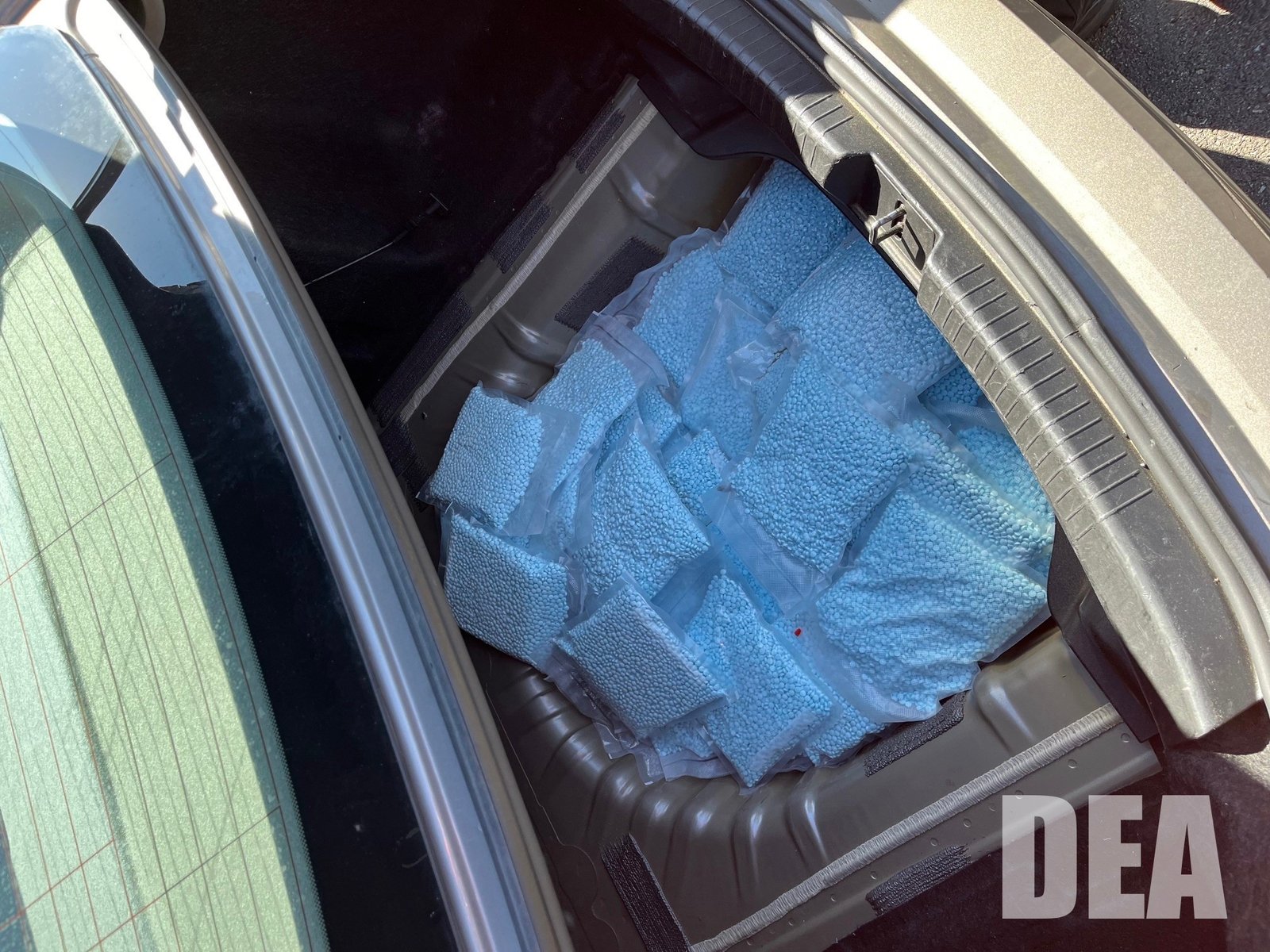
Last week, the Drug Enforcement Administration recognized National Fentanyl Awareness Day with a memorial shining a spotlight on lives lost to the opioid epidemic.
Federal law enforcement officials warn that fentanyl is no longer the only drug parents need to fear. Increasingly, a far more potent synthetic opioid is appearing. Carfentanil is a substance so powerful it is measured in grains smaller than salt and can be lethal in nearly invisible amounts.
Although fentanyl-related deaths have declined slightly in recent years, the drug remains the leading cause of death among Americans ages 18 to 45, according to the DEA. Six months ago, the agency launched its Fentanyl Free America initiative to further combat the crisis.
“We will never forget the lives lost and the families forever changed by this devastating crisis,” said DEA Administrator Terrance Cole. “National Fentanyl Awareness Day serves as a reminder of the urgent need to come together, educate our communities, and intensify our fight against fentanyl — a weapon of mass destruction that continues to kill Americans every day.”
But even as fentanyl remains the central focus of prevention and enforcement efforts, DEA officials say traffickers are increasingly turning to other synthetic opioids. None are more dangerous than carfentanil.
What is carfentanil, and why is it so dangerous?
Carfentanil is a synthetic opioid originally developed as a tranquilizer for elephants and other large mammals. It is approximately 100 times more potent than fentanyl and 10,000 times stronger than morphine, making it one of the most powerful opioids known.
“It’s essentially fentanyl on steroids,” said Jonathan Pullen, associate chief of operations for the DEA’s South Central Region, during a recent interview with Straight Arrow. “Carfentanil is about 100 times stronger than fentanyl. In incredibly small amounts, it can be lethal to humans.”
To put that in perspective, a potentially fatal dose of fentanyl is roughly two milligrams, about the size of a few grains of salt. Carfentanil is lethal at fractions of that amount. The quantities are so small they may not even be visible to the naked eye.
Because of its extreme potency, carfentanil poses an especially serious risk not only to users, but also to first responders and law enforcement officers who may unknowingly come into contact with it. The drug can be absorbed through the skin or accidentally inhaled, and exposure symptoms can begin within minutes.
Carfentanil often hidden in other drugs
DEA officials say carfentanil is rarely sold on its own. Instead, it is typically mixed with other drugs, including fentanyl, heroin, methamphetamine and cocaine. In many cases, users have no idea they are consuming it.
“We’re seeing carfentanil mixed into stimulants like cocaine,” Pullen said. “Someone thinks they’re using cocaine, and what they actually get is a lethal dose of carfentanil.”
That deception is at the heart of the growing danger. According to the DEA, drug trafficking organizations like the Sinaloa Cartel and the Jalisco New Generation Cartel (CJNG) are pressing synthetic opioids into counterfeit pills that are nearly indistinguishable from legitimate prescription medications.
Fake oxycodone, Percocet, Xanax and even Adderall tablets are flooding the illicit market, often stamped with familiar markings such as “M30” or dosage numbers that give users a false sense of safety.


“These pills look real,” Pullen said. “Even trained professionals sometimes need lab tests to tell the difference. The average person on the street has no chance of knowing what’s actually in them.”
Rising presence across the US
While fentanyl remains far more prevalent overall, carfentanil has been increasingly detected in drug seizures and overdose deaths, particularly in the western and south-central United States.
DEA officials confirmed carfentanil-related activity in Texas, Colorado, El Paso, Dallas and Houston, including a fatal overdose in Houston in 2018 involving a Rice University football player. Significant seizures of carfentanil pills were also reported in 2024.
“It’s not everywhere at the same level as fentanyl — but it’s popping up more often,” Pullen said. “That trend alone should worry everyone.”
Compounding the problem, carfentanil is just one of several emerging synthetic opioids now appearing in the market, as traffickers adjust to tighter controls on fentanyl precursor chemicals. Other substances, including nitazene analogs, xylazine and cyclororphine, have already been linked to deaths in parts of the country.
“The drug market is evolving,” Pullen said. “As we pressure one substance, they pivot to another. There’s always something new, and it’s usually more dangerous.”
A message for parents and communities
The DEA says one of its most urgent messages this Fentanyl Awareness Day is directed at parents, educators and young people: never trust pills that don’t come directly from a licensed medical professional.
“We hear the same heartbreaking stories over and over,” Pullen said. “A teenager takes a pill from a friend — something they think is safe — and they don’t wake up the next morning.”
DEA officials stress that a single counterfeit pill containing fentanyl or carfentanil can be fatal, even to someone with no prior drug use.
“If you didn’t get it from a doctor or a pharmacist,” Pullen said, “you should assume it contains fentanyl — and assume it could kill you.”
Round out your reading
- Scientists unearth new evidence on how the Grand Canyon was shaped.
- Why the Army is adding a second fitness test for combat.
- Illegal midwives, growing demand: The fight over home birth in America.
- 40 years after Chernobyl, the U.S. pushes nuclear power once again.
- We’re building a new Straight Arrow. Help us shape our future by taking our survey.