

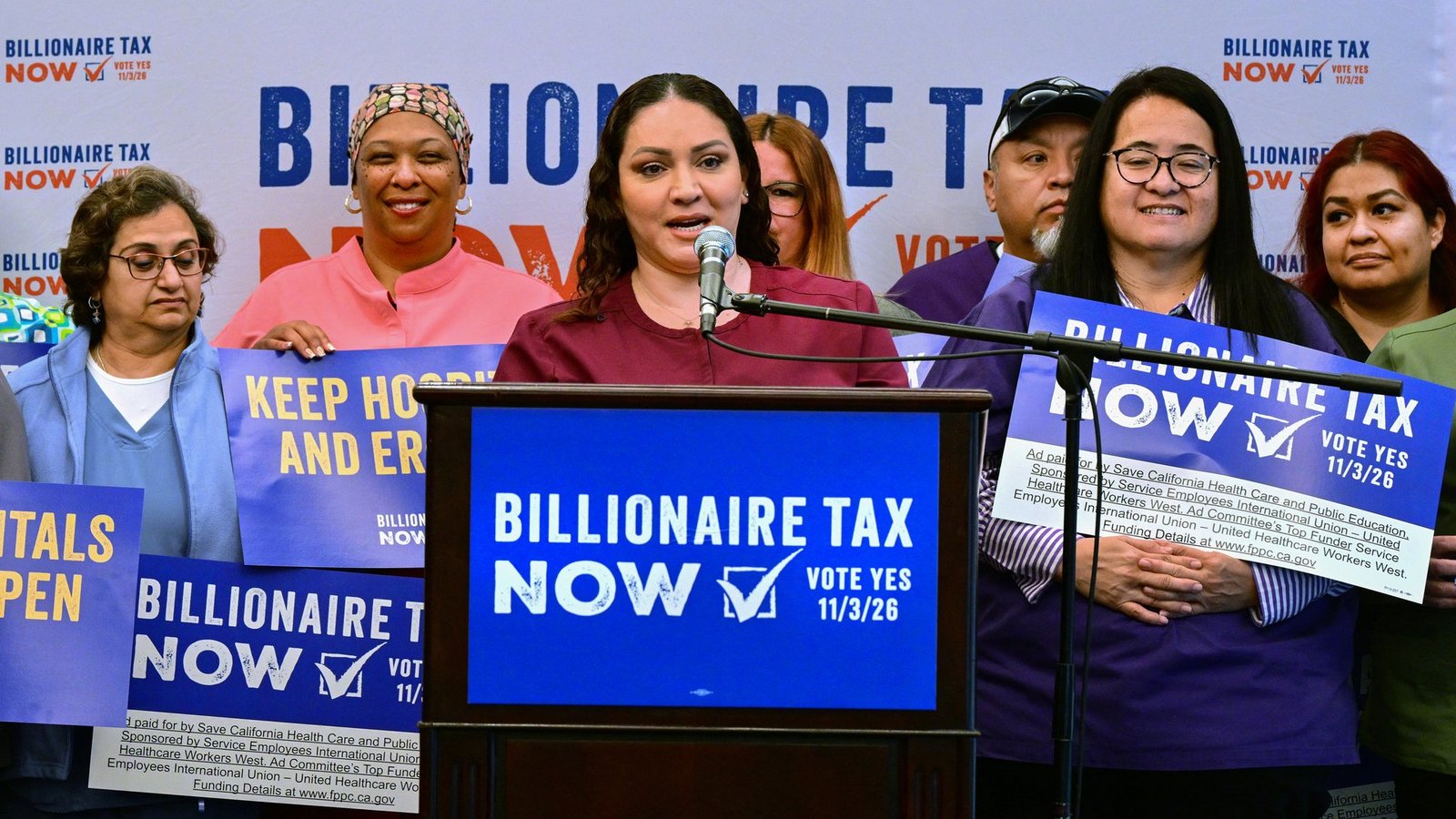
Will a proposed one-time tax on billionaires bring in more revenue for the state or harm state tax revenue in the long run? It’s a question voters are going to really need to think about now that the proposal is likely to be on the November ballot.
The 2026 Billionaire Tax Act is a proposal for a one-time 5% tax on the total net worth of anyone in the state with a net worth of over $1 billion. That’s different from a regular income tax, which only taxes any earned income for a given year.
But that debate over help or harm only grows more heated in the California sunshine as we move closer to Election Day, and another new analysis suggests it will be detrimental to long-term state tax revenue.
On the ballot
That initiative reportedly received more than 1.5 million signatures, well above the 875,000 threshold required to get on the ballot.
There is a small chance it could still not end up on the ballot if enough signatures are invalidated, courts intervene or other unlikely options come up.
“A very small group of the most controversial billionaires on the planet tried to stop Californians from being able to save their local emergency rooms and hospitals — but our current signature tally proves frontline healthcare workers will prevail in bringing this commonsense proposal to voters,” Suzanne Jimenez, chief of staff at SEIU United Healthcare Workers West (SEIU-UHW) and lead sponsor of the California Billionaire Tax Act ballot measure, said.
That union represents more than 120,000 healthcare workers and is the main driver behind the proposal.
Much of the money raised would go to the California healthcare system. Proponents say that’s necessary because the system is losing significant funding after President Donald Trump’s “One Big Beautiful Bill” passed last year.
Several high-profile billionaires have pushed back against the measure by funding groups opposed to the initiative and moving out of the state altogether.
New argument against
A new analysis by Jared Walczak, a visiting fellow with the California Tax Foundation, found this tax would reduce state revenue by $3.53-$4.49 billion.
According to the report, most of that lost revenue comes from billionaires departing the state.
“The proposed wealth tax is already yielding billionaire departures, with the likelihood of more to follow,” Walczak told Straight Arrow.
Walczak said he used two different methodologies to crunch the numbers. The first came from an IRS data matching study done, in part, by one of the authors of the billionaire tax.
Emannuel Saez and his coauthors matched Forbes data to tax returns to determine net worth of some of the wealthiest Americans.
“Saez has unique access to IRS records that other researchers don’t have, so he’s able to do this in ways that others don’t,” Walczak said.
The second method came from a study done by Joshua Rauh and Ryan J. Shu. That study gathered tax return data from the California Franchise Tax Board on high-income Californians.
According to Walczak’s analysis, all of that money leaving the state pointed to major losses in state tax revenue in the future.
“There will be long-term losses, both because billionaires have left and don’t return, and also losses because future entrepreneurs and innovators are going to think twice about starting their business in California, because they fear a reprise of the wealth tax,” Walczak said.
The argument for
David Gamage is a law professor at the University of Missouri and one of the authors of the billionaire tax proposal. He made his thoughts on Walczak’s analysis clear.
“It’s not a serious analysis,” he told Straight Arrow. “It’s an attempt to make an op-ed-style argument. It’s purposely designed in a way that the overall picture is highly misleading.”
Gamage said that despite what Walczak said, his new analysis is based on a separate study by Rauh and Benjamin Jaros for the Hoover Institute.
That study claimed the tax proposal will cost California $25 billion.
“The Hoover analysis suggests that the billionaire tax might raise more revenue than our projections even say,” Gamage said. “So, this is disingenuous and implausible, and I believe Jared knows it’s disingenuous and implausible.”
Gamage said there are a number of reasons for that, including that it takes “elasticities.”
In other words, he said it’s projecting how people will respond to the billionaire tax.
When it comes to billionaires leaving the state, Gamage said it’s a bit overblown.
California has nearly 200 billionaires and while big names like Mark Zuckerberg and the founders of Google have made a public show of leaving the state, many of the others have remained quiet.
“Lots of wealthy people say they’re going to leave, and then after the dust clears, we find out that very few, if anyone, actually leaves,” Gamage said. “This is the repeated pattern, and there’s lots of reasons why it makes sense for wealthy people to say that they’re going to leave. It’s a very low-cost signaling for opposition to a measure.”
Gamage continued to push back against the new analysis.
“One smaller point, just demonstrating Jared’s pattern of being disingenuous, he has another set of analysis where he claims, based on misinformation that has been spreading, that the billionaire tax would tax voting control shares, not actual marketability,” he said. “Which we’ve already explained, is based on a misreading of the actual text.”
The big divide
The divide on this between experts could be part of the reason why some of the state’s most powerful politicians have stayed out of this fight.
Gov. Gavin Newsom has actually made it clear he doesn’t believe the billionaire tax is a good idea, but he also may need money from some of those billionaires for a presidential campaign.
So why are economists and experts so split on this?
“I think there’s less of a divide than might be believed,” Walczak said, “There will be people on both sides of almost anything, and that’s true with economists. But most economists across the world recognize that wealth taxes are uniquely harmful.”
As many as 14 European countries used to have wealth taxes, but 11 of them have since repealed them. The other three are much broader wealth taxes, applicable to people making more than $200,000 USD.
A recent report from the CATO Institute found that wealth taxes are overall harmful to an economy.
The California Legislative Analysis’ office, who Gamage said attempted to “do the best job possible,” also put out a report. They said there will likely be a temporary influx of revenue from this tax but less tax revenue in the long-run.
Part of the reason experts may be on different sides is that we just don’t know what the result will be.
“No one can say with confidence based on the existing academic literature that the measure will hurt or help California,” Gamage said. “There’s just too many contested empirical questions in that.”
Despite that, he still pushed back against the new analysis.
“There’s a plausible range of disagreement about empirical effects, and then there’s off-the-wall analysis that’s completely implausible, like Jared’s,” he said.