

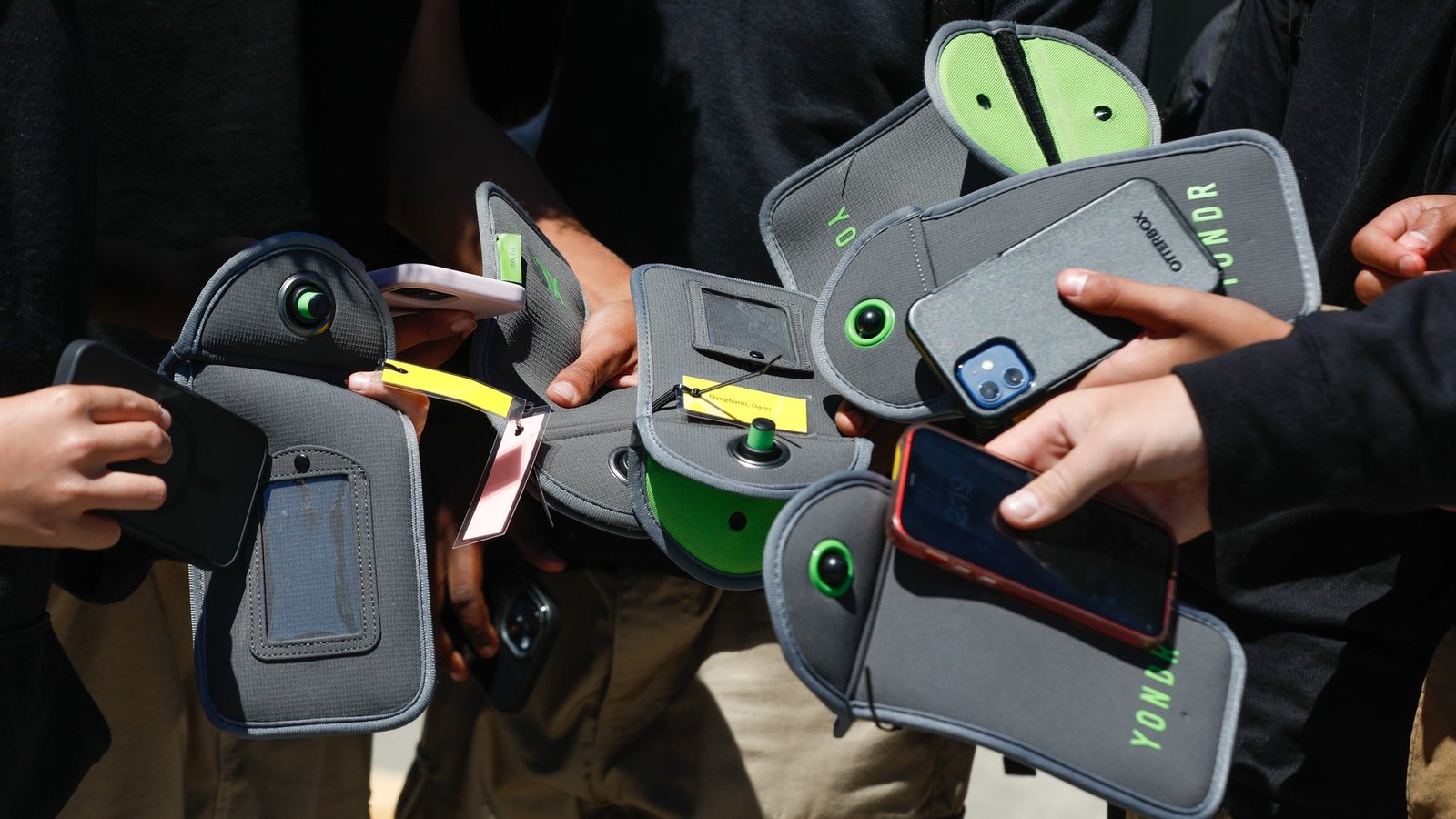
First, they started popping up in schools. Now, they’re showing up in the workplace. Cellphone bans and locked phone pouches are gaining popularity across the U.S.
You’ve likely heard of schools and districts adopting phone-ban policies that require students to lock their phones in a pouch or leave them in their lockers during class time. Often, it’s used as a tool to curb distractions in the classroom.
Now, it seems, some U.S. companies want to implement similar measures.
ID.me adopts phone ban policy
One digital identity verification company, ID.me, adopted the policy several years ago. It introduced phone pouches to nearly 300 employees, saying it was an effort to protect clients’ personal information.
The bags are sealed but allow staff to keep their phones with them; they simply have to tap the pouch against a dedicated magnetic station to unlock it.
One staff member told The Financial Times the new policy was “a hard pill to swallow.”
“Having my phone with me is something I’ve had my whole life,” said Kamilah Muiruri. However, she noted there have actually been some benefits to the pouches, including establishing a better relationship with her coworkers.
“It gets us to connect with each other,” she said. “I didn’t really know people in the office as I was focusing on the friends I have outside the office. Now, we are very close as a team.”
Other companies, like JPMorgan Chase, have implemented no-phone policies only in specific instances, such as during meetings. CEO Jamie Dimon described bringing phones to meetings as “disrespectful.”
In a letter to shareholders, Dimon complained of “people in meetings all the time who are getting notifications and personal texts or who are reading emails. This has to stop. It’s disrespectful. It wastes time.”
Other motivations besides security
While ID.me introduced the pouches as a security measure, other companies are implementing policies to limit distractions in the workplace.
Yondr, a company that makes phone pouches, told The Financial Times that courts, childcare facilities and government agencies are among its customers. It noted that while some companies had adopted “phone-free” policies, “a phone policy on paper is not the same as a phone-free environment.”
Many companies are hoping for increased productivity. Muiruri says that, for her, it has. She told the Financial Times before the policy, she found herself constantly checking her phone, keeping her distracted from work.
Whether phone bans increase productivity in a measurable way, however, remains to be seen. Data remains limited and is relatively inconclusive.
Adrian Chadi, an associate professor of economics at the University of Southampton, conducted his own research and found that phone bans may increase productivity for routine tasks, but not necessarily for tasks that require more creativity and knowledge.
Support for phone bans
Regardless, studies show support for phone bans, specifically in schools, is on the rise.
As Straight Arrow previously reported, 74% of adults support school-day phone bans, an increase from 68% in fall 2024.
We should note, however, that those numbers are likely different for office phone bans because, let’s be honest … we all want to have our phones on us while we work.
Round out your reading
- Scientists unearth new evidence on how the Grand Canyon was shaped.
- Why the Army is adding a second fitness test for combat.
- Illegal midwives, growing demand: The fight over home birth in America.
- 40 years after Chernobyl, the U.S. pushes nuclear power once again.
- We’re building a new Straight Arrow. Help us shape our future by taking our survey.