

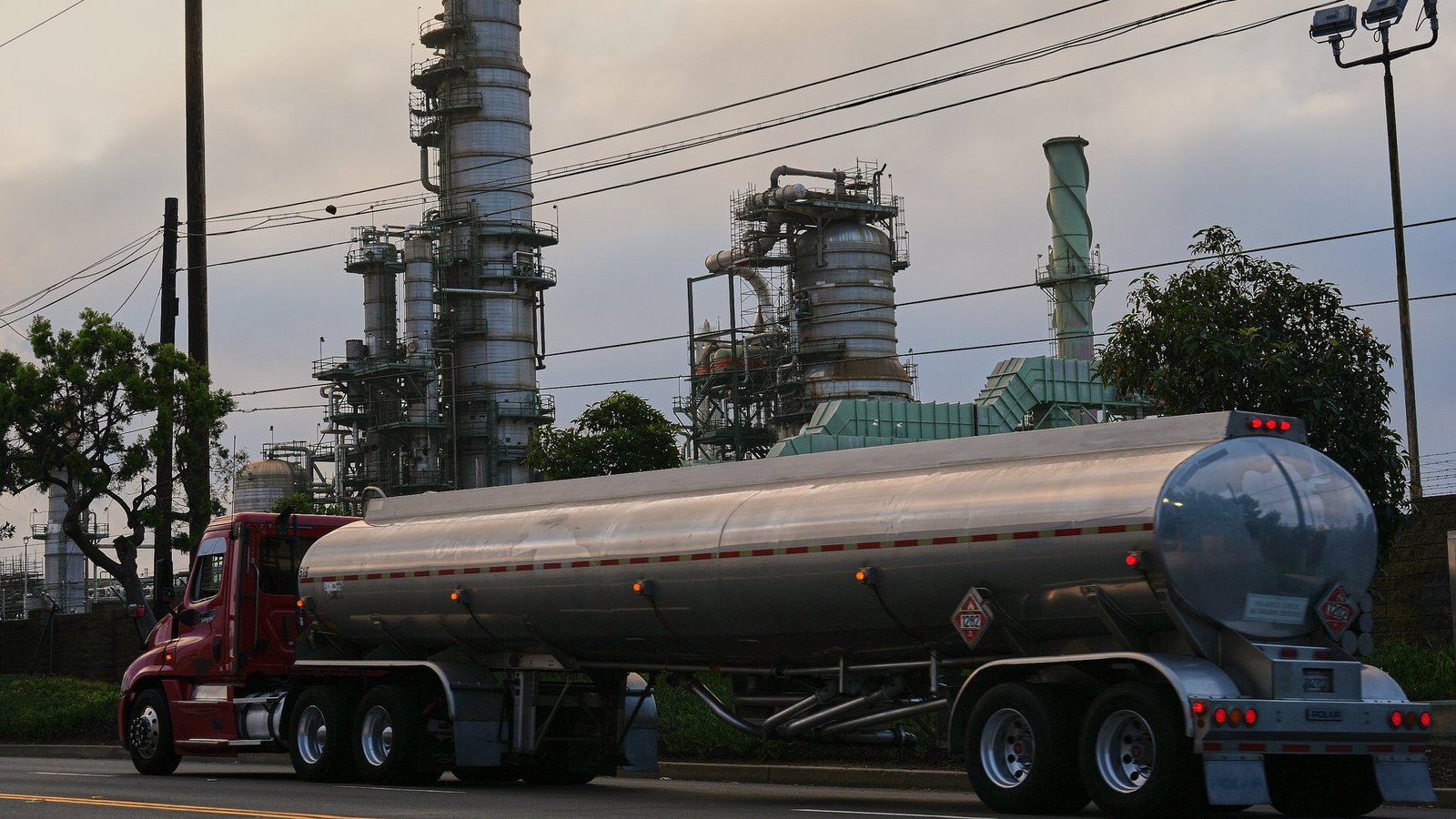
Gasoline prices are surging as the U.S. and Israel continue to exchange attacks with Iran. Facing a price spike in line with what occurred in 2022 after Russia invaded Ukraine, President Donald Trump outlined a plan Tuesday to bring the price of oil under control.
In a post on Truth Social, Trump said the U.S. International Development Finance Corporation (DFC), a government agency established during Trump’s first term, would offer insurance for oil tankers traversing the Strait of Hormuz on Iran’s southern border. Trump also said, “if necessary, the United States Navy will begin escorting tankers through the Strait of Hormuz, as soon as possible.”
The steps are intended to keep global oil markets flowing uninterrupted despite military conflict in the region. The Strait of Hormuz is considered the most critical chokepoint in the global oil market, where up to 20% of seaborne oil passes through each day.
How much does a gallon of gasoline cost?
The average price for regular gasoline nationwide on Wednesday reached $3.20 per gallon, according to AAA. That’s over 22 cents higher than a week earlier.
Data compiled by Patrick De Haan, head of petroleum analysis at GasBuddy shows March 2 and 3 were among the top five largest single-day gasoline price increases this century.
That places the Iran conflict on par with Russia’s invasion of Ukraine in 2022 in terms of the immediate impact at the pump. The price of gasoline increased by over 20 cents in two days after the invasion that March; by June of 2022, gas prices topped out at more than $5 per gallon.
Prices are not rising uniformly everywhere. In his Substack, De Haan noted that Wisconsin saw the largest weekly jump at 38.8 cents per gallon, followed by Oklahoma, Georgia and Ohio, where prices rose by at least 32 cents.
Diesel also hit a $4 per gallon average price for the first time since 2024. A week earlier, diesel cost about $3.75.
What’s causing prices to increase?
About 53% of the price of gasoline is determined by the cost of crude oil, according to the U.S. Energy Information Administration. The U.S. imports relatively little oil from the Middle East, but because oil is a globally traded commodity, supply chain shocks in one region can push up prices everywhere.
Before the Feb. 28 U.S.-Israeli strike on Iran, the main global price benchmark for oil, Brent, closed the previous day at $72 per barrel.
Following the attack, Iran announced the closure of the Strait of Hormuz, and major maritime insurance companies dropped war risk coverage for shippers operating in the strait. From Feb. 27 to March 3, traffic through the strait fell by 90%, according to data from the global tracking service Marine Traffic.
“The Strait of Hormuz was way easier to close than anyone imagined,” said Jim Krane, lead on energy and geopolitics in the Middle East at Rice University’s Center for Energy Studies.
Despite the closure, Krane told Straight Arrow News that the impact on oil prices is “surprisingly mild” compared to what analysts expected because of a surplus of oil supply in storage across the globe.
In addition to closing the strait, Iran also struck energy infrastructure in neighboring countries, including Saudi Arabia and Qatar. The combined effect prevents a major portion of the world’s oil supply from reaching global markets.
By Wednesday, the price of Brent increased to about $82 — a 15% week-over-week rise. Historically, every $1 increase in the price of oil translates to a 2-3 cent uptick in how much a gallon of gasoline costs.
What is Trump’s plan?
The plan Trump announced on Tuesday would address the lack of insurance coverage and potentially enhance security for ships threatened by Iran.
The U.S. Navy has escorted oil tankers through the Strait of Hormuz before, during the war between Iran and Iraq in the 1980s.
“We’ve done this in the past and it worked,” Skip York, a nonresident fellow at Rice University’s Baker Institute for Public Policy, told SAN. For now, York said the prospect of a plan is “calming the market, which is exactly what the president wants,” but implementation will take several weeks with details yet to be determined.
To make up for lost insurance, the DFC on Tuesday confirmed plans to offer coverage to shippers using the strait.