

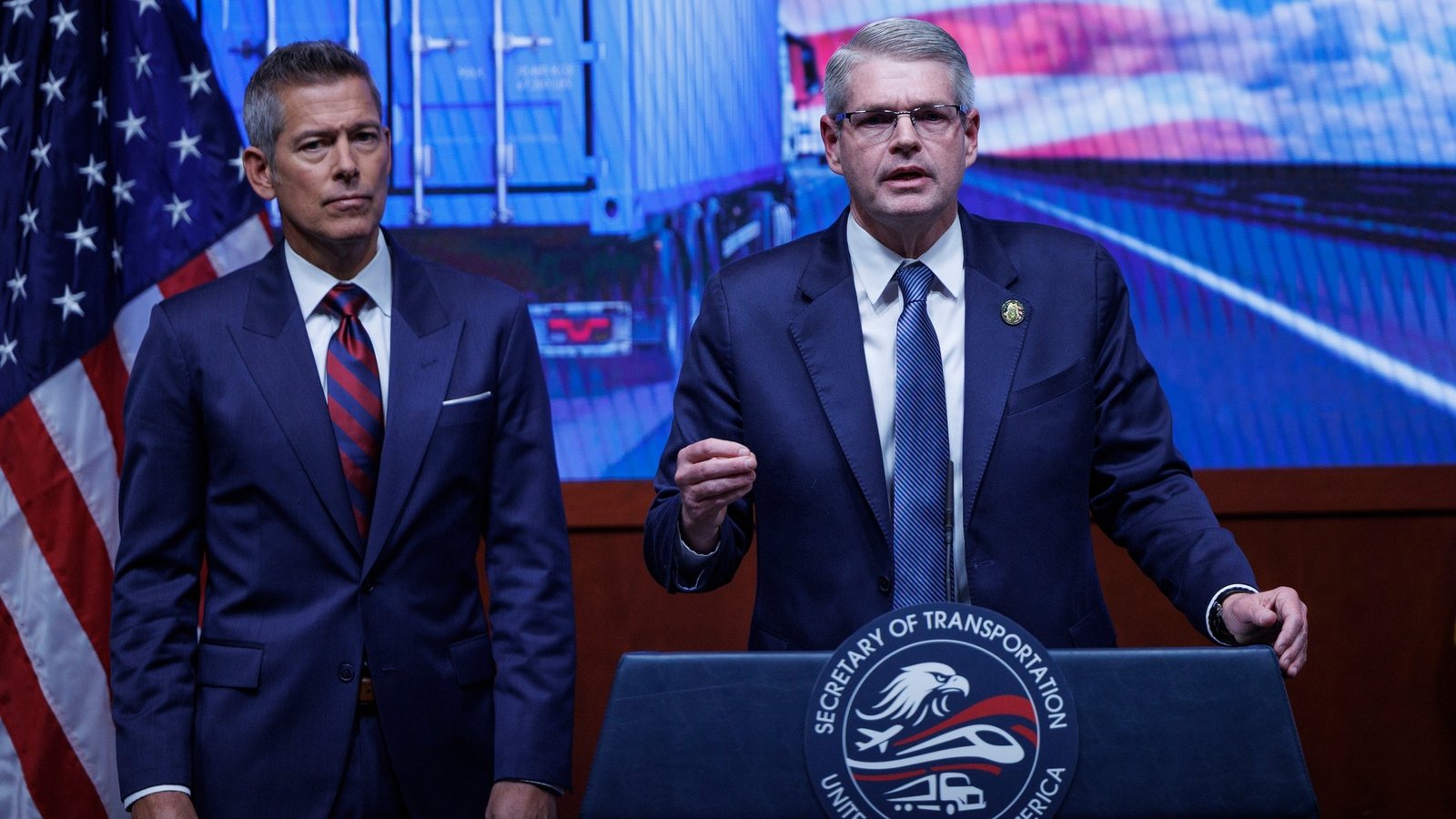
The Federal Motor Carrier Safety Administration (FMCSA) announced it plans to toughen enforcement against so-called “chameleon carriers.” FMCSA Administrator Derek Barrs made the announcement alongside U.S. Transportation Secretary Sean Duffy, saying these bad actors have caused some deadly accidents.
What are ‘chameleon carriers?’
“Chameleon carrier is when a trucking company, typically a small trucking company, closes down and then opens up as a new one under some other name and perhaps some other owner, obviously, often related to the owner of the original company,” Alex Scott, associate professor of supply chain management at the University of Tennessee, told Straight Arrow News.
Those companies often pull that move when they’re having certain issues.
“Either they’ve been shut down for serious safety-related violations in the past, or they have high safety scores or something to that effect, and so they get shut down, and they reincarnate,” Brandon Wiseman, president of Trucksafe, told SAN. “They just spin up another trucking company and continue on doing business and avoid that negative safety compliance history.”
Safety issues tend to be the main cause of chameleon carriers.
“They rack up this bad safety score, then they can’t get business, so they just close down and open up as some new carrier,” Scott said. “And then they start doing the same thing over and over.”
Wiseman said there are elements of this that are outright illegal.
“It’s not illegal, per se, to have one owner that owns multiple different trucking companies, different DOT registrations,” he said. “That’s not what is unlawful. What is unlawful is using multiple duty numbers to try and avoid some kind of a negative compliance history.”
FMCSA enforcement
“One bad actor continues to bad act as they switch from one DOT number to the next,” Duffy said. “We’re going to put an end to that.”
Wiseman said the reform is “sorely needed.”
“Chameleon carriers have been around for a long time, but they are starting to become more crafty in the way that they avoid these negative safety compliance histories and the way that they structure their fraudulent operations,” he said.
The FMCSA didn’t give more details on how they plan to strengthen enforcement against the shape-shifting companies.
“I think the big thing is figuring out ways on the front end, through the FMCS registration system, to try and flag potential chameleon carriers better than they already do,” Wiseman said. “They’ve already got some technology built into their registration system that is supposed to flag similar ownership, similar phone numbers, similar equipment, but it’s clearly not robust enough.”
During the press conference, Duffy mentioned plans to modernize and strengthen federal systems they use to verify identity, ownership and compliance.
Scott is less optimistic that the agency would actually be able to get tougher on chameleon carriers.
“Frankly, if you’re waiting for the government to figure it out, it’s too late,” he said. “Because they set these rules, but then these carriers are smart enough to get around these rules and around slow data that the DOT is collecting. And so, I’m not super optimistic that the FMCSA is going to be able to capture all of these chameleon carriers.”
There are no widely known cases where a chameleon carrier operator faced serious criminal charges for their actions.
“I don’t think, unless it’s extreme negligence, that jail time occurs,” Scott said. “They can be sued in civil court and have judgments against them. But again, if they just go out of business and start up a new one, there’s really not a whole lot you can do if they just go out of business.”
Recent crashes
“In Indiana, a preventable crash involving a non-domicile driver took the life of Terry Schultz,” Barrs said. “And in Jay County, Indiana, another preventable crash claimed four innocent lives of an Amish community. The driver held a non-domicile CDL, was trained by a non-compliant school, and worked for a motor carrier operator as a part of a chameleon network.”
Schultz was killed in a crash on Feb. 18, while the Jay County crash happened on Feb. 3.
“This has been a problem for a long time, but I think what you’ve seen in the last few years is an acceleration of these small companies, often foreign-owned companies, because of what I call the ‘app-lification’ of the industry,” Scott said.
He explained that trucking companies can now get business through apps like Amazon’s Relay app.
“It’s very easy to get these loads, whereas in the past, you often had to have sales people and relationships with shippers and brokers, but now it’s just very easy for anybody set up a company, go get a load off one of these load boards, or through one of these apps, and then be in business and then typically don’t require that much safety history to get those loads,” Scott said.
While Scott doesn’t think the government will be very effective in stopping thesechameleon carriers, he believes there is another way.
“What we need is private enforcement,” he said. “And I’m a big preacher of private enforcement. So many people want to point to the FMCSA, but it really comes down to the shippers and the brokers who are using these guys.”
However it gets done, Wiseman said getting chameleon carriers off American highways is an important mission.
“They give the whole industry a bad name, really,” he said. “Because the more and more prominence these types of accidents take, national news and stuff like that, it just makes trucking in general look bad. We’re being judged by the worst actors in the industry.”
On top of that, costs go up for trucking companies doing things the right way.
“As these bad actors continue to operate and create significant exposure to their insurers and stuff like that, it jacks up the rates for everybody else,” Wiseman said. “We’re seeing these outrageous, they’re called nuclear verdicts, these multimillion dollar jury verdict awards in these cases involving trucking companies, and those are on the rise over 1,000% over the last 10 years in those types of cases.”