

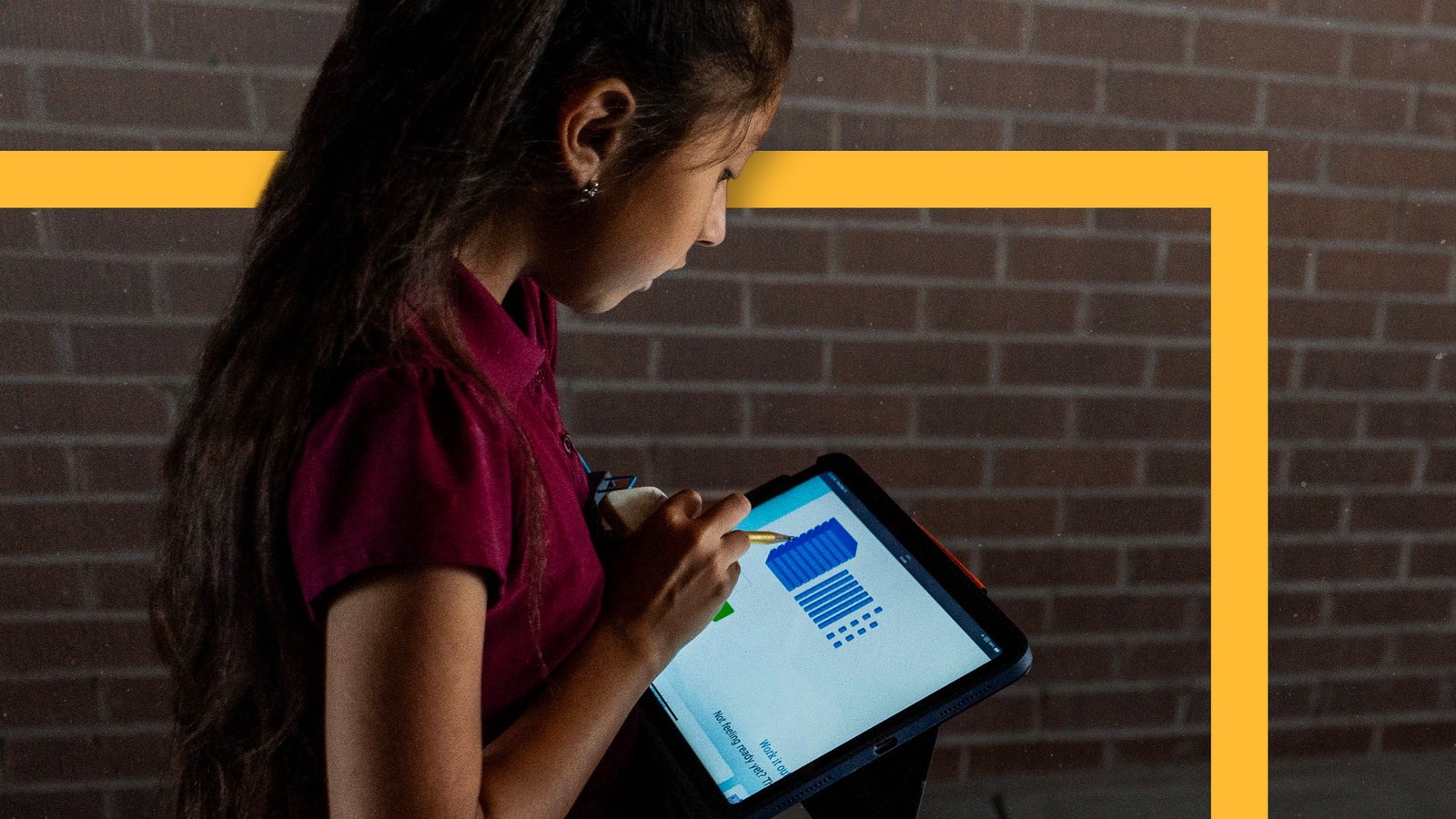
After decades of pushing to bring technology into schools, parents are now leading the charge to take tech out again. Student learning outcomes have shifted, and not in a positive way. The most recent report from the National Center for Education Statistics shows a drop in reading and math scores.
While some of the setbacks may be attributable to the COVID-19 pandemic, parents are placing at least partial blame on the use of computers in the classroom. Citing research that indicates that “old-school” methods like taking notes by hand or choosing print books over digital versions result in greater retention and comprehension, parents are organizing to reduce or remove digital devices from classrooms.
More studies show that – among other things – 30% of teens report being exposed to pornography in school; heightened screen time can be linked with student inattention and behavioral issues; and there is at least a correlational link between screen time and ADHD symptoms.

Last month, the Los Angeles Unified School District (LAUSD), the nation’s second largest, committed to developing a screen time policy. Other districts are also evaluating their policies, and laws regarding digital screen use in schools have been passed or proposed in at least 14 states, including Utah, Vermont and Alabama.
How did digital devices take over American classrooms?
Personal computers have quickly evolved from a nascent technology to a ubiquitous part of American life and education. According to the NCES, 96% of American public schools provided students with digital devices by 2021.
Jim Shoemaker, a recently retired high school social studies teacher in Pennsylvania, was an early advocate for classroom tech. He helped the Wissahickon School District introduce SmartBoards and MacBooks to classrooms in 2007 to prepare students for the workforce.
“I think we did a good job, in terms of helping them prep for that technological world,” Shoemaker told Straight Arrow. “Kids or young adults can hop on and do stuff that more seasoned adults aren’t as comfortable doing.”
He’s less enthusiastic today. While he still believes technology in education holds benefits, he said it requires a thoughtful approach.
“It used to be ‘Go play in the sandbox.’ I think that sandbox is pretty dangerous now, and I think there are people trying to monetize kids’ attention,” he said. “It’s almost like there needs to be a ‘Stranger Danger’ talk with technology.”
In those early days, he said, classroom tech was used for creation. Now, it’s more about consuming.
“The advent of AI, for me, was a real game changer,” he said. It’s great for people who know what they’re doing, but most kids don’t “have that wealth of knowledge.” he said.
“Kids are being kids; they’re just constantly trying to work around whatever system is put in front of them,” Shoemaker told Straight Arrow. “AI and these algorithms thrive on that. If we [pulled] out laptops, inevitably someone would try to work around actually doing the work.”

Or, instead of using tech “for educational purposes that could promote learning … they could also be checking social media or playing video games at school on these same devices,” said Jason M. Nagata, an associate professor of pediatrics at the University of California, San Francisco.
Tiffany Munzer, a pediatrician and assistant professor at University of Michigan, goes a step further. Kids need a chance to be bored, she said. And screens can prove an obstacle to this need.
“They also need opportunities to work with their hands, and work with pen and paper, and learn to write and read using physical objects, and physical, really tactile experiences, and to have time to be bored,” she told Straight Arrow. “A digital product doesn’t provide that same level of tactile experience or opportunities to just have that boredom.”
Do classroom computers cause behavior problems?
Screens aren’t inherently bad for learning. A recent policy statement from the American Academy of Pediatrics (AAP), which Munzer helped develop, points out that “high-quality educational content is associated with greater prosocial behaviors and language among preschoolers and kindergarteners,” especially when screens are used with a caregiver. Because random, controlled trials “are not ethically or practically feasible when it comes to exposing children to potentially harmful levels of digital media,” the AAP notes that causation is much harder to determine in this field than correlation.
“Our societies have long had different rules and regulations and laws with respect to children, for example, how they may consume certain substances, what are legal ages for owning guns or voting,” said Marc Potenza, a professor of psychiatry, neuroscience, and child study at the Yale School of Medicine.
“A central question is: How do we gain the benefits of digital technologies while not experiencing the harms? And who are the individuals who are most prone to developing harms? I think it’s clear that developing youth are a vulnerable group with respect to many behaviors,” he said.
The experts are quick to defend teachers, who are doing the best they can.

“We don’t have a ton of research around how [screens are] actually being used in schools, but we do know that kids learn well from technology when it’s designed with their well-being in mind and [has] a very specific learning goal,” Munzer said. “Unfortunately, that’s not quite how they’re being used in the classrooms, not because the teachers aren’t using them in the right way, [but] because the technology itself was not necessarily designed with kids in mind.”
Nagata is especially concerned about social media use, which his studies show affects cognitive abilities in children as young as 9.
“The minimum age requirement for social media apps is 13, but we found that two-thirds of 11- to 12-year-olds already had social media apps,” Nagata said. “And, on average, most of them had more than three different accounts on three different platforms.”
How much time do students spend on screens at school?
Further, he said studies that examine screen time for young adults and teens find that in general, their use during those years “are patterns that they take forward through their adult life.”
The move to rein in technology has even made it to Capitol Hill. In a January Senate hearing, several experts presented testimony citing research on the effects of digital media on American youth. During the testimony, neuroscientist Jared Cooney Horvath noted that one in four students spend more than four hours in front of a screen during a typical seven-hour school day.
“Unfortunately, studies suggest that less than half of this time is spent actually learning,” Horvath noted in his testimony, “with students off-task for up to 38 minutes of every hour when on classroom devices.”
And that behavior is being designed with intention – not by teachers, but by Big Tech.
READ MORE: Is social media to blame for the youth mental health crisis?
“In my research lab at the University of Michigan, we have found repeated instances of digital platform design that revolves around revenue generation goals at the expense of child wellbeing, and in a manner that misaligns with child and teen developmental needs,” Jenny Radesky, an associate professor of pediatrics at the University of Michigan, wrote in her own testimony to the committee.

Radesky also pointed out that despite high self-reported levels of screen use, almost half of teens admit they spend too much time on social media, and believe that these platforms have a mostly negative effect.
How are parents fighting screen time in schools?
Even among all this research, Potenza told Straight Arrow it is important to refrain from knee-jerk reactions like instituting screen bans without thorough research.
“That being said, I think given the power of digital devices, and [the still] developing impulse control of adolescents who engage in more risk taking, the idea of physically limiting access seems like it’s a reasonable thing to do. We do that with pornography, we do that with tobacco, we do that with alcohol.”
Among other efforts, Munzer advocates changes in policy. Since kids are so smart, she said, “we need better software and also better policies around how laptops are designed, because they were designed for adults to use; they weren’t designed for children’s learning in mind. We need to work with kids and families and teachers around designing a product that actually could be helpful in the classroom setting.”
The more stakeholders involved, the merrier, said Potenza. In addition to involving students in decisions, Potenza said “there may be additional groups like parents that have an important role, teachers, other community groups like police officers,” who can explain some of the risky or illegal behavior kids may engage in online.
“And then there are their roles for researchers in terms of understanding the processes. But then there are also important roles for government in terms of thinking about what regulations are going to protect vulnerable individuals and promote public health. And there’s roles for the industry in terms of transparency and trying to ensure that their products are safe for consumption.”
Communities are coalescing. Parents, concerned about behavioral and other issues that seem to correlate with the amount of time their kids are spending on screens, are pushing back.

LAUSD parents formed Schools Beyond Screens in 2025. It has since spread, not only throughout California, but across the country. Their website offers parents templates for petitions, letters and surveys, and also offers chats and workgroups to connect with like-minded parents.
Pencils Over Pixels in Lower Merion, Pa., provides details about software used in the district, and points out problematic privacy concerns, among other issues. While their recent proposal to allow parents to opt-out of allowing their children’s use of digital devices was shut down this May, the group’s Facebook page affirms its commitment to “drastically reducing tech usage, significantly increasing time limits on screen use and implementing much stricter content filtering on district-provided devices.”
While it’s unlikely that schools will go completely screen free, parent requests mirror what the experts recommend: using digital technology actively as a tool, alongside ample hands-on learning opportunities and human-centered connections. They stress that children need to be protected from harmful content and that teachers should be spending time teaching, not policing screens. They want educational policies to be guided by research, not by the corporations that supply the technology.
Shoemaker said there “needs to be a systemic approach.” More than anything, he said, parents and other stakeholders must constantly ask: “Are we doing things the right way?”
Round out your reading
- Tennessee officials will pay $835,000 for jailing man over Charlie Kirk meme.
- Why the immune system turns on women more often than men.
- More than 340 newspapers block the Wayback Machine. What that means for the future of the internet.
- Why Rep. Cohen filed articles of impeachment against Supreme Court Justice John Roberts.
- We’re building a new Straight Arrow. Help us shape our future by taking our survey.