

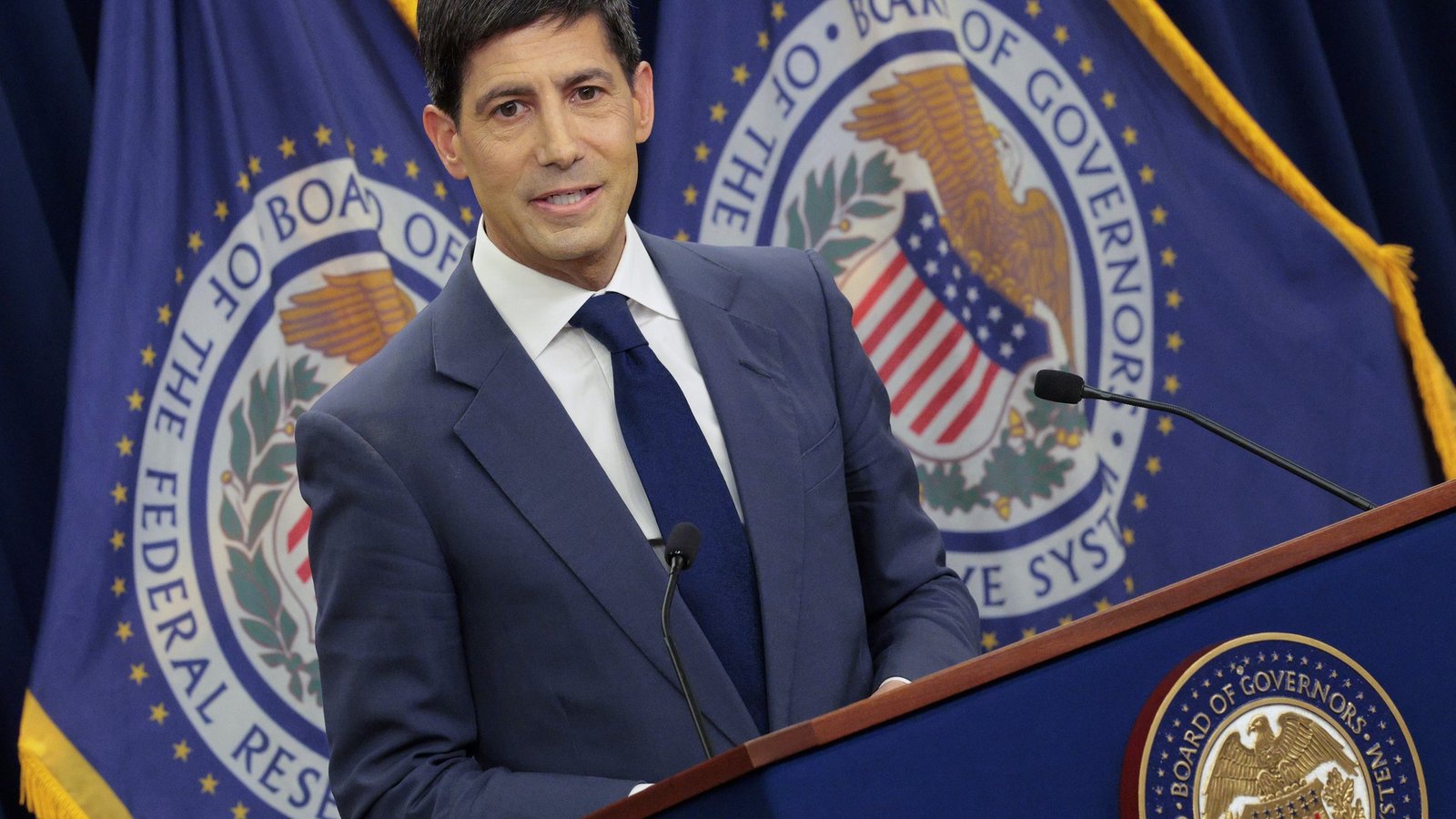
The Federal Reserve left its key interest rate unchanged, but policymakers delivered a clear warning: Rate hikes are back on the table.
The markets got the message.
After Wednesday’s Fed announcement and a press conference by the new chair, Kevin Warsh, markets experienced a sell-off. Stocks fell in the afternoon, while Treasury yields rose.
The reaction was sharpest in the bond market. The yield on the 2-year Treasury note, which closely tracks expectations for Fed policy, jumped after the announcement, while the 10-year yield also rose.
Wednesday’s announcements moved the market, said Steve Sosnick, chief strategist at Interactive Brokers.
Before this week, the markets had priced in an 80% chance that the Fed will raise rates by December, Sosnick told Straight Arrow. But now “they’re pricing in 100% chance of a hike by October.”
By Thursday, markets had regained their footing. But that coincided with the U.S. and Iran signing a peace agreement that is expected to reopen the Strait of Hormuz. That move had previously been expected for Friday.
New approach
The Fed kept its benchmark federal funds rate — what banks charge each other for short-term loans — in a range of 3.5% to 3.75%. The decision was unanimous.
But in a sharp reversal, nine of the 18 Fed officials who submitted new projections signaled that at least one interest rate increase could be appropriate before the end of 2026. None had projected a hike in March.
Warsh, who presided over his first Fed meeting this week, did not submit an individual rate projection, breaking with recent Fed practice.
That kind of reticence was expected from the Trump-appointed Fed chair who took office in late May.
“We know that Warsh does not want to follow the standard Fed practice of the last couple of decades of giving people in the markets a lot of guidance about where interest rates might be going,” said Jon Hilsenrath, senior adviser at the financial services firm StoneX.
Both Hilsenrath and Sosnick said investors still don’t know if Warsh will be a “hawk,” more inclined to raise interest rates to bring down inflation, or a “dove,” more inclined to lower or keep interest rates steady to keep unemployment in check.
Warsh pledged to “deliver price stability.” Fed-watchers saw that as a sign that he may be willing to increase rates to help bring down inflation, even if it risks slowing down economic growth.
Higher interest rates would drive up the borrowing costs for everything from mortgages to car loans to business loans. But keeping rates low could risk pushing annual U.S. inflation, which rose to 4.2% in May, even higher above the Fed’s target of 2%.
The case for raising rates
The central bankers’ apparent willingness to raise rates reflects a growing consensus among economists that an increase may be warranted.
In a survey published on Monday by Hilsenrath and Duke University, 17 of 32 former Fed officials and staff said an increase would likely be appropriate in 2026, while 14 said no increase would be appropriate.
“It’s possible that this economy is overheating,” Hilsenrath said, “and if the Fed is late to respond, it could make it harder to get inflation down.”
Hilsenrath also warned that if the Fed keeps interest rates too low for too long, “in addition to pushing up consumer prices, it could also push up asset prices, including stocks.”
While President Donald Trump has made no secret of his preference for lower interest rates, his reaction to Wednesday’s Fed announcement was muted.
Round out your reading
- Could a common dietary supplement accelerate Alzheimer’s?
- NY AG Letitia James gets hundreds of taunts, racial slurs in ICE public reporting portal.
- As Musk becomes the first trillionaire, historian sees warning signs.
- An experimental weight loss drug is so effective, many Americans don’t care it’s not FDA approved.
- How search engine optimization reduced Simone Biles to an ‘NFL wife’.