

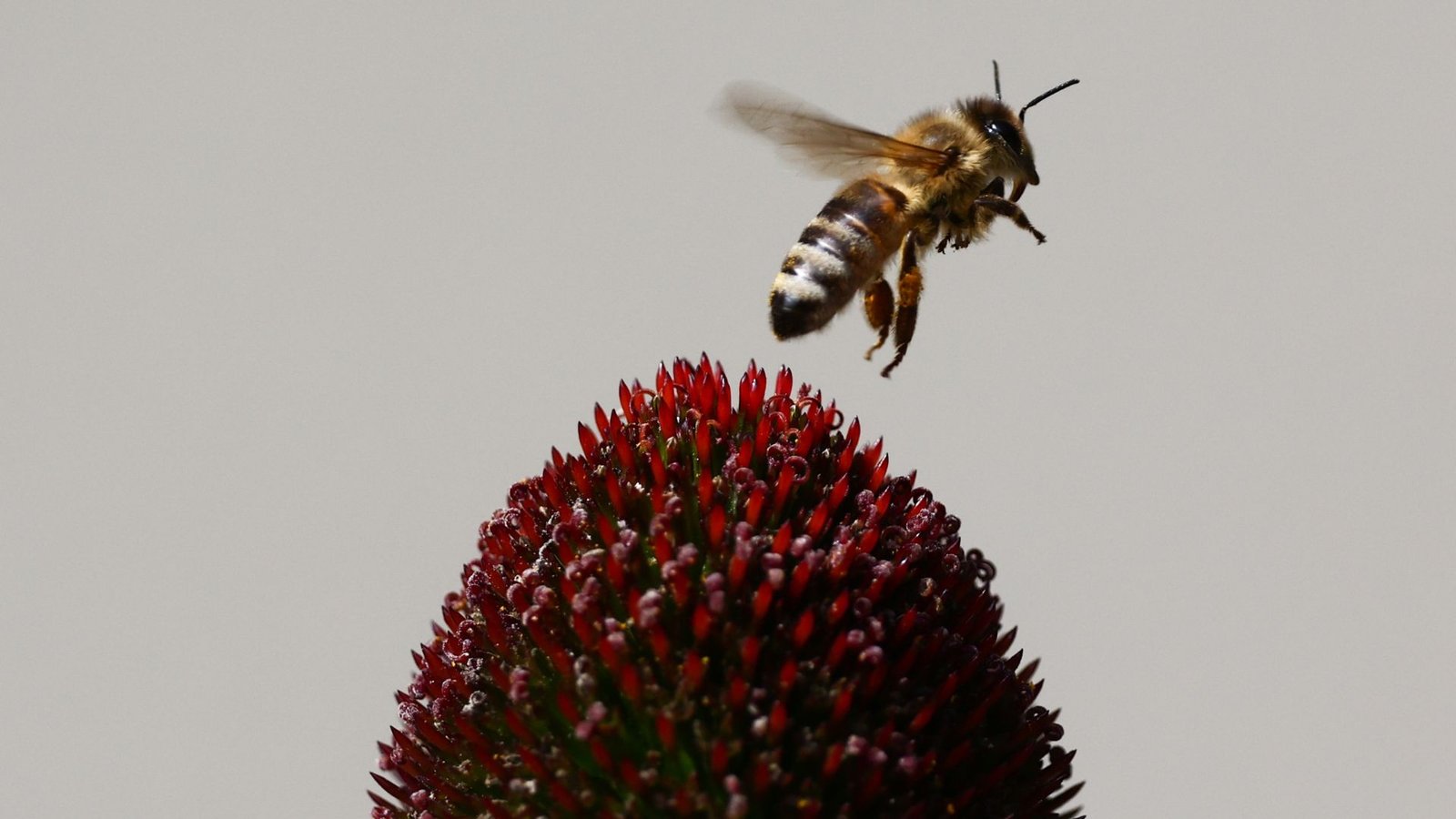
At just 21 days old and with a brain the size of a sesame seed, honeybees can understand complex numerical processes, according to a new study. Researchers didn’t go as far as to say that they’re helping with algebra homework, but they did suggest that honeybees can understand the concept of zero, something humans don’t learn until age three or four.
The study, published in the Proceedings of the Royal Society B: Biological Sciences, also found that western honeybees can distinguish between numbers up to six and understand greater-than and less-than relationships.
But this wasn’t the first time scientists had proposed that honeybees, an animal with fewer than a million neurons, could understand math. A 2009 research paper found that bees can “protocount” landmarks to help with navigation. Researchers discovered this by creating a Y-shaped maze for the bees. At the fork, bees were shown a card with varying numbers of symbols and trained to go down the lane with either fewer or more symbols, depending on the test. After the training, the bees were able to fly along the correct path quickly.
Other studies, however, suggested the opposite. But what Dr. Scarlett Howard, the lead researcher on the latest study, discovered was that those previous studies didn’t actually test what bees were seeing, but rather what people were seeing.
“We see and experience the world quite differently from animals, so we must be careful [not to center] human perspectives and senses when studying animal intelligence,” Howard told The Sydney Morning Herald.
How did researchers find this out?
A team of researchers from Australia, Italy and France conducted the latest study. First, the researchers used a technique called a Fast Fourier Transform to determine how honeybees actually see the world. This test essentially breaks an image down into visual frequencies and determines how much fine detail versus coarse patterns it contains.
Once they determined that, the researchers converted those frequencies to degrees of visual angle, the standard unit used in animal vision research. To accomplish that, the scientists needed only to know how far away the bee was from the object and how big the object was. The conversion allowed the researchers to compare their analysis with other research that studied what bees can perceive.
“The way we’ve now redone the modeling is actually by using what the bees perceive and what we know they can see based on these previous studies that have looked at their vision,” Howard said.
The research team then used this new data to reexamine previous tests, like the one that used a Y-shaped maze. In those tests, scientists rewarded bees for choosing cards with fewer symbols. But when researchers in that previous study introduced a card with zero symbols, bees trained on “less” picked it immediately. Researchers had not taught them zero — they chose that themselves.
“So what we’re saying here is that [bees are] doing number discrimination,” Howard told the Herald. “Like if we saw three apples versus four apples, we would be able to tell which one’s the bigger one, and which one’s the smaller one.”
Why is it important to study bee intelligence?
Studying the intelligence of bees might not seem significant, but Howard said it has applications in understanding human evolution.
“It tells us whether the rise of mathematics and number ability is something related to human culture and human language, or if it’s something that’s quite widespread,” she said. “So you kind of start to get to philosophical questions of what is it to be a human, or what is it to be a bee.”
One topic Howard’s team was unable to answer was how bees compute the information they take in. She said their brains are entirely different from humans but they still seem able to do complex tasks.
“We have 86 billion neurons, and they have less than a million,” Howard said. “We’re not exactly sure if they’re processing numbers in a way that’s similar to us, or if they’re doing it in a completely different way.”