

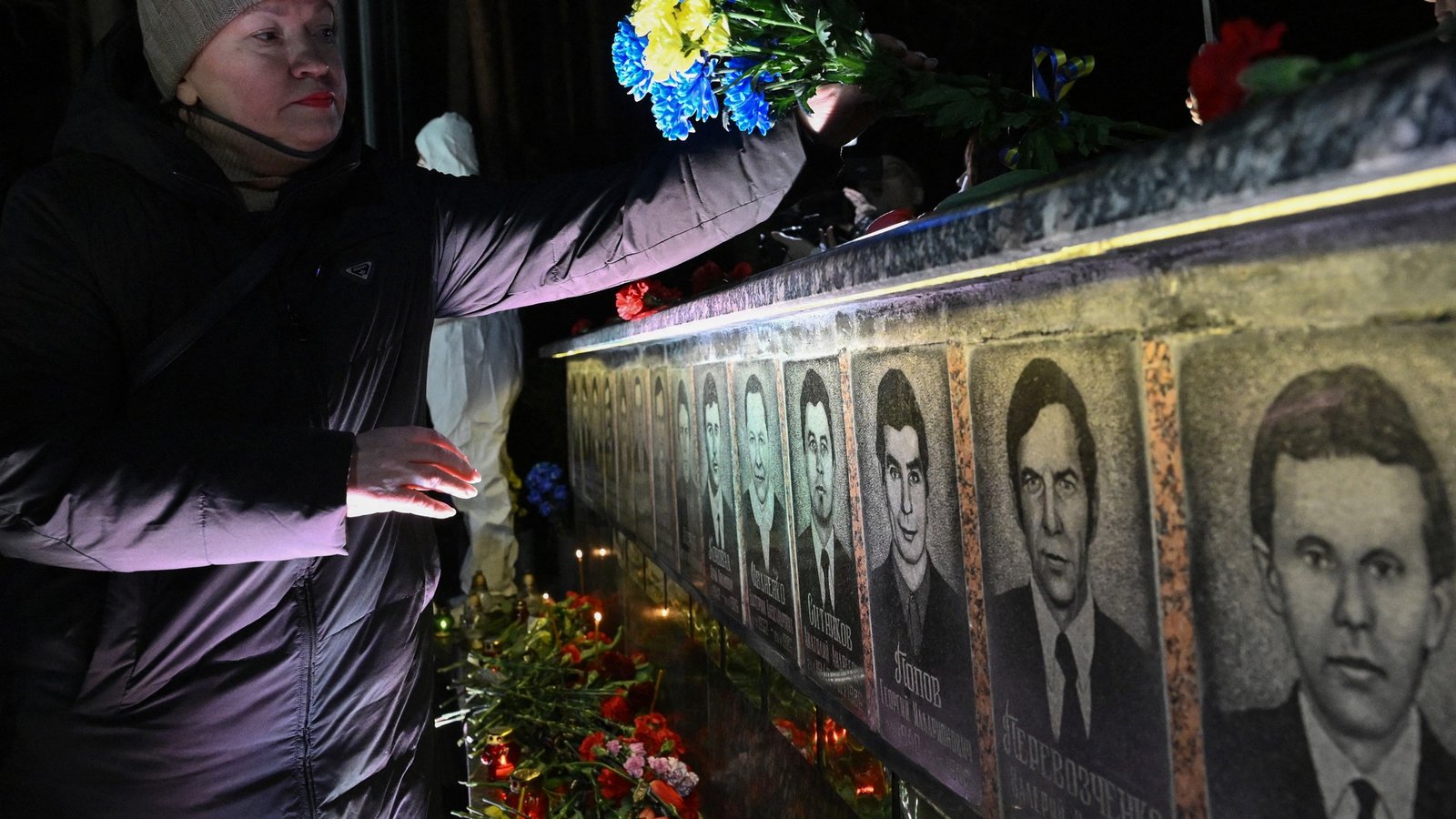
Russian and Ukrainian drone and missile strikes killed at least 16 people across Ukraine and Russia, authorities said Sunday, as the 40th anniversary of the Chernobyl nuclear disaster renewed warnings about the risks of military activity near nuclear facilities during the war.
The latest violence comes as Ukrainian and international nuclear officials marked four decades since the April 26, 1986, explosion of Reactor 4 at the Chernobyl Nuclear Power Plant — the world’s worst nuclear accident.
Ukrainian President Volodymyr Zelenskyy and Rafael Grossi, the head of the International Atomic Energy Agency, toured a newly opened permanent Chernobyl exhibition at Kyiv’s National Museum on Sunday. Zelenskyy warned that Russia’s military operations risk repeating history.
“Through its war, Russia is once again bringing the world to the brink of a man‑made disaster,” Zelenskyy wrote on social media, pointing to Russian‑Iranian Shahed drones regularly flying over the site. One drone struck the plant’s protective structure last year, he said.
Grossi echoed those concerns, saying repairs to Chernobyl’s damaged outer protective shell must begin immediately. The IAEA said assessments show the damage sustained during a strike in 2025 has already compromised a key safety function of the structure, increasing risks to the older concrete sarcophagus beneath it if left unaddressed.
The European Bank for Reconstruction and Development has estimated that repairs would cost at least $586 million.
Chernobyl anniversary renews debate in US
The anniversary of the disaster has also prompted renewed debate about nuclear power well beyond Ukraine. In the United States, policymakers have moved to expand nuclear energy production, arguing it is necessary to meet future electricity demand and reduce carbon emissions.
In May 2025, President Donald Trump issued four executive orders calling for the expansion of the U.S. nuclear power industry, including a goal of adding 300 gigawatts of nuclear capacity by 2050. The orders also directed faster reactor testing and licensing, expanded fuel production and fuel recycling, and an overhaul of the Nuclear Regulatory Commission.
Critics, however, warn that weakening regulatory safeguards risks ignoring hard‑earned lessons from past disasters. Edwin Lyman, director of nuclear power safety at the Union of Concerned Scientists, told Straight Arrow Energy Reporter Keaton Peters the push for rapid expansion raises alarms.
“Complacency is the enemy of safety,” Lyman said, warning that policymakers appear “anxious to unlearn” the lessons of Chernobyl.

The 1986 disaster was triggered during a late‑night safety test that was conducted without proper coordination between reactor operators and safety personnel, according to the World Nuclear Association. A cascade of technical failures and human errors led to a massive explosion and radioactive release that reshaped global nuclear policy and left long‑lasting health and environmental consequences.
Forty years later, as war rages near the remains of the plant, nuclear officials say the lessons of Chernobyl are as urgent as ever.