

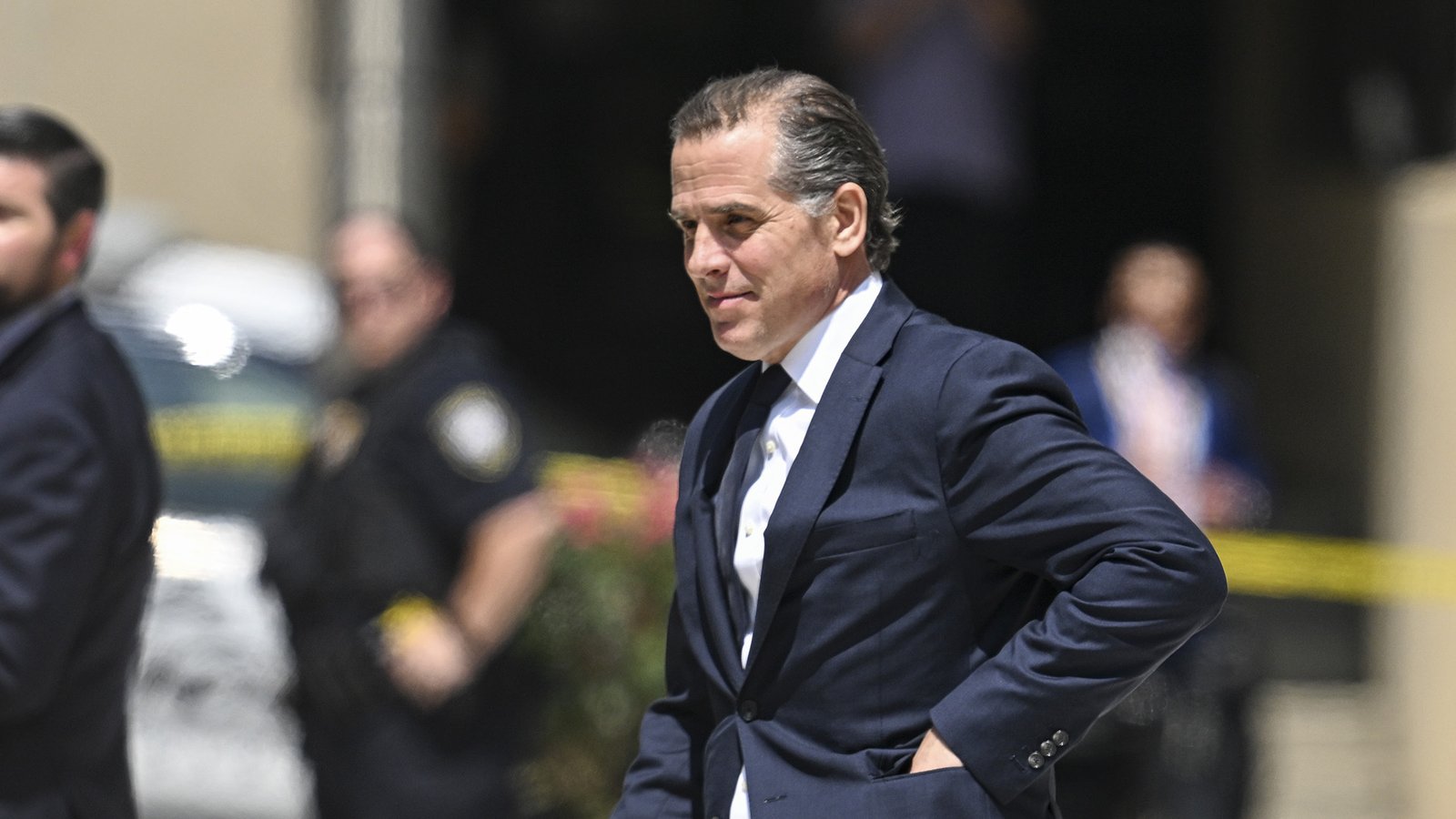
Artist, lawyer and presidential son Hunter Biden had a long history of battling drugs. After his brother, Beau, died in 2015, his addiction worsened, particularly to crack cocaine.
In 2024, a federal jury in Delaware found Biden, by then a recovery advocate, guilty of being in “possession of a firearm by a person who is an unlawful user of or addicted to a controlled substance.”
But before he could be sentenced for the crime, his father, President Joe Biden, gave him an unconditional pardon. The president called his son’s conviction a “miscarriage of justice.”
A Supreme Court decision on Thursday suggests the former president may have been right.
Ruling unanimously in a Texas case, the court narrowed the statute under which Hunter Biden was prosecuted, which banned everyone who uses illegal drugs from owning or possessing a gun.
While saying the law could no longer be broadly applied, the court said the government still has the power to take guns from drug users in certain circumstances.
“We appreciate that drugs and guns can sometimes make for a dangerous mix,” Justice Neil Gorsuch wrote. But he said the court has previously held that restrictions on the Second Amendment right to bear arms must be rooted in the nation’s “tradition.”
“Apart from pointing to habitual drunkard laws,” Gorsuch wrote, “the government has not even attempted to prove that any other specific historical principle might justify its prosecution in this case.”
In a concurring opinion, Justice Samuel Alito alluded to a shift in societal attitudes toward some drugs.
“Marijuana use today is like alcohol use at the founding,” Alito wrote. “It is widespread and increasingly considered socially acceptable in many quarters. And from a practical standpoint, law enforcement widely tolerates the use of marijuana.”
Hunter Biden did not respond publicly to the court’s ruling. His representatives did not respond to Straight Arrow’s request for comment.
Ruling in Texas case
The court ruled in the case of Ali Danial Hemani, who faced as much as 15 years in prison after federal agents discovered a 9 mm handgun, 60 grams of marijuana and 4.7 grams of cocaine when they raided his home near Dallas in 2022. Hermani, whose family was suspected of having ties to the Iranian government, admitted to using marijuana about every other day.
A federal district judge granted Hemani’s motion to dismiss the indictment on Second Amendment grounds. But the 5th U.S. Circuit Court of Appeals reinstated the case, which then made its way to the Supreme Court.
The prosecution “is inconsistent with the Second Amendment,” Gorsuch wrote. “The Second Amendment protects the right of ‘all Americans’ to keep and bear firearms for self-defense.’”
“The statute under which Hemani was charged “bans a class of people … from possessing essentially any firearm for any purpose,” Gorsuch added.
The decision was based in part on the court’s 2022 Bruen ruling, which requires courts to examine the constitutionality of gun bans and restrictions based on the nation’s “history and tradition” of firearms regulation.
Unusual allies
The case created unusual coalitions among advocacy groups. Both the American Civil Liberties Union and the National Rifle Association supported Hemani’s position.
“With nearly half of Americans reporting marijuana use at some point in their lives, this ruling protects the rights of millions and curbs the government’s ability to impose arbitrary and discriminatory penalties,” said Cecillia Wang, the ACLU’s legal director.
Gun safety groups such as Everytown sided with the Trump administration, however. Janet Carter, managing director of Second Amendment litigation at Everytown Law, said in a statement that the organization disagreed with the court’s ruling.
However, she said, “the court has stressed that its decision is limited — rightly recognizing that drugs and guns can make for a dangerous mix, and leaving open the possibility of prosecuting someone with proof that their drug use renders their gun possession dangerous to themselves or others.”
Round out your reading
- Could a common dietary supplement accelerate Alzheimer’s?
- NY AG Letitia James gets hundreds of taunts, racial slurs in ICE public reporting portal.
- As Musk becomes the first trillionaire, historian sees warning signs.
- An experimental weight loss drug is so effective, many Americans don’t care it’s not FDA approved.
- How search engine optimization reduced Simone Biles to an ‘NFL wife’.