

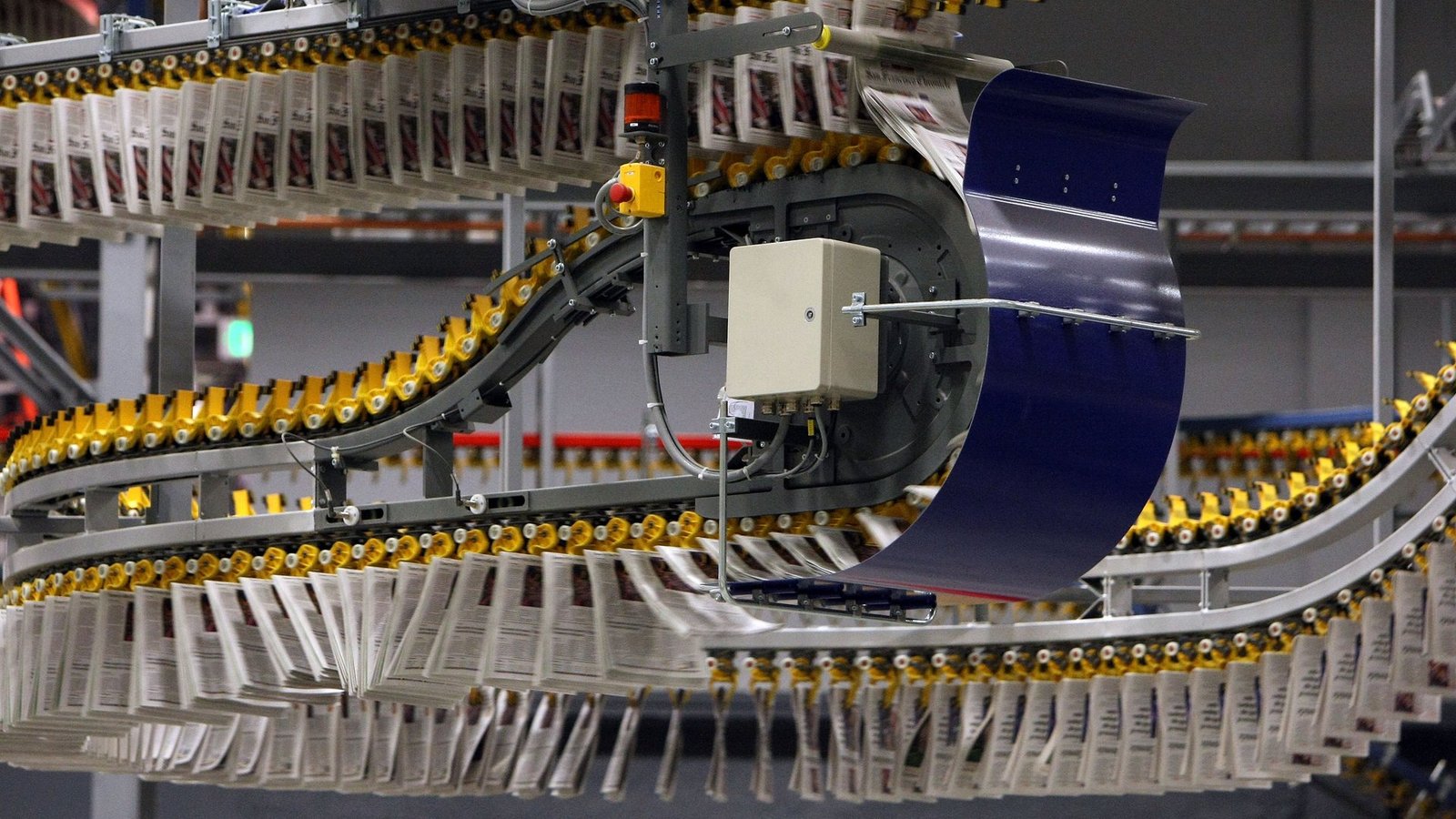
The company behind some of the country’s largest local newspaper brands — including the Miami Herald, The Kansas City Star and The Sacramento Bee — is in trouble.
Revenue is down, pageviews have waned, and the company’s efforts to draw in new, repeat customers have failed. Can artificial intelligence save McClatchy Media?
During a contentious, off-the-record virtual town hall last month, company executives touted a flood of AI-generated content as a key to solving their business woes — and pleaded with skeptical journalists to get on board.
Taken together, the executives’ comments appeared to be a threat: Embrace AI or face consequences.
“Ask yourself, would you rather our business be ruined than change?” Greg Farmer, the company’s executive vice president of local news, asked during the May 20 webinar with staff from McClatchy’s 29 daily newspapers across 14 states.
“Or instead, can we overcome that threat, can we walk through that fear, can we climb the cross of the moment and work together to solve our problems?” Farmer continued. “Can we let our illusions die once and for all?”
The town hall comes at a moment of internal strife at McClatchy as reporters across the country protest the company’s full-throttled embrace of artificial intelligence, including a tool that leverages AI to repackage news articles at varying lengths for varying audiences. The tool, called the “Content Scaling Agent,” puts the bylines of real reporters onto AI-generated stories and is part of a broader effort at McClatchy to harness AI to increase the number of articles its local brands publish and reach new audiences.
Executives’ statements during the meeting — a recording of which was shared with Straight Arrow — haven’t been previously reported. The company has not spoken publicly about the clash, and executives didn’t respond to Straight Arrow’s requests for comment.
For some McClatchy staffers, the meeting further intensified the division between labor and management. Kristine Sherred, chair of the Washington State NewsGuild, told Straight Arrow the company “is headed in a direction that makes me uncomfortable, and I know I’m not alone in that sense.”
Sherred’s union recently went on strike to demand better pay and “ethical limits” to the use of AI. She did not share the town hall audio recording with Straight Arrow.
“I don’t know what its purpose was,” Sherred, who is also the food and dining reporter at The Tacoma News Tribune, said of the meeting. “I don’t know if it was supposed to make us feel good or bad.”
Can AI save local news?
AI-generated articles have flooded the internet, with one recent report finding they now account for more than half of articles on the web. Legacy publications have scrambled to adapt, with varying degrees of optimism about a future dominated by chatbots. At McClatchy, where reporters’ use of AI is now factored into performance reviews, executives made clear they plan to go all in.
“We have a company-wide effort to agentify the entire enterprise,” McClatchy CEO Tony Hunter said during the town hall.

Executives made clear the focus centered on increasing the number of articles McClatchy publishes across its brands, and that reporters would be held to high standards of performance in service of that goal.
“We are losing ground in market share in the news and information marketplace,” Hunter told the company’s journalists. “I need you to compete. We need to take back some share.”
For news outlets, the rise of AI has only worsened longstanding financial woes. McClatchy executives offered staff detailed insight into the company’s struggles.
Revenue is down $34 million year-over-year, executives said, and unique page views — at roughly 200 million in the last quarter — were below company goals. The company was seeing some 15 million “new known users” per month a year ago. That number is now down to fewer than 4 million.
Tony Berg, McClatchy’s chief revenue officer, said the company has observed a decline in digital subscribers for the first time. He also said investments in local reporting have failed to garner “a dramatic improvement” in web traffic or repeat customers.
“Over the last couple of years, we have tried every price under the sun to acquire new subscribers,” Berg said. “We’ve tried prices as low as 99 cents, we’ve tried prices as high as $99 for the year.”
But none of it has paid off, he said, as the company failed to secure “a measurable improvement in our subscriber engagement” or subscriber retention.
Can human reporters keep up with chatbots?
“Incremental actions” have produced “incremental results,” Hunter told staff, but bolder changes must occur “to get us to the North Star.”
Reporters, he said, must step up to meet the company’s “cultural expectations.”
To succeed, executives said, they need to dramatically increase the number of stories that appear across their local news websites. Executives see the content scaling agent and other AI investments as the key to achieving that goal.
Since its launch, the AI-powered tool has published more than 1,000 stories that generated more than 7 million page views. In April, four of the top-five articles produced by AI outperformed the original articles written by humans, Farmer said.
The company, he said, is raising performance expectations for reporters, especially for those who haven’t embraced AI.
“Our company spends the same amount in payroll for the reporters who generate 12% of our subscriber readership as it does for those who generate more than 60%,” Farmer said. “It’s a big disparity and I want to be clear: Our leaders, me included, we have to provide better direction going forward.”
McClatchy journalists have been vocal in opposition to the executives’ embrace of AI.
Last month, as Straight Arrow previously reported, reporters at the Centre Daily Times newspaper in State College, Pennsylvania, launched a union bid after their bylines were slapped onto AI-written articles.
Last week, the Washington State NewsGuild, which represents 31 workers at four newspapers in the state, went on strike for a day, noting on its website that the company “hopes you won’t notice if it replaces human stories with AI-generated content,” and that executives believe readers will “happily consume clickbait over real community stories.”
McClatchy maintains its content scaling agent helps newsrooms improve efficiency and cut costs. But some reporters say it has actually cost them time because they have to fix errors introduced by the AI tool.

To Sherred, the Tacoma-based reporter, executives’ embrace of AI-generated content makes clear the company is facing “some sort of existential crisis.”
“The executives at the company really came to the team and said, ‘Hey, we’re bleeding money and this is how we’re going to go about saving the industry, saving our business,’” she told Straight Arrow. The entire news business is struggling financially, Sherred acknowledged, but she said McClatchy’s AI pivot mirrors the industry’s stumbles in adapting to the internet and capitalizing on online advertising revenue.
“I was coming out of college as the industry was sort of having its first major moment, I guess, of falling apart in the mid-2000s, and to me it feels like the same kinds of short-sighted decision-making is driving the ship here,” she said. “It’s just dressed up in a different costume.”
Do readers trust AI-generated news?
Many news organizations prohibit the publication of AI-generated articles. Others, such as The Associated Press, use AI to produce routine content, such as corporate earnings reports and sports box scores. Bloomberg and The Washington Post use it to create summaries that accompany news stories.
Straight Arrow uses AI to help produce features such as Media Miss and Media Landscape, which analyze coverage from multiple news outlets. However, editors review all AI content, and AI is never used to write news articles.
McClatchy reporters aren’t alone in pushing back. Last week, for example, employees at The New York Times announced legal action against the paper and accused the outlet of using an AI tool to “surveil and monitor union members.”

Readers, meanwhile, have signaled skepticism of news written by robots. In a 2024 Pew Research Center report, half of respondents said they believe AI will have a negative impact on news over the next two decades. Among respondents, 59% said AI will lead to fewer journalism jobs, and 41% believed AI would do a worse job writing articles than reporters. Two-thirds of respondents said they’re concerned that AI would provide them with inaccurate information.
In fact, few people — just 9% of adult respondents — said they get news at least sometimes from AI chatbots, according to a 2025 Pew Research Center survey. Three-fourths of respondents said they never rely on chatbots for news. Of those who do rely on tools like ChatGPT for news, half said they sometimes come across information they believe is inaccurate.
Sherred said McClatchy and other publishers should double-down on producing original, high-quality content.
“We hear this from people in the community all the time: They don’t want short snippets, they don’t want rehashed work and they don’t want AI telling them the news,” she said. “The only way you get high-quality local news is by having high-quality local reporters actually out there making it.”
Round out your reading
- Plea bargains keep America’s courts running. Guilt or innocence barely matters.
- Trump says the media isn’t covering one of his biggest accomplishments. We checked.
- Mike Lindell denied MyPillow was hacked. Its private data is now online.
- Red meat allergy rises with ticks as HHS targets Lyme disease, alpha-gal syndrome.
- We’re building a new Straight Arrow. Help us shape our future by taking our survey.