

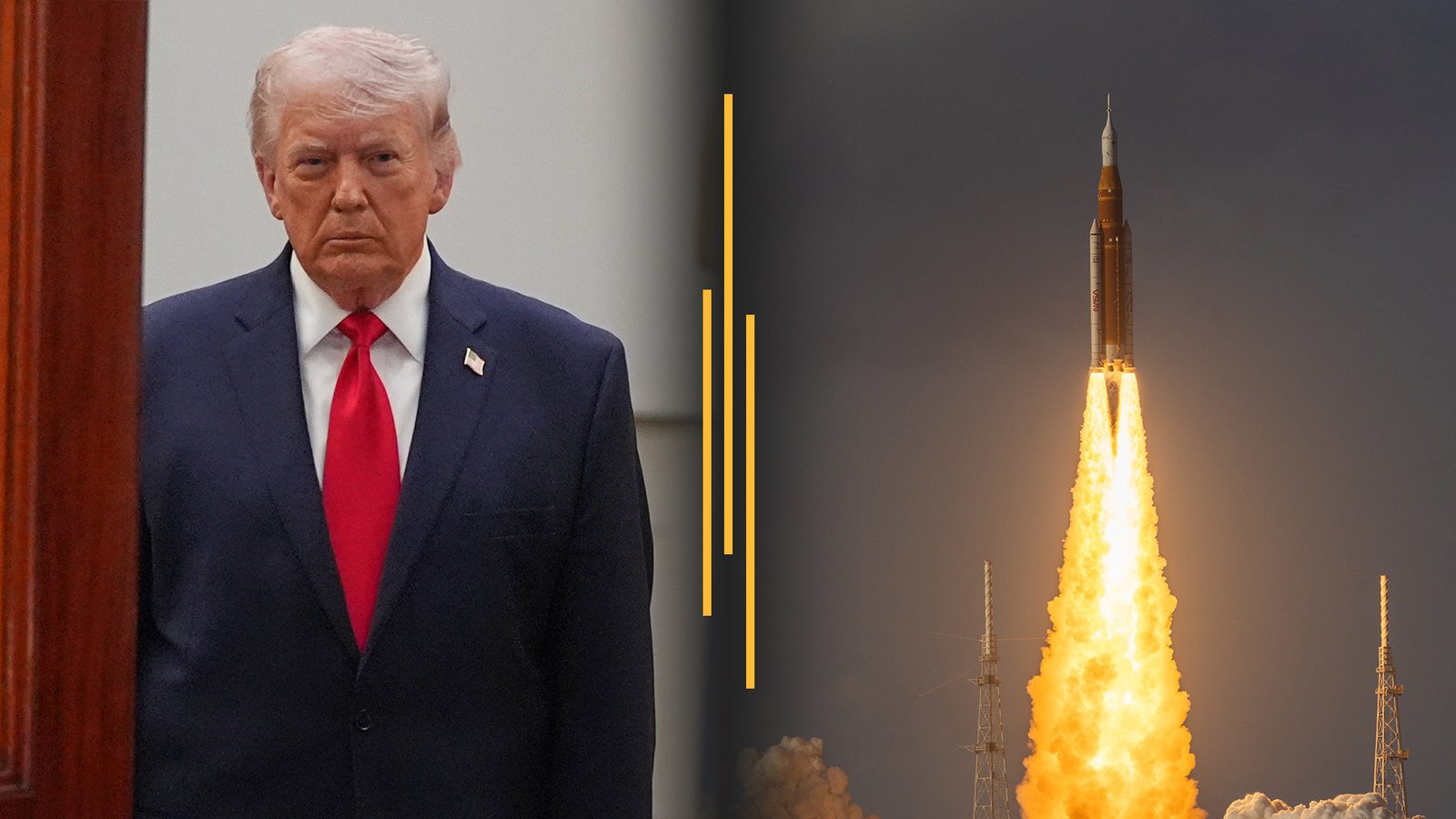
President Donald Trump says the war in Iran will continue until objectives are met. As of Thursday morning, there is no timeline and no clear off-ramp.
Plus, nearly three dozen countries scramble to reopen the Strait of Hormuz after Iran disrupts a key oil route. The U.S. steps back, forcing allies to figure it out.
And Artemis II blasts off and heads toward the moon. The first real test is now underway, with astronauts already in deep space.
These stories and more highlight your Unbiased Updates for Thursday, April 2, 2026.
Trump predicts Iran war could end soon, but gives no timeline as strikes expand
President Donald Trump said the war with Iran could end soon, but he offered no clear timeline. In a prime-time address Wednesday night, Trump said the U.S. is on track to complete its military objectives “shortly,” but did not give a specific end date.
He also repeated that negotiations are underway. Iran continues to deny that.

An Iranian military spokesman responded Thursday, warning of “stronger, wider and more destructive” attacks against the U.S. and Israel.
State media reported Iran’s military said the war will continue until it forces what it calls “surrender and permanent regret.” And while Trump said the conflict could wrap up in “two or three weeks,” he also made clear more strikes are coming.
“Thanks to the progress we’ve made, I can say tonight that we are on track to complete all of America’s military objectives shortly; very shortly. We are going to hit them extremely hard over the next two to three weeks. We’re going to bring them back to the Stone Age, where they belong. If, during this period of time, no deal is made, we have our eyes on key targets. If there is no deal, we are going to hit each and every one of their electric-generating plants very hard and probably simultaneously. We have not hit their oil, even though that’s the easiest target of all. Because it would not give them even a small chance of survival or rebuilding. But we could hit it, and it would be gone. And there’s not a thing they could do about it.”
— President Donald Trump
The White House has also warned of new threats in the region. The U.S. Embassy in Baghdad has urged all Americans to leave immediately, citing intelligence that Iran-aligned militias could launch attacks in the next 24 to 48 hours.
U.S. allies, including Israel, Saudi Arabia and the United Arab Emirates, reported fresh Iranian attacks overnight.
35 countries meet on Strait of Hormuz, focused on reopening oil route
Leaders from nearly three dozen countries will meet Thursday to try to reopen the Strait of Hormuz after Iran blocked one of the world’s most critical oil routes. The meeting comes as oil prices jump more than 6%, and Asian markets slide after Trump said the U.S. will continue to hit Iran hard.
Iran has restricted passage through the Strait since fighting began on Feb. 28, disrupting a key shipping lane that carries a major share of the world’s oil.

Prices have stayed above $100 a barrel for much of the past month.
The United Kingdom will host the talks, which will include 35 countries, including France, Germany, Italy, Canada, Japan and the United Arab Emirates.
The U.S. will not attend. Trump said securing the waterway is not America’s responsibility, telling allies to “go get your own oil.”
So far, no country has stepped forward to reopen the Strait by force. But U.K. Prime Minister Keir Starmer said military planners are working on options to protect shipping once the fighting ends.
GOP pushes DHS funding plan, sidesteps immigration fight
Republicans said they have a plan to reopen Homeland Security, while pushing a separate path to fund immigration enforcement without Democrats.
The deal would restart funding for parts of the Department of Homeland Security through September, after weeks of disruption. That includes agencies like the Transportation Security Administration (TSA), where long lines and staffing issues have already caused major backups at airports.
But immigration enforcement is being split off.
Republicans said Immigration and Customs Enforcement (ICE) and Border Patrol would continue operating with existing funds while they work on a new funding bill.
Trump is pushing the plan, calling for a GOP-only bill that bypasses the Senate filibuster. He set a June 1 deadline to get that legislation to his desk.
Senate Majority Leader John Thune has backed the approach after the Senate already passed a version of the funding plan.
House Speaker Mike Johnson rejected that plan last Friday night, but he’s now on board with the two-track strategy.
Democrats said they’re open to restarting DHS funding but continue to oppose funding immigration enforcement without new limits on how agents operate, such as no masks and judicial warrants before entering a person’s home.
The Senate could take up the plan as early as Thursday morning, but it’s still unclear when the House will move, or if Republicans can stay unified long enough to pass it.
US lifts sanctions on Venezuela’s Delcy Rodríguez
The Trump administration has lifted sanctions on Venezuela’s acting president, paving the way for closer relations and new business opportunities with the U.S. Treasury officials removed Delcy Rodríguez from the U.S. sanctions list, lifting restrictions that have been in place since 2018.
That move allows Rodríguez to access certain blocked assets and collaborate with American companies and investors.

A notice from the Treasury Department’s Office of Foreign Assets Control showed her name as having been deleted from the Specially Designated Nationals list.
The decision comes after a major shift in Venezuela.
U.S. forces captured former leader Nicolás Maduro earlier this year and brought him to New York to face drug trafficking charges. He has pleaded not guilty.

Rodríguez, who was once Maduro’s deputy, is now leading the country and working directly with the Trump administration. The U.S. officially recognized her as Venezuela’s leader last month and has started the process to reopen its embassy in Caracas.
The administration is also relaxing restrictions on Venezuela’s oil industry, permitting U.S. companies to invest and operate there.
1974 cold case linked to serial killer Ted Bundy
The killing of a Utah teenager has been officially connected to one of America’s most notorious serial killers, finally offering answers more than 50 years after the crime.
Laura Ann Aime, 17, disappeared on Halloween night in 1974 after leaving a party alone. Searchers found her body about a month later.

Investigators had long suspected serial killer Ted Bundy, but they couldn’t prove it — until now.
“Although Bundy did claim that he committed the murder of Laura, the confession he gave was deemed to be not enough evidence to close the case.
We can now say without a doubt that Theodore Ted Bundy did, in fact, murder Laura Ann Aime in the fall of 1974, and that law enforcement now has DNA testing results that are compatible with the latest DNA testing standards. This will make any future DNA test comparison easier for those law enforcement agencies who still have open cases involving Bundy.”
— Utah County Sheriff Mike Smith
A jury convicted Bundy of multiple murders in Florida in 1979, and the state executed him in 1989. Before his death, he confessed to killing 30 women, though investigators believe the number could be far higher.

Bundy has been linked to killings across several states, including Utah, Florida, Washington, Colorado, Idaho, California, Vermont and Pennsylvania, with crimes dating back to at least 1969.
Artemis II lifts off, begins historic crewed journey back to the moon
NASA’s Artemis II launched from Kennedy Space Center last night, and the Orion capsule is now in orbit around Earth, preparing to head toward the moon.
The launch went off without a hitch, with crowds watching along Florida’s space coast. The spacecraft now begins a four-day journey, traveling roughly 248,000 miles to the moon.
The crew will not land. Instead, they’ll circle the moon and head back — a full test run for NASA’s plan to return astronauts to the lunar surface as early as next year. In the long term, the program aims to advance human exploration toward Mars.
Artemis II is the first crewed mission to the moon in over 50 years, carrying four astronauts.
On Thursday, the crew will perform system checks — testing communications, navigation and propulsion — to confirm the spacecraft’s readiness for the 10-day mission.

On Monday, they will reach a key milestone by entering the moon’s sphere of influence, where lunar gravity takes over and Orion begins its orbit around the moon.
More from Straight Arrow News:

Trump criticizes State Farm over California wildfire insurance delays
President Donald Trump has weighed in on the difficulty for people trying to rebuild their homes following the deadly fires in California in January 2025, specifically calling out insurance companies. Residents have previously told Straight Arrow News that insurers have been less than helpful in paying out contracts. Read the full story now>