

The morning after a gunman opened fire at the security screening area outside the White House correspondents’ dinner, President Donald Trump used the shooting to argue in favor of the construction of a White House ballroom.
“This event would never have happened with the Militarily Top Secret Ballroom currently under construction at the White House,” Trump said on Truth Social. “It cannot be built fast enough!”
Trump went on to say that the ballroom will have “every highest level security feature there is, plus, there are no rooms sitting on top for unsecured people to pour in, and [it] is inside the gates of the most secure building in the World — The White House.”
Some of Trump’s allies concurred with this, including Louisiana Gov. Jeff Landry, who said he and his wife had to be evacuated from the dinner.
“This event is yet another reason that President @realDonaldTrump’s ballroom should be built!” Landry wrote on X.
There is no evidence, though, that such a ballroom would make the White House correspondents’ dinner itself safer. The event is not typically hosted at or by the White House. Instead, it’s been at the Washington Hilton hotel for decades, and is put on by the independent White House Correspondents’ Association, which represents journalists.
Legal battle behind ballroom
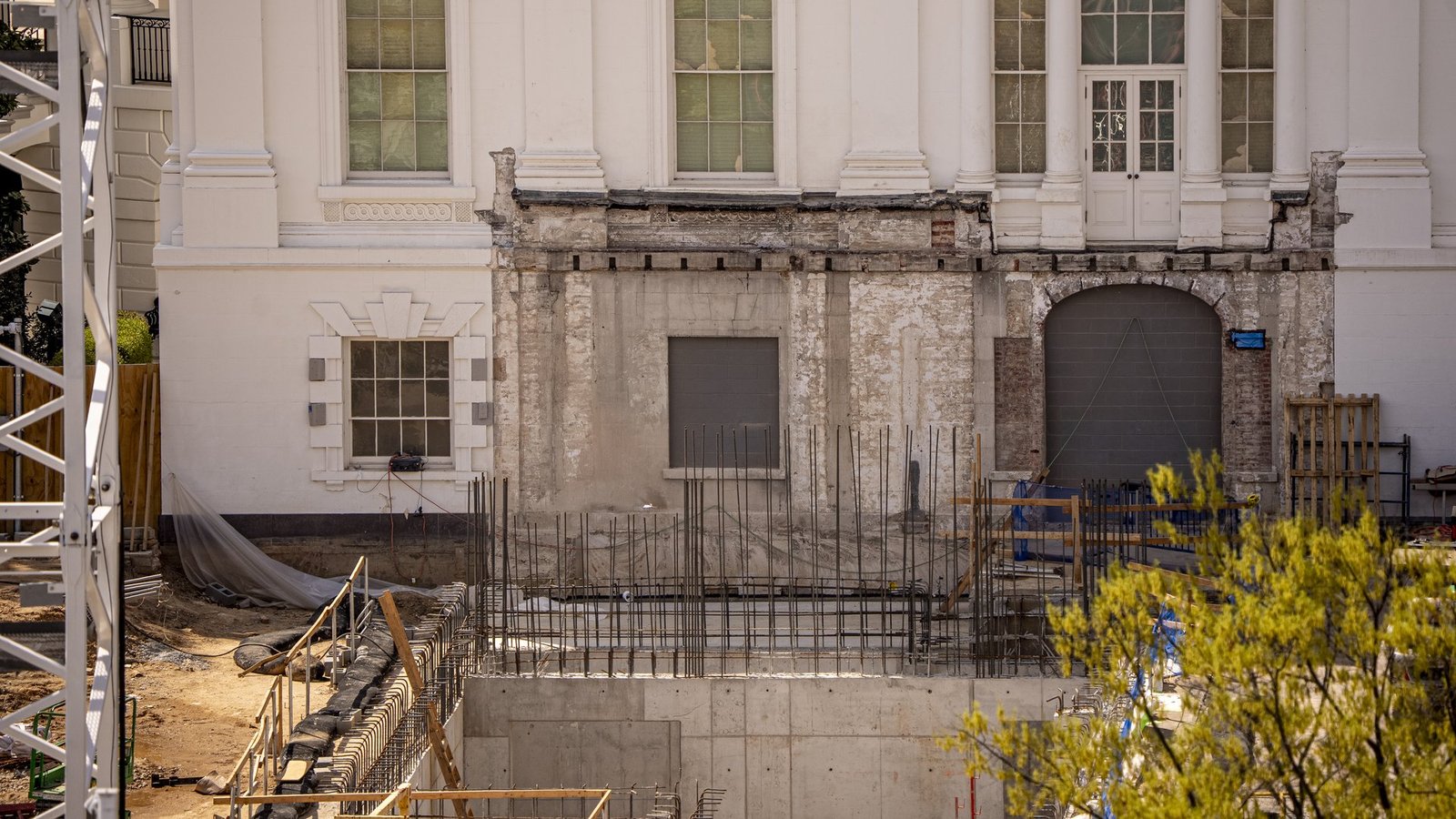
Earlier this month, a federal judge halted most above-ground construction on the $400 million, 90,000 square foot ballroom, granting a request brought by the National Trust for Historic Preservation in a lawsuit. The only additions he allowed were below-ground work and anything “strictly necessary to cover, secure, and protect such national security facilities.”
Shortly before U.S. District Judge Richard Leon handed down his decision, Trump defended the ballroom by portraying it as a matter of presidential security.
“We have a drone-proof roof,” Mr. Trump told reporters, according to The New York Times. Included in the ballroom plans, he said, are bulletproof glass, “air-handling systems,” “biodefense all over,” “secure telecommunications and communications,” medical facilities and more.
A federal appeals court, a couple days later, put Leon’s order on hold, allowing building on the ballroom to continue for now.
Trump mentioned the lawsuit in his Truth Social post, saying it “must be dropped, immediately.”
“Nothing should be allowed to interfere with its construction,” he said.
Straight Arrow reached out to The National Trust for Historic Preservation for comment.
The National Trust for Historic Preservation, in a previous court filing, cast doubts on Trump’s insistence that stopping construction on the ballroom would affect safety.
“It is difficult to believe that even Defendants really think the absence of a massive White House ballroom jeopardizes national security,” the National Trust’s attorneys wrote.
In its initial complaint, submitted after the Trump administration demolished the East Wing to make way for the ballroom, the organization said the project is unlawful as it has not been authorized by Congress, nor did it go through a “legally mandated review” process, including a public comment period and environmental assessment.
Leon, in his ruling, agreed that the construction appeared to be a clear violation of a law requiring congressional approval for any building construction on federal property.
“The President of the United States is the steward of the White House for future generations of First Families,” Leon started his ruling with. “He is not, however, the owner!”
Security at the White House correspondents’ dinner
When it comes to the Washington Hilton, which is also where an attempt was made against the life of former President Ronald Reagan in 1981, Trump said it is “not particularly a secure building.”
Reuters reported that 2,600 attendees of the correspondents’ dinner had to pass metal detectors to go into the basement ballroom of the Hilton, but they only needed to show a ticket to enter the hotel, which was also open to guests.
Fox News congressional correspondent Bill Melugin wrote on X that his name was not checked against a list, he didn’t need to show ID and he was not patted down.
“Secret Service reacted quickly to an active armed threat and prevented that threat from getting into the ballroom,” he wrote. “But the security leading up to that point, in my opinion, appeared to be lacking severely.”
Experts in law enforcement and presidential security, in interviews with the BBC, said that the fact the gunman did not make it into the ballroom indicates that security arrangements worked the night of the shooting.
Former Secret Service agent Barry Donadio said to the BBC there appeared to be “no lack of agents, officers and police” at the dinner. Still, experts also said they expected there to be stronger measures at events Trump attends in the future, such as a wider security perimeter.
Acting U.S. Attorney General Todd Blanche said in an interview on NBC News’ Meet the Press that the shooting suspect “barely broke the perimeter” of the event by a few feet.
U.S. Secret Service Director Matthew Quinn made a similar remark on X, writing that he “underestimated the protective capabilities of the U.S. Secret Service, and was stopped at first contact.”
Round out your reading
- Work for food: New SNAP rules reshaping who gets to eat.
- How Iranians actually feel about regime change and war.
- Feds warn that Russians may hack your internet router. Why?
- The truth behind a medical condition that never existed.
- We’re building a new Straight Arrow. Help us shape our future by taking our survey.