

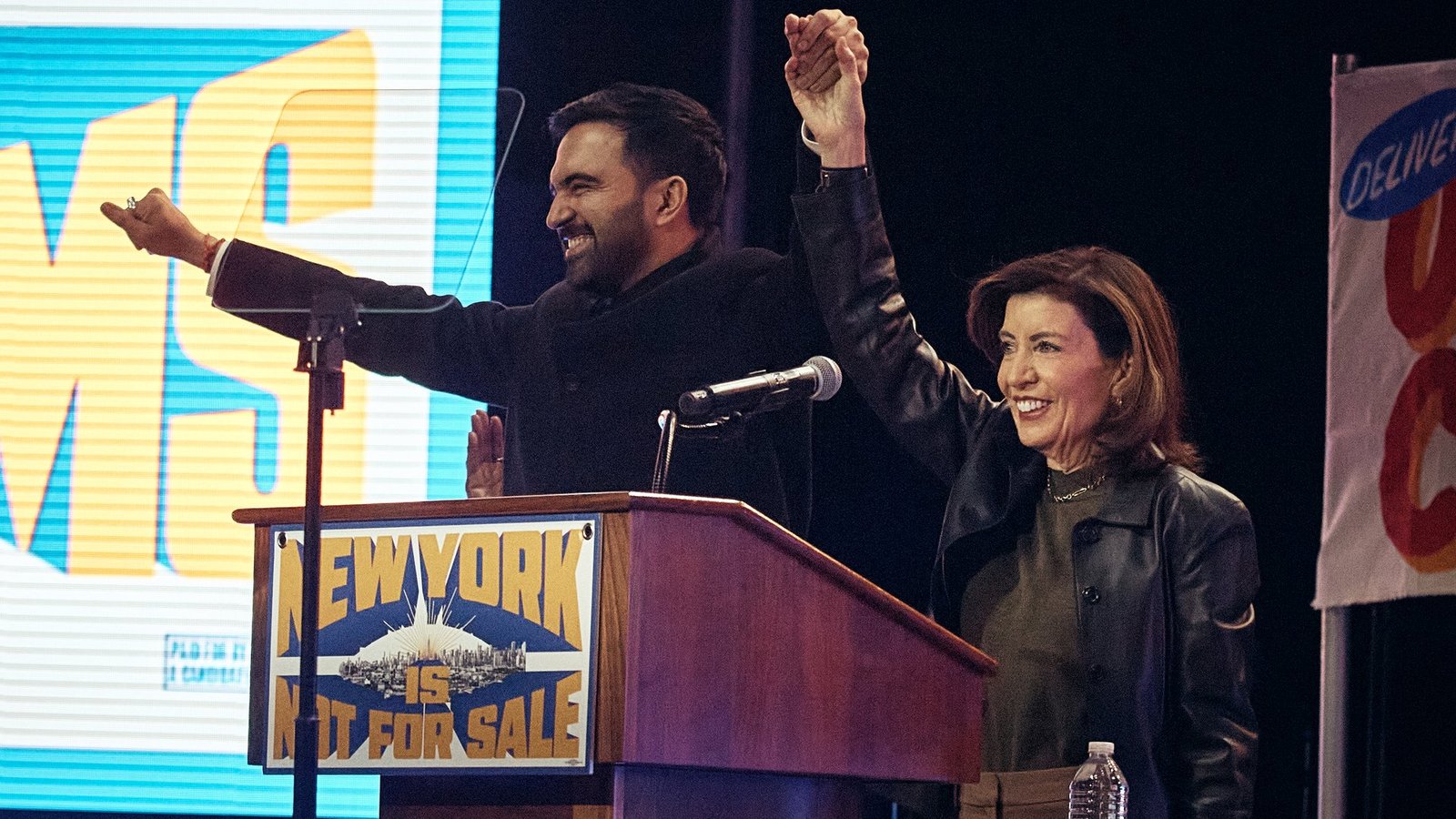
Mayor-elect Zohran Mamdani made several big promises along the campaign trail, including free buses and universal child care. Keeping some of those promises will be difficult, because it’s not entirely up to him.
Mamdani’s promises
Mamdani defeated Andrew Cuomo and Curtis Sliwa by promising voters significant social reforms. Along with taxpayer-funded buses and child care, Mamdani said he plans to raise billions of dollars for housing, freeze rent for rent-stabilized tenants, raise the minimum wage and even open government-run grocery stores.
“Everywhere I go, I hear New Yorkers talking about the outrageous prices of groceries,” Mamdani said in an interview with The New York Times. “This is a bold and workable plan.”
Mamdani’s plans will cost billions of dollars. The source of that funding is where he could run into some issues.
Follow the money
“In reality, if he had wanted to accomplish some of these big picture items, he would have had to run for governor,” Nicole Gelinas, senior fellow at the Manhattan Institute, told Straight Arrow News.
Mamdani’s plan to raise all that money to pay for his promises involves raising taxes. That includes raising the top corporate tax rate from 6.5% to 11.5%, which would match New Jersey.
The other tax increase would come to individuals making more than $1 million per year, which is why most of the city’s billionaires spent millions trying to stop Mamdani from winning the election.
However, both of those tax increases are not Mamdani’s choice to make alone.
“What he wants to do for New York City mostly requires both the approval of the governor and the state legislature,” Gelinas said.
Any change to the city’s personal income tax rate would require approval from the state legislature.
“He wants the state legislature and the governor to enact $9 billion worth of annual taxes,” Gelinas said. “Without those tax hikes, he can’t implement his programs, his universal child care, his department of community safety, free buses. He can’t do those things without that state revenue, so the governor and the legislature would have to consider, is this a risk that we want to take with the state’s tax base?”
Mamdani does have some support from the state legislature to raise taxes on the rich.
“The more difficult part will be convincing the governor, because she has said she hasn’t ruled it out, but she has said she’s disinclined to raise taxes,” Gelinas said.
Free buses
Gov. Kathy Hochul has pumped the brakes on Mamdani’s plan for free buses, saying she “cannot set forth a plan right now that takes money out of a system that relies on the fares of the buses and the subways.”
The NYC bus system is controlled by Metropolitan Transit Authority, a state-run agency.
“So, it would be the governor who would have to give the green light to her MTA chairperson to say, ‘okay, we can do free buses,’” Gelinas said. “And also, the state would have to come up with this seven, $800 million in funding from fair revenue that would be lost.”
Another issue regarding that plan is that New York City isn’t the only place where people with low means need to take the bus.
“Buffalo, Rochester, Albany – would they also want their own free bus system?” Gelinas said. “So, there’s more to think about than just okay, the New York City buses can be free. You’re kind of opening the door to an entirely free transit system because the same arguments that poor people take the bus that also holds for the rest of the state’s transit systems.”
Gelinas said that number could get into the billions of dollars when it comes to lost fare revenue.
New York Financial Control Board
Another player in the New York City financial world is the New York Financial Control Board. It was created in 1975 following the city’s near bankruptcy.
“We just increased spending much faster than the tax revenues came in,” Gelinas said. “By the 1970s, we were starting to have a cratering tax base, as we saw flight to the suburbs. Major corporations leaving New York City for the suburbs and for southern states, so we just ran out of money.”
Considering New York City’s position as one of the biggest municipal debt issuers in the world, filing for bankruptcy would’ve been a disaster, not just for the city itself but for the global financial market.
So, the state stepped in with a rescue package and created this board.
“Governor [Hugh Leo] Carey and the legislature set up this financial control board made up of appointees by the governor and other top elected officials,” Gelinas said. “People from the financial industry, legal industry, people who really understood state and local finance. They served on this board that effectively controlled New York City’s finances for a decade.”
That board still exists but mostly lies dormant. Their lone role now is making sure the city presents a balanced budget every year.
“Other than doing that, it doesn’t have any real control over New York City’s budget anymore,” Gelinas said.
Still, Mamdani will need to go in front of them every summer, and many of the budgetary maneuvers other cities could use will not be enough for the FCB.
“If he can’t balance his budget, if he has to rely on borrowing for operating spending, as opposed to borrowing to, say, build a bridge, then the financial control board could step in and say, ‘hey, you can’t do this,’” Gelinas said.
What happens next?
Will Mamdani really be able to raise this money, convince his fellow politicians and follow through on his promises?
“The realistic view is that he purposely asked for a lot more than he knew that he was going to get,” Gelinas said. “So, just go out and ask for a wild $9 billion figure, and then he would say that he’s happy with getting half of that, a four or $5 billion tax increase. The problem with that framing is it is still a very large tax increase for New York City to absorb within New York state when we’ve had a slower jobs recovery than the country as a whole.”
Gelinas said the state has only recovered about 5% of jobs relative to the COVID-19 pandemic, while the nationwide average is closer to 6%.
“This is the first time in modern history that New York City, or New York State has had a slower recovery than the country as a whole,” Gelinas said.
Data also shows high-net worth individuals have been moving out of the state and the city for years now.
“We were losing thousands of high net-worth earners every year, and we’re not replacing them,” Gelinas said. “So, it just may not be the best idea to embark upon a regime of tax increases.”
While many have referred to Mamdani as a socialist, Gelinas said one thing Mamdani hasn’t floated is a move that more closely resembles actual socialism.
“He could have run on raising the property tax,” Mamdani said. “The property tax in New York City is the only tax that the city can raise by itself. Mamdani would only need permission of the city council, not state legislature or the governor, and that would be closer to a traditional view of socialism, where everybody pays more but everybody gets more benefits.”
Renters would pay that property tax as part of their rent while homeowners pay their own and businesses pay a fairly high property tax.
“So, everybody’s going to pay more, but everyone’s going to get a better government,” Gelinas said. “But that was not the platform that he ran on. He ran explicitly on redistribution from wealthier earners and from businesses, and for that, he does need the state.”
The post Albany pumps the brakes on Mamdani’s free NYC buses. What’s next? appeared first on Straight Arrow News.