

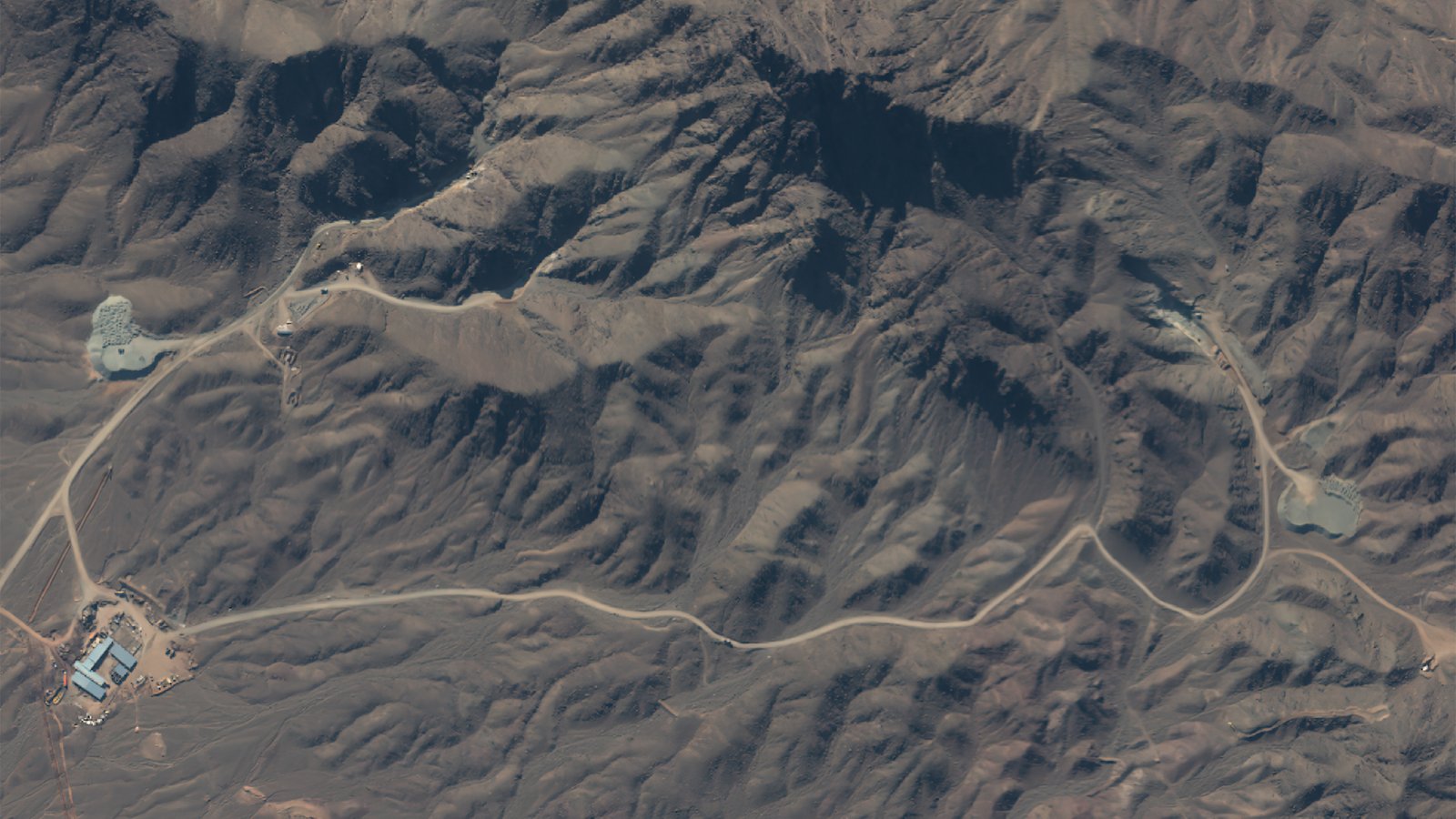
Iran is expanding a deeply buried site near the Natanz Enrichment Complex months after U.S.-Israeli strikes that wrecked thousands of centrifuges, new satellite imagery shows. Fresh tunneling at “Pickaxe Mountain” suggests that Tehran is hardening a facility that the International Atomic Energy Agency hasn’t inspected, and whose purpose remains unclear.
According to a Washington Post review and expert analysis, work has continued on deeply buried tunnels and surface protections. Recent imagery revealed a reinforced tunnel entrance, an enlarged spoil pile of excavated material and a newly extended security wall. Analysts said the measures appear designed to harden the facility against future strikes.
The site’s purpose remains unclear, but experts say the tunnels, estimated to extend 260–330 feet underground, could shield sensitive nuclear work or uranium stockpiles. The construction comes as inspectors report uncertainty over the whereabouts of Iran’s uranium enriched to 60%, a short step from reaching weapons-grade concentration.
“The presence of dump trucks, trailers and other heavy equipment … indicates continued construction and expansion of the underground facility,” said Joseph Rodgers of the Center for Strategic and International Studies, according to The Washington Post.
Where Iran’s nuclear program stands after the June attacks
The June air campaign struck Natanz, Fordo and Isfahan with bunker-penetrating bombs and cruise missiles. The Institute for Science and International Security assessed that nearly 22,000 centrifuges at those sites were destroyed or left inoperable.
“For the first time in over 15 years, Iran has no identifiable route to produce weapon-grade uranium … in its centrifuge plants,” the report said.
The IAEA said in early September that it does not know where the material is stored, raising concerns that Tehran could covertly advance its program.
In a PBS FRONTLINE interview, Ali Larijani, secretary of Iran’s Supreme National Security Council, said Tehran had not abandoned its facilities, and warned that if sanctions were reinstated, “we will end our participation with the IAEA.” He declined to discuss activities at Pickaxe Mountain
“We haven’t abandoned any of those locations,” Larinjani said. “But in the future, they could possibly continue to run as they currently do or be shut down.”
Larijani told FRONTLINE that Iran has no plans to build nuclear weapons but said U.S. and Israeli strikes turned negotiations into a “farce.” He urged Americans to recognize Iran’s right to equal treatment, warning U.S. actions risk global chaos.
What about Iran’s missile program?
At the same time, The Associated Press reported that Iran is repairing missile-production sites at Parchin and Shahroud that were hit in June. Satellite images show repair work at buildings that once housed the large planetary mixers needed to make solid-fuel propellant. Experts say Tehran still lacks those mixers but may look to China for supplies.
“If they’re able to reacquire some key things like planetary mixers, then that infrastructure is still there and ready to get rolling again,” Sam Lair of the James Martin Center for Nonproliferation Studies told the AP.
The Jewish Institute for National Security of America says Iran fired more than 570 missiles at Israel during the “12-day war,” depleting a significant portion of its arsenal. Reconstituting missile production is seen by analysts as critical for deterrence.
What are the broader implications?
U.S. officials say they are monitoring Iran’s moves closely. President Donald Trump has repeatedly said that Iran should never obtain a nuclear weapon. Israel has also signaled it could strike again if Tehran rebuilds its nuclear or missile capabilities.
Kelsey Davenport of the Arms Control Association said the strikes inflicted severe damage but cautioned against assuming Iran wouldn’t replicate its destroyed facilities. “Iran still has the capacity to reconstitute fairly quickly if they make the decision to,” she told the Post.
The post Iran expands ‘Pickaxe Mountain’ site near Natanz after June strikes appeared first on Straight Arrow News.